

On this page
Ask five classmates for the number of isomers of C5H10 and you may hear 10, 12 and 13. All three can be right. The answer depends on whether the question wants structural isomers only, or stereoisomers as well. Wikipedia's C5H10 page lists 13 hydrocarbon isomers with this formula, split into cycloalkanes and alkenes. Below we build that list by hand, so you can rebuild it in an exam without memorising it.
Why does C5H10 have both alkenes and rings?
Start with the degree of unsaturation. For a hydrocarbon it is C + 1 − H/2, and it tells you the number of rings and extra bonds in the structure, as Wikipedia's degree of unsaturation entry explains.
For C5H10 that is 5 + 1 − 5 = 1. One unit can be spent in only two ways: one C=C double bond in an open chain, or one ring with all single bonds. So the isomers fall into exactly two families, alkenes and cycloalkanes. If the formula is new to you, our explainer on calculating the degree of unsaturation works through more examples.
How many alkene isomers does C5H10 have?
Work from the longest chain down, and place the double bond in every position that gives a new compound.
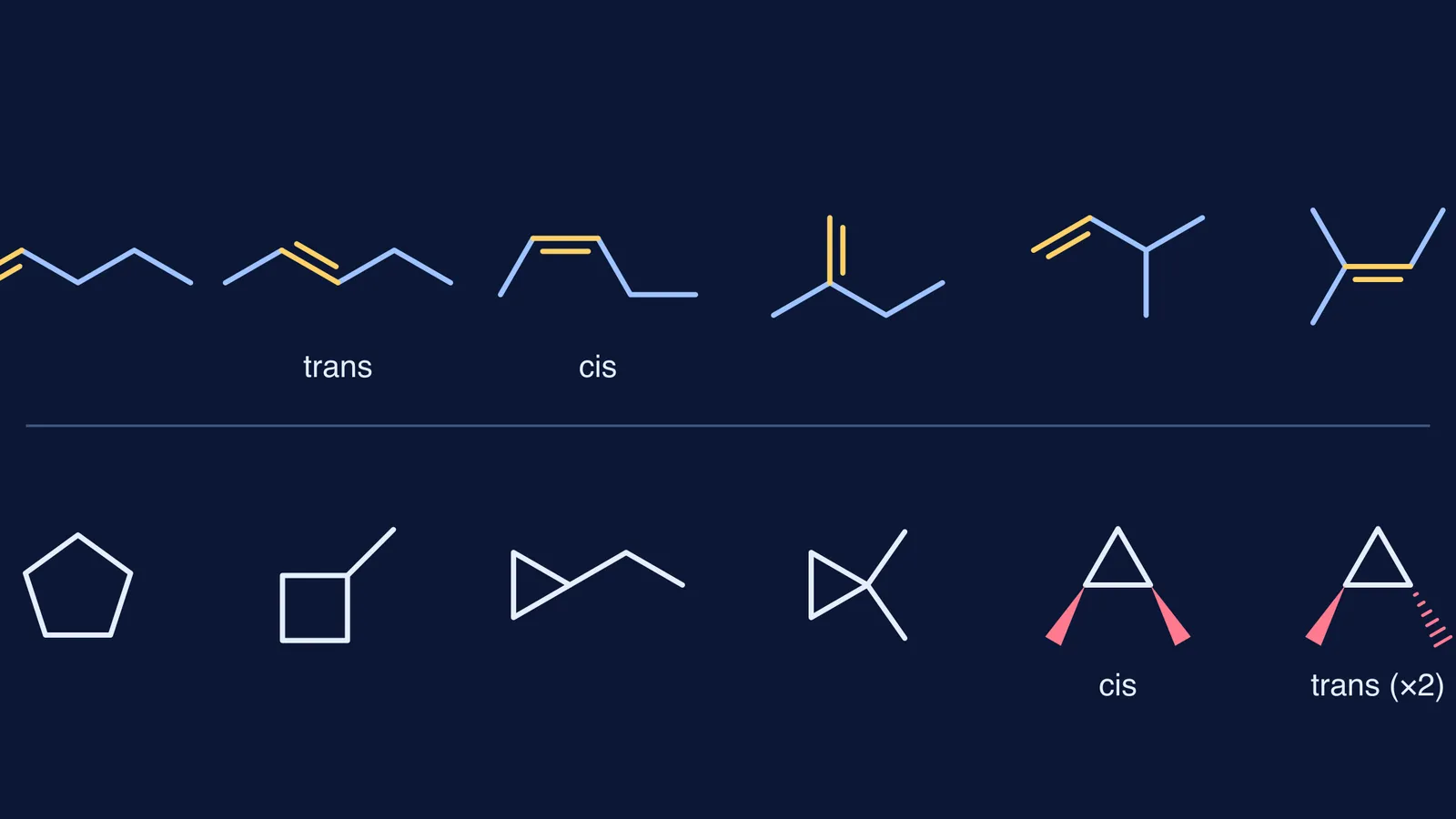
Five-carbon chain: pent-1-ene and pent-2-ene.
Four-carbon chain with one methyl branch: 2-methylbut-1-ene, 3-methylbut-1-ene and 2-methylbut-2-ene.
Three-carbon chain with two methyls: impossible. The middle carbon already has four carbon neighbours, so it has no bond left for a C=C.
That gives five structural alkenes. Only one of them shows geometrical isomerism: Wikipedia's 2-pentene page states that 2-pentene has two geometric isomers, cis-2-pentene and trans-2-pentene. The rule behind this is simple. Rotation about a double bond is restricted, as the cis–trans isomerism entry explains, but cis and trans forms only differ if each double-bond carbon carries two different groups. In pent-1-ene, C1 carries two hydrogens; in 2-methylbut-2-ene, C2 carries two methyls. Neither can have cis and trans forms.
How many cycloalkane isomers does C5H10 have?
Now shrink the ring one carbon at a time and hang the leftover carbons on it.
Five-membered ring: cyclopentane.
Four-membered ring: methylcyclobutane.
Three-membered ring, one substituent: ethylcyclopropane.
Three-membered ring, two methyls on the same carbon: 1,1-dimethylcyclopropane.
Three-membered ring, methyls on different carbons: 1,2-dimethylcyclopropane.
That is five more structural isomers. The last one hides three molecules. A ring stops rotation just as a double bond does, so the two methyls can sit on the same face (cis) or opposite faces (trans). Wikipedia's 1,2-dimethylcyclopropane page states that it has three stereoisomers, one cis isomer and a pair of trans enantiomers. The cis form has a mirror plane through the ring, so it is not chiral; the trans form has no mirror plane, so it exists as two non-superimposable mirror images. For more ring cases, see our guide to cis-trans isomerism in rings.
So is the answer 10, 12 or 13?
It depends on the words in the question. Here is the tally:
Structural isomers: 5 alkenes + 5 cycloalkanes = 10.
Add geometrical isomers: pent-2-ene and 1,2-dimethylcyclopropane each split into cis and trans, giving 12.
Add optical isomers: trans-1,2-dimethylcyclopropane splits into two enantiomers, giving 13.
A quick way to read the question:
"Structural isomers" or "constitutional isomers": answer 10.
"Including geometrical isomers": answer 12.
"Total isomers including stereoisomers": answer 13.
"Open-chain isomers" or "alkenes only": 5 structural, 6 with cis and trans.
One common slip: students mark 3-methylbut-1-ene as chiral. Look at C3. It carries H, CH=CH2 and two CH3 groups, so it has only three different groups and is not a stereocentre.
How do you check an isomer count in under three minutes?
Use this routine on any isomer-counting question, not only C5H10.
Find the degree of unsaturation to decide which families are possible.
List chain lengths or ring sizes from largest to smallest.
Place the double bond, ring or branches in every position, and name each structure.
Cross out any name that appears twice.
For each double bond, check that both carbons carry two different groups. For each ring, check whether two different ring carbons carry substituents.
For chirality, look for a carbon with four different groups, or a disubstituted ring with no mirror plane.
Our post on counting geometrical isomers applies step 5 to molecules with more than one double bond.
If you get the count wrong because a step went wrong, not because you missed a fact, try the Fermi Problem Library: worked problems with a step-by-step solver that explains the reasoning rather than printing an answer. If the gap is the idea itself, such as what makes a molecule chiral, the Fermi Concept Library covers every concept in chemistry, each with its own lesson.
Draw all 13 C5H10 isomers from memory tomorrow, then check them against the list above, and check your five C4H8 structures against Wikipedia's C4H8 list.


