

On this page
You probably learned the shortcut "look for a carbon with four different groups." It is a shortcut, not the definition: a molecule is chiral if it cannot be superimposed on its mirror image. Allenes and ortho-substituted biphenyls break the shortcut in JEE and olympiad problems. Neither needs a stereocentre; each has a chiral axis instead.
Can a molecule be chiral without a chiral carbon?
Yes. What decides it is symmetry. If a molecule has a plane of symmetry or a centre of symmetry, its mirror image is the same molecule and there are no optical isomers. If it has neither, the two mirror images are different compounds (enantiomers), whether or not a stereocentre is present.
For allenes and biphenyls, chemists call this axial chirality: the groups are arranged unevenly around an axis rather than around one atom. The LibreTexts notes on biphenyl conformations/Chirality/Stereoisomers/Chirality_and_Symmetry/Enantiomorphism/Conformational_Enantiomorphism/Conformations_of_Biphenyls) put the symmetry rule plainly: a biphenyl whose stable conformer has a plane of symmetry cannot be resolved into enantiomers.
If you want the stereocentre route first, our walk-through of chirality, meso compounds, R/S and E/Z covers it, and counting stereoisomers from the number of chiral centres shows the counting rules.
Why are some allenes chiral?
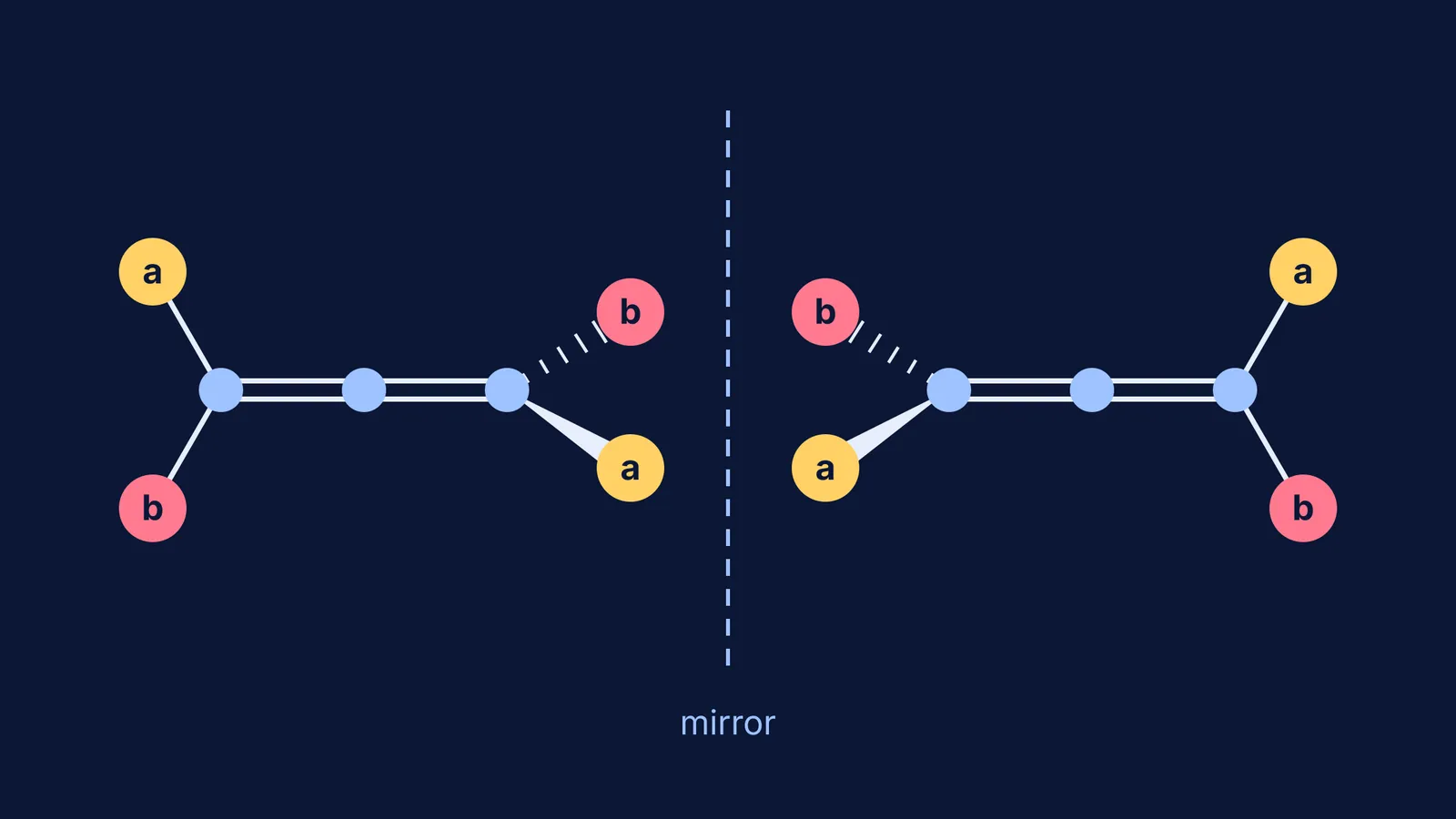
An allene has two double bonds sharing one carbon: C=C=C. The central carbon is sp hybridised, so its two pi bonds sit at right angles, and the groups on the two end carbons lie in perpendicular planes. LibreTexts' chapter on cumulated alkadienes (Roberts and Caserio)/13%3A_Polyfunctional_Compounds_Alkadienes_and_Approaches_to_Organic_Synthesis/13.05%3A_Cumulated_Alkadienes) states that allenes of the type RR'C=C=CRR' are chiral and exist as two mirror-image forms, because of restricted rotation rather than a tetrahedral atom with four different groups.
The exam rule: an allene abC=C=Cab is chiral only if the two groups differ on both end carbons. If either end carries two identical groups, a plane of symmetry passes through that end and the molecule is achiral.
The same chapter notes that van 't Hoff proposed it in 1875 and that the first resolutions came only in 1935. One was reported in Nature by Peter Maitland and W. H. Mills, in a letter titled Experimental Demonstration of the Allene Asymmetry.
When is an ortho-substituted biphenyl chiral?
Biphenyl is two benzene rings joined by a single C-C bond, which normally spins freely. Put bulky groups at the ortho positions (2, 2', 6 and 6') and they collide, so the rings stay twisted and cannot easily pass through the flat arrangement. Stereoisomers that exist only because rotation about a single bond is blocked are called atropisomers. (For why rotation about single bonds is usually easy, see conformations of ethane and Newman projections.)
Two conditions must both hold:
Rotation must be slow. A barrier of about 16 to 19 kcal/mol is needed to stop a substituted biphenyl racemising at room temperature, according to the LibreTexts biphenyl page/Chirality/Stereoisomers/Chirality_and_Symmetry/Enantiomorphism/Conformational_Enantiomorphism/Conformations_of_Biphenyls). With small ortho groups the rings slip past each other, so the mirror images interconvert and cannot be separated.
Neither ring may be symmetric about the axis. If one ring has two identical ortho groups (and is otherwise symmetric), the stable twisted conformer has a plane of symmetry and the compound cannot be resolved, however bulky those groups are.
The first resolved example came from George Christie and James Kenner, who in 1922 separated 6,6'-dinitrodiphenic acid into optically active forms (J. Chem. Soc., Trans., 1922; Wikipedia's atropisomer article credits it as the first experimental case). Each ring there carries an NO2 and a COOH at its ortho positions: bulky, and different.
How do you test for optical isomers without a chiral carbon?
Run this four-step check on any structure:
Look for a stereocentre. If there is one, do the usual R/S work, but still check for a meso plane.
If not, look for an axis: C=C=C, or an aryl-aryl single bond with ortho groups.
Check each end of the axis. Allene: are the two groups on each end carbon different? Biphenyl: are the two ortho groups on each ring different?
Biphenyl only: are the ortho groups big enough to block rotation? If every answer is yes, the molecule exists as a pair of enantiomers.
Worked examples
Penta-2,3-diene, CH3CH=C=CHCH3: each end has H and CH3. Chiral, two enantiomers.
Buta-1,2-diene, CH3CH=C=CH2: the CH2 end has two H atoms. Plane of symmetry, achiral.
3-Methylbuta-1,2-diene, (CH3)2C=C=CH2: both ends carry identical pairs. Achiral.
6,6'-Dinitrobiphenyl-2,2'-dicarboxylic acid: bulky, unlike ortho groups on both rings. Chiral, as Christie and Kenner showed.
2,2',6,6'-Tetranitrobiphenyl: each ring has two identical ortho groups. Plane of symmetry, achiral, even though rotation is hindered.
The usual mistake is seeing bulky groups and skipping step 3. If that is where you lose marks, the Fermi Problem Library has worked problems with a step-by-step solver that explains the reasoning rather than printing an answer.
To see how axial chirality sits next to stereocentres, meso compounds and geometrical isomerism, the Fermi Concept Library gives every chemistry concept its own lesson and its place in the map.
No chiral carbon? Look for the axis, then check both ends.


