

On this page
Nitrogen and phosphorus sit one above the other in group 15, and both reach +5 in their common oxoacids. Yet concentrated nitric acid oxidises copper, iodide, sulphur and even phosphorus itself, while phosphoric acid oxidises almost nothing. In fact, when concentrated nitric acid oxidises phosphorus, the product is H₃PO₄: P₄ + 20HNO₃ → 4H₃PO₄ + 20NO₂ + 4H₂O. Nitric acid pushes phosphorus all the way to +5 and stops there. This post shows why, using electrode potentials, and then uses the result to answer a common exam question about making HI and HBr.
What do the electrode potentials of HNO₃ and H₃PO₄ show?
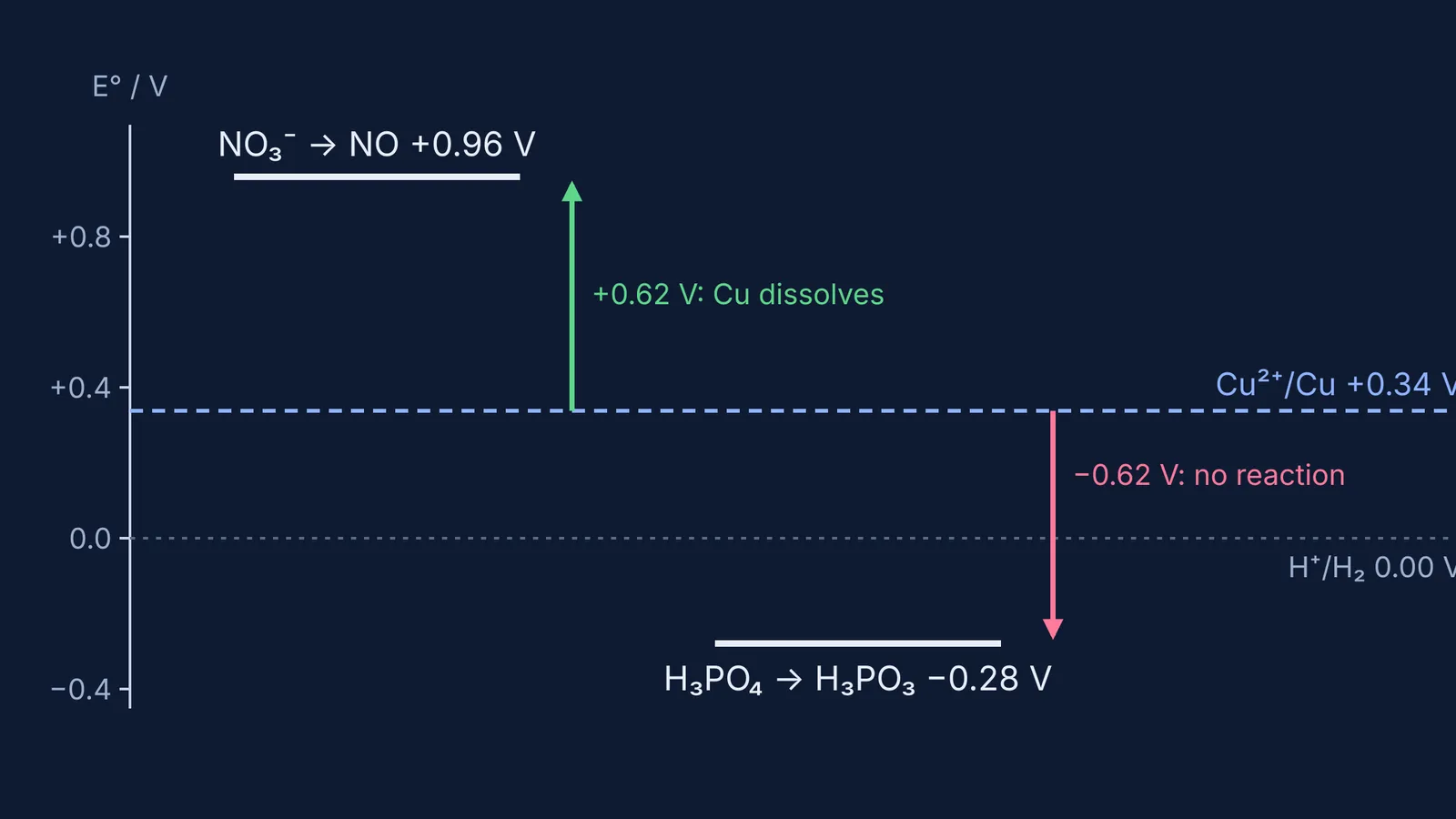
An oxidising agent is something that is easily reduced. So compare how much each acid "wants" to be reduced, using standard reduction potentials (values vary slightly between tables, so treat them as approximate):
NO₃⁻ + 4H⁺ + 3e⁻ → NO + 2H₂O, E° ≈ +0.96 V
H₃PO₄ + 2H⁺ + 2e⁻ → H₃PO₃ + H₂O, E° ≈ −0.28 V
Check the first half-equation: N goes from +5 to +2, a gain of 3 electrons; charge on the left is −1 + 4 − 3 = 0, on the right 0; O is 3 = 1 + 2. The second: P goes from +5 to +3, a gain of 2 electrons; charge is 0 on both sides; O is 4 = 3 + 1.
A positive E° means the reduction is favourable against the hydrogen electrode. Nitrate's value is high, so it pulls electrons from many substances. Phosphoric acid's value is negative, below even H⁺/H₂ at 0.00 V. Reducing H₃PO₄ is uphill, so it pulls electrons from almost nothing. Both acids hold the element at +5. Only one of them finds that state uncomfortable.
Why is +5 an oxidising state for nitrogen but stable for phosphorus?
Three facts about the atoms explain the potentials.
Electronegativity. On the Pauling scale N is about 3.0 and P about 2.2, while O is about 3.4. In +5 a nitrogen atom has formally handed its valence electrons to oxygen, an atom only slightly more electronegative than itself. That is a strained arrangement, and nitrogen takes electrons back whenever it can. Phosphorus is much less electronegative than oxygen, so giving electron density to oxygen is a natural state for it.
Bond strength. Approximate single-bond enthalpies are about 200 kJ mol⁻¹ for N–O and about 335 kJ mol⁻¹ for P–O. Reducing H₃PO₄ means breaking a strong P–O bond. Reducing nitrate breaks weaker N–O bonds and forms NO or NO₂, which are stable molecules in their own right.
Size. Phosphorus is large enough to hold four oxygens in a tetrahedron, as in PO₄³⁻. Nitrogen, being small, can bond to only three oxygens in the flat nitrate ion, and its maximum covalency is four.
Older books explain the difference using vacant d orbitals on phosphorus. You do not need that argument, and modern bonding studies do not support a large d-orbital role. Electronegativity and bond strength are enough.
The +5 state does not stay stable all the way down the group. Going from P to Bi, the +5 state becomes less stable again because of the inert pair effect, and bismuth(V), as in NaBiO₃, is a strong oxidant. Phosphorus sits at the point where +5 is most comfortable.
Worked example: does copper dissolve in each acid?
Question. Use E°(Cu²⁺/Cu) = +0.34 V with the two values above. Decide whether copper reacts with nitrate in acid and with phosphoric acid under standard conditions.
Write E°cell. Copper is oxidised, so it is the anode. E°cell = E°(cathode) − E°(anode).
Nitrate. E°cell = 0.96 − 0.34 = +0.62 V. Positive, so the reaction is favourable.
Balance the nitrate reaction. Cu loses 2 electrons; each N gains 3. The lowest common multiple is 6, so use 3Cu and 2NO₃⁻: 3Cu + 8H⁺ + 2NO₃⁻ → 3Cu²⁺ + 2NO + 4H₂O. Charge: +8 − 2 = +6 on the left, +6 on the right. O: 6 = 2 + 4. H: 8 = 8.
ΔG° for nitrate. n = 6, so ΔG° = −nFE° = −6 × 96485 × 0.62 ≈ −359 kJ per 3 mol Cu.
Phosphoric acid. E°cell = −0.28 − 0.34 = −0.62 V. Negative.
ΔG° and K for phosphate. For Cu + H₃PO₄ + 2H⁺ → Cu²⁺ + H₃PO₃ + H₂O, n = 2, so ΔG° = −2 × 96485 × (−0.616) ≈ +119 kJ mol⁻¹. log K = nE°/0.0591 = 2 × (−0.616)/0.0591 ≈ −20.8, so K ≈ 10⁻²¹.
The nitrate reaction is the familiar one that gives NO with dilute acid; why concentrated acid gives NO₂ instead is covered in copper and nitric acid: NO vs NO₂. For phosphoric acid the equilibrium lies so far to the left that no reaction happens. Say "thermodynamically unable", not merely "slow": a negative E°cell means no catalyst or waiting time will make it go under these conditions.
If you want more E°cell problems where the sign decides the answer, the Fermi Problem Library has a step-by-step solver that explains the reasoning.
Why is H₃PO₄ used with KI to make HI, but not H₂SO₄?
To make HI or HBr in the lab, you heat a halide salt with a non-volatile acid and let the volatile hydrogen halide escape: KI + H₃PO₄ → KH₂PO₄ + HI. Concentrated H₂SO₄ also displaces HI, but hot concentrated H₂SO₄ is oxidising enough to turn much of the HI into I₂, and HBr into Br₂. That is why sulphuric acid is not used with KI to prepare alkyl iodides.
Phosphoric acid avoids the problem, and the potentials show why. With E°(I₂/I⁻) = +0.54 V:
Nitrate and iodide: 0.96 − 0.54 = +0.42 V, so nitric acid oxidises iodide to iodine.
Phosphoric acid and iodide: −0.28 − 0.54 = −0.82 V, so no oxidation.
Bromide (E°(Br₂/Br⁻) ≈ +1.09 V) is even harder to oxidise, so H₃PO₄ is safe with KBr too. You can explore electrode potentials and redox rules in the Concept Library.
Does phosphoric acid react with any metals?
Yes, but not as an oxidant through phosphorus. Zinc and iron dissolve in H₃PO₄ and give hydrogen: Zn + 2H⁺ → Zn²⁺ + H₂. Here H⁺ is the oxidising agent, exactly as in dilute HCl, and phosphorus stays at +5. Copper, with E° above that of hydrogen, does not dissolve.
Nitric acid is different. Even dilute HNO₃ reacts with copper, and with most metals it gives oxides of nitrogen rather than hydrogen, because nitrate is reduced more easily than H⁺. Notice also that the nitrate half-equation uses 4H⁺. By the Nernst equation, raising the pH lowers its potential: at pH 7 it drops by about 0.0591 × 4/3 × 7 ≈ 0.55 V, to roughly +0.4 V. That is why a neutral nitrate solution is a much weaker oxidant than nitric acid.
Quick checklist
N and P are both +5 in HNO₃ and H₃PO₄, but only nitrate is a strong oxidant.
E°: NO₃⁻/NO ≈ +0.96 V; H₃PO₄/H₃PO₃ ≈ −0.28 V.
Reasons: N is nearly as electronegative as O, N–O bonds are weaker than P–O, and N is small.
Skip the d-orbital argument.
Cu with nitrate: E°cell = +0.62 V; with phosphoric acid: −0.62 V, so no reaction.
H₃PO₄ is used with KI or KBr because it cannot oxidise I⁻ or Br⁻.
Zn and Fe dissolve in H₃PO₄ because of H⁺, not phosphate.


