

On this page
Copper does not give hydrogen with nitric acid. The nitrate ion does the oxidising, and how far its nitrogen gets reduced depends on how strong the acid is. That one idea explains every product in this topic, from brown NO₂ to ammonium nitrate.
What does copper give with dilute and concentrated nitric acid?
Both reactions give copper(II) nitrate and water; only the nitrogen gas differs (Wikipedia: Nitric acid).
Dilute acid: 3Cu + 8HNO₃ → 3Cu(NO₃)₂ + 2NO + 4H₂O, giving nitric oxide, NO.
Concentrated acid: Cu + 4HNO₃ → Cu(NO₃)₂ + 2NO₂ + 2H₂O, giving nitrogen dioxide, NO₂.
The same article notes that, for less reactive metals like copper, "the products depend on temperature and the acid concentration", and that most commercial nitric acid is 68% in water.
Nitric oxide is a colourless gas, while nitrogen dioxide is deep brown (OpenStax Chemistry 2e, via LibreTexts). Here is the trap: even with dilute acid you often see brown fumes at the mouth of the tube. The Royal Society of Chemistry's classroom experiment uses about 5 M acid on copper turnings and shows why: the NO formed meets air, and 2NO + O₂ → 2NO₂ (RSC Education). Brown at the top does not mean concentrated acid.
Why does dilute nitric acid give NO but concentrated gives NO₂?
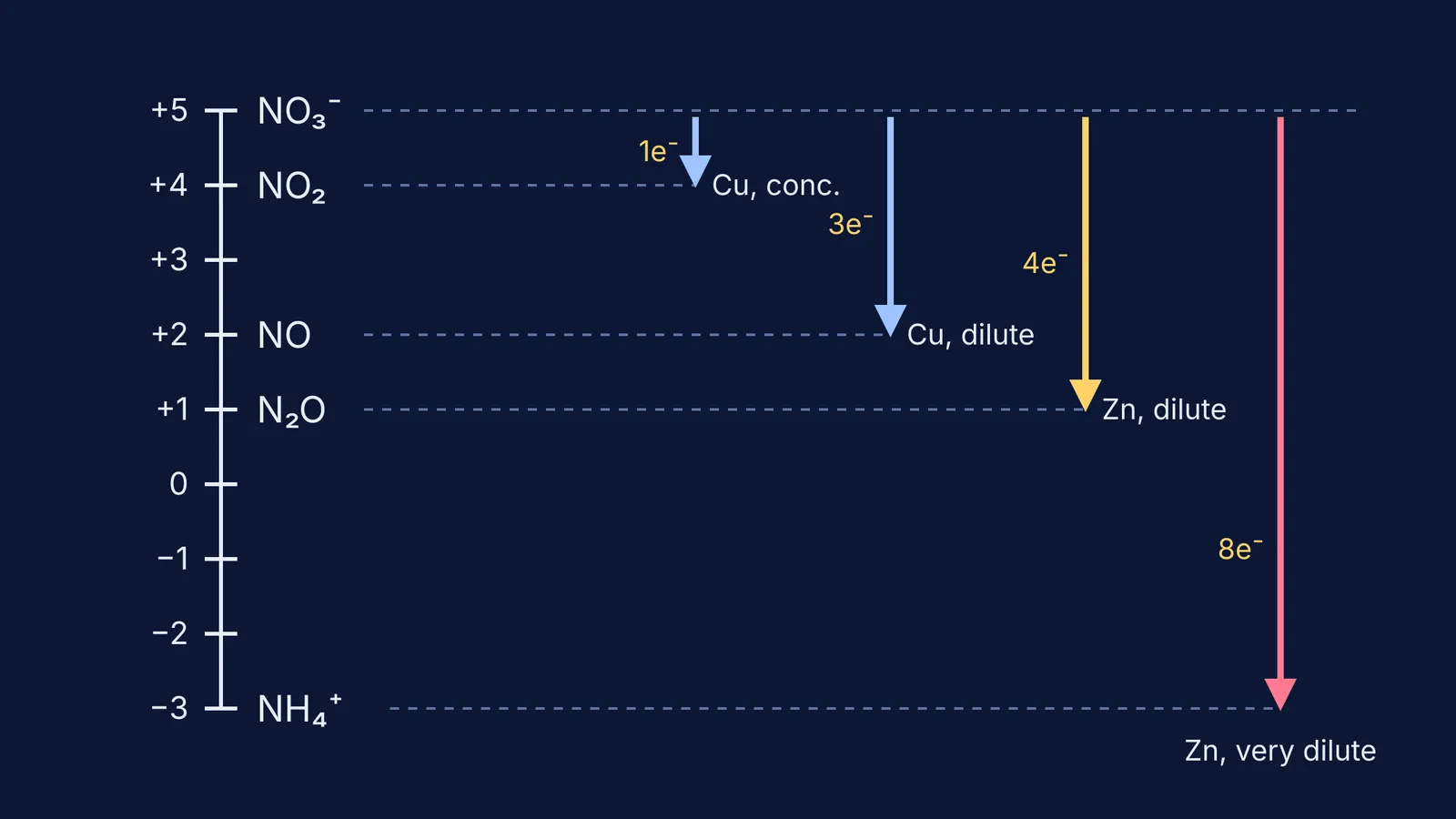
In HNO₃, nitrogen is at +5. In NO₂ it is +4, in NO it is +2. So with concentrated acid each reduced nitrogen gains one electron; with dilute acid it gains three.
One common way to see why water matters: NO₂ does not survive long in water. In the Ostwald process for making nitric acid, NO₂ is absorbed in water and 3NO₂ + H₂O → 2HNO₃ + NO (Wikipedia: Ostwald process). With plenty of water around, NO₂ tends to be turned back into nitric acid plus NO, so NO is what escapes. In concentrated acid there is little water, and NO₂ comes off as the main gas. For the shapes and oxidation states of these gases, see our guide to the structures of the oxides of nitrogen.
How do you balance copper with nitric acid, step by step?
Use the electron count. It works for both equations.
Write oxidation states: Cu goes 0 → +2 (loses 2 e⁻). N goes +5 → +2 in NO (gains 3 e⁻).
Make electrons equal: 3 Cu lose 6 e⁻, 2 NO gain 6 e⁻. So 3Cu and 2NO.
Count nitrogen: 3Cu(NO₃)₂ holds 6 N as nitrate, plus 2 N in NO. That is 8 HNO₃.
Balance hydrogen with water: 8 H on the left gives 4H₂O.
Check oxygen: 24 on the left; 18 + 2 + 4 = 24 on the right. Done.
For concentrated acid, N goes +5 → +4 (gains 1 e⁻), so one Cu needs two NO₂. Add 2 nitrate in Cu(NO₃)₂ and you get 4HNO₃, then 2H₂O. Check oxygen: 12 each side.
Remember that only some of the nitric acid is reduced; the rest supplies nitrate for the salt. Forget this and you end up with too little HNO₃. If you want the general method with half-reactions, read balancing redox reactions with oxidation numbers. To practise more like these, the Fermi Problem Library has worked problems with a step-by-step solver that explains the reasoning rather than printing an answer.
How does zinc give N₂O or NH₄NO₃?
Zinc is a stronger reducing agent than copper (compare their places in the electrochemical series), so it can push nitrogen further down. A practice question tagged JEE Main on Careers360 asks exactly this, with the answer N₂O for dilute and NO₂ for concentrated acid (Careers360 solution):
Dilute: 4Zn + 10HNO₃ → 4Zn(NO₃)₂ + N₂O + 5H₂O
Concentrated: Zn + 4HNO₃ → Zn(NO₃)₂ + 2NO₂ + 2H₂O
Very dilute: 4Zn + 10HNO₃ → 4Zn(NO₃)₂ + NH₄NO₃ + 3H₂O (Vedantu)
Older references describe the same pattern: nitric acid attacks most metals to give a nitrate and an oxide of nitrogen, "or occasionally" ammonium salts (1911 Encyclopædia Britannica, Wikisource).
Check them with electrons. Four Zn lose 8 e⁻. In N₂O, two nitrogens each fall from +5 to +1, gaining 8 e⁻ in total. In NH₄⁺, one nitrogen falls from +5 to −3, also 8 e⁻. That is why both zinc equations start with 4Zn + 10HNO₃.
A quick revision list
The metal ends up as its nitrate.
Concentrated acid, small drop: NO₂ (+4).
Dilute acid, bigger drop: NO (+2) with copper, N₂O (+1) with zinc.
Very dilute acid with zinc: nitrogen reaches −3 as NH₄NO₃.
Brown fumes over dilute acid come from NO meeting air.
If oxidation states still feel shaky, the Fermi Concept Library has a lesson for every chemistry concept, so you can fix the gap before the next mock.


