

On this page
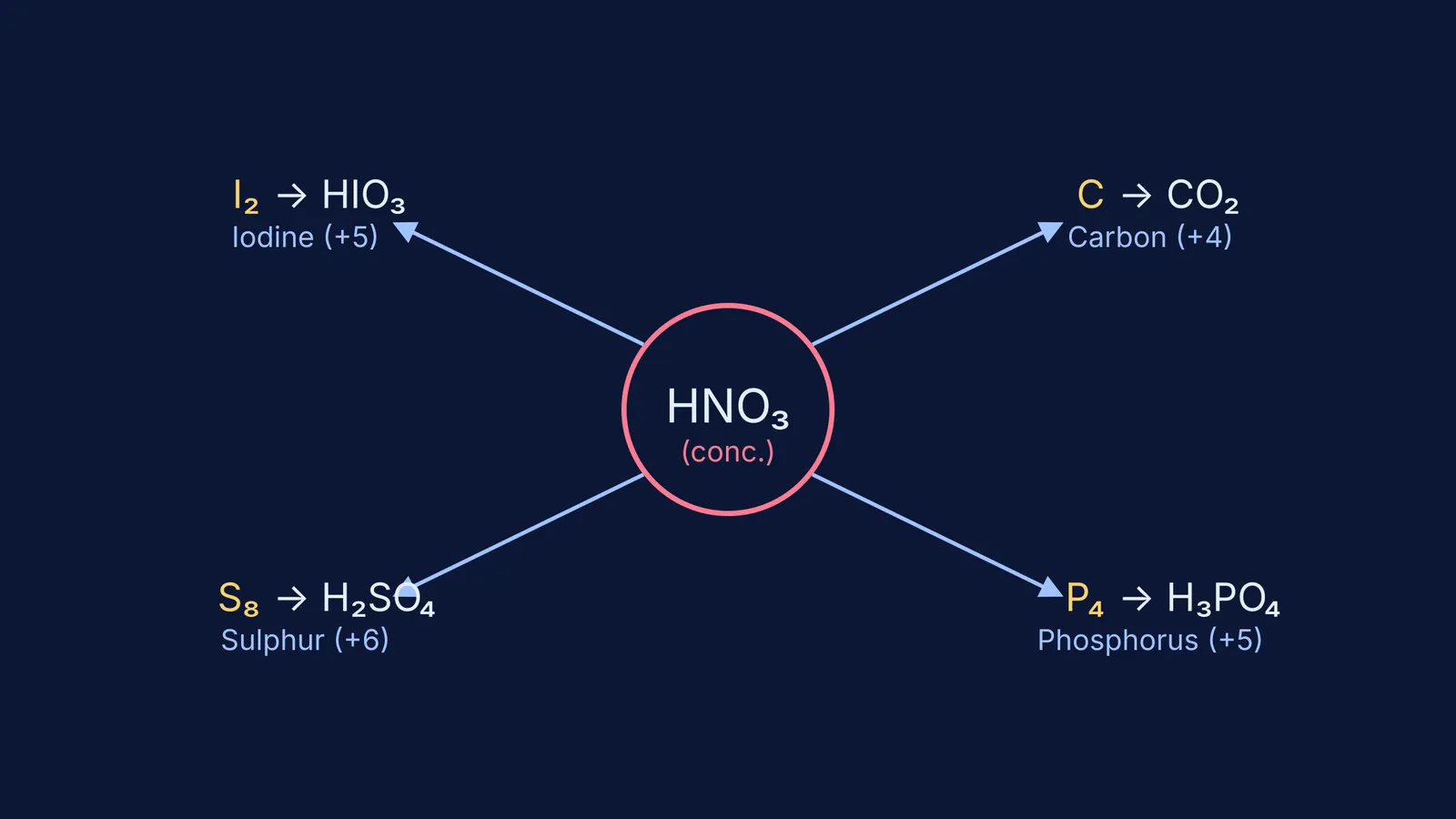
Concentrated nitric acid (HNO₃) is a powerful oxidising agent that reacts vigorously with non-metals. According to standard texts like Wikipedia's chemical properties of nitric acid, it oxidises solid non-metals to their respective highest oxoacids or oxides, while the nitric acid itself is reduced to nitrogen dioxide (NO₂). These reactions are a cornerstone of inorganic chemistry, demonstrating how a strong acid can force non-metals to lose electrons and reach their highest possible oxidation states.
What is the reaction of concentrated nitric acid with iodine?
When hot concentrated nitric acid reacts with solid iodine (I₂), it produces iodic acid (HIO₃), nitrogen dioxide gas, and water. The balanced chemical equation is:
I₂ + 10HNO₃ → 2HIO₃ + 10NO₂ + 4H₂O
In this reaction, the oxidation state of iodine increases dramatically from 0 in elemental iodine to +5 in iodic acid. This requires a significant transfer of electrons, which is facilitated by the reduction of ten moles of nitric acid. You can review how oxidation states correlate with molecular geometry in our guide on oxidation numbers from structure.
How does concentrated nitric acid oxidise carbon?
Carbon is oxidised by concentrated nitric acid to yield carbon dioxide (CO₂). As outlined in standard references, the balanced equation is:
C + 4HNO₃ → CO₂ + 4NO₂ + 2H₂O
Carbon goes from an oxidation state of 0 to +4, meaning each carbon atom loses four electrons. Meanwhile, the nitrogen in the concentrated nitric acid is reduced from +5 to +4, accepting these electrons and releasing dense brown fumes of NO₂. The evolution of NO₂ gas is a hallmark of concentrated nitric acid reactions. (To understand the structures of NO₂ and other similar compounds, see oxides of nitrogen).
What is the reaction of concentrated nitric acid with sulphur?
Sulphur, which exists as polyatomic molecules (S₈) in its standard state, is oxidised to sulphuric acid (H₂SO₄) by hot concentrated nitric acid. The balanced equation is:
S₈ + 48HNO₃ → 8H₂SO₄ + 48NO₂ + 16H₂O
Sulphur reaches its maximum oxidation state of +6 in sulphuric acid. Because one molecule of S₈ contains eight sulphur atoms, the total electron transfer is massive—48 electrons in total. This requires 48 molecules of nitric acid to drive the reaction forward. This reaction demonstrates the intense oxidising power of concentrated HNO₃, as opposed to the industrial contact process for sulphuric acid which relies on catalytic oxidation rather than a liquid oxidising agent.
How does phosphorus react with concentrated nitric acid?
Phosphorus (P₄) reacts with concentrated nitric acid to form orthophosphoric acid (H₃PO₄). The exact reaction is:
P₄ + 20HNO₃ → 4H₃PO₄ + 20NO₂ + 4H₂O
The oxidation state of phosphorus increases from 0 to +5 during this transformation. Similar to sulphur, elemental phosphorus exists as a tetratomic molecule, meaning four atoms must be oxidised simultaneously. The reaction proceeds vigorously, breaking the P-P bonds and inserting oxygen and hydroxyl groups to form the final tetrahedrally coordinated phosphoric acid molecules.
A practical framework to remember these reactions
It is easy to get overwhelmed by the large stoichiometric coefficients in these reactions, especially for sulphur (where 48 moles of HNO₃ are required). A practical framework to master these is to focus on the oxidation products and electron balancing rather than rote-learning the numbers.
Identify the target product: Know the highest stable oxoacid or oxide for each non-metal. Iodine becomes iodic acid (HIO₃), carbon becomes carbon dioxide (CO₂), sulphur becomes sulphuric acid (H₂SO₄), and phosphorus becomes orthophosphoric acid (H₃PO₄).
Assign the oxidation states: Calculate the change in oxidation number for a single atom of the non-metal. For example, sulphur goes from 0 to +6, a change of six electrons per atom.
Multiply by atom count: Account for the natural molecular state of the element. Since sulphur is S₈, you multiply the six electrons by eight atoms, giving a total of 48 electrons that must be transferred.
Account for the reduction: Concentrated HNO₃ is always reduced to NO₂. In this step, nitrogen goes from +5 to +4, meaning each nitric acid molecule accepts exactly one electron.
Balance the electrons: Match the total electrons lost by the non-metal with the number of nitric acid molecules. This explains why S₈ requires exactly 48 molecules of HNO₃. Water is then added to balance the hydrogen and oxygen atoms.
This logical progression ensures that you can always derive the correct coefficients in an exam setting without relying purely on memory. If you want to practise balancing complex redox equations and identifying oxidation states step by step, explore the Fermi Concept Library.


