

On this page
Converting an alcohol (R-OH) into an alkyl iodide (R-I) requires replacing the hydroxyl group (−OH) with an iodine atom. The hydroxyl group is a poor leaving group on its own. It must first be protonated by a strong acid to form a water molecule (−OH₂⁺), which can then leave easily. Hydrogen iodide (HI) serves both of these purposes well: its acidic proton activates the alcohol, and the large, polarisable iodide ion acts as a strong nucleophile to attack the carbon chain and displace the water.
However, hydrogen iodide is a highly reactive and unstable gas that slowly decomposes into hydrogen gas and solid iodine when exposed to light or air. For this reason, it is rarely stored in a bottle on a laboratory shelf. Instead, chemists generate it directly in the reaction flask—a process called generating the reagent *in situ*. They achieve this by adding an acid to a stable iodide salt, such as potassium iodide (KI) or sodium iodide (NaI).
Why H₂SO₄ is not used with KI to prepare alkyl iodides?
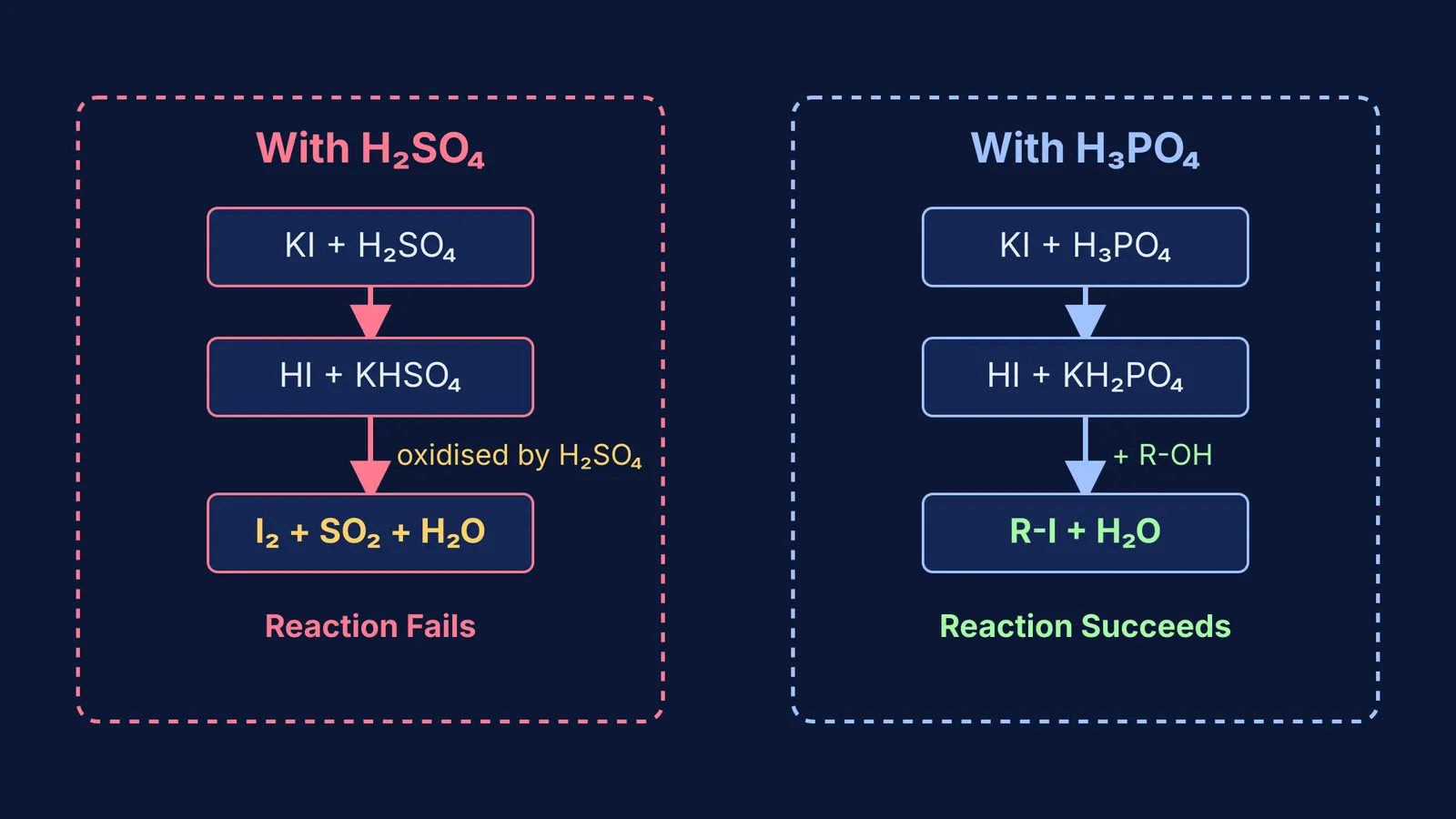
If you add concentrated sulphuric acid (H₂SO₄) to potassium iodide, you will immediately see a dense, violet vapour rise from the flask. This striking visual indicates that the reaction has failed to produce the required HI.
The initial step of the reaction does produce hydrogen iodide as intended: KI + H₂SO₄ → KHSO₄ + HI
However, concentrated sulphuric acid is a powerful oxidising agent, while the newly formed HI is a strong reducing agent.
The sulphuric acid immediately oxidises the iodide ions into elemental iodine (I₂), while being reduced itself to sulphur dioxide (SO₂) according to Wikipedia's chemical data: 2HI + H₂SO₄ → I₂ + SO₂ + 2H₂O
The purple I₂ gas escapes or crystallises on the cold sides of the flask. Because the hydrogen iodide is completely destroyed by this redox reaction, it is no longer available to react with the alcohol. The nucleophilic substitution cannot take place, and no alkyl iodide is formed.
Interestingly, this problem does not occur when making alkyl chlorides. Hydrogen chloride (HCl) is much harder to oxidise because the chloride ion holds tightly to its electrons. Therefore, mixing sodium chloride (NaCl) with concentrated sulphuric acid is a perfectly valid and common way to generate HCl gas in the laboratory.
What is used instead of sulphuric acid?
To prevent the oxidation of hydrogen iodide, the reaction requires an acid that is strong enough to displace the iodide ion from KI, but without any oxidising properties. Concentrated phosphoric acid (H₃PO₄) is the standard choice.
Phosphoric acid reacts with potassium iodide to provide a steady supply of HI: KI + H₃PO₄ → KH₂PO₄ + HI
Because phosphoric acid cannot oxidise the HI into iodine, the hydrogen iodide remains completely intact. It is now free to protonate the alcohol and complete the nucleophilic substitution: R-OH + HI → R-I + H₂O
Alternative routes to alkyl iodides
If generating HI in situ with phosphoric acid is not practical, chemists use entirely different methods to introduce the iodine atom. A common alternative is the Finkelstein reaction. Instead of starting with an alcohol, this method starts with an alkyl chloride or alkyl bromide. The starting halide is reacted with sodium iodide (NaI) in a solvent like dry acetone. Because sodium chloride and sodium bromide are insoluble in acetone, they precipitate out of the solution. This removes the products from the mixture, driving the equilibrium forward to produce a high yield of the alkyl iodide.
A framework for haloalkane synthesis
Memorising individual reactions is less effective than understanding the properties of your reagents. When planning a synthesis, use this checklist to evaluate your reaction conditions:
Is the acid an oxidising agent? Avoid sulphuric acid when working with iodides or bromides. It is an effective choice for dehydrating alcohols to alkenes, but its oxidising nature ruins sensitive reducing agents.
Is the reagent stable? Reagents like HI and HBr must be generated in the flask (in situ) because they degrade over time.
What is the solvent doing? The choice of solvent can completely change the reaction pathway. For example, understanding the difference between aqueous vs alcoholic KOH dictates whether you get substitution (forming an alcohol) or elimination (forming an alkene).
If you are struggling to spot these underlying patterns in organic chemistry, the Fermi Concept Library groups reactions by their mechanisms. Once you see why a reagent acts as an oxidiser, a reducing agent or a nucleophile, predicting the products becomes straightforward. If you find yourself staring at a complex reaction sequence not knowing where to begin, Fermi's AI tutor can work out what you already know and build a plan for the session, giving you a clear next step instead of a blank page.


