

On this page
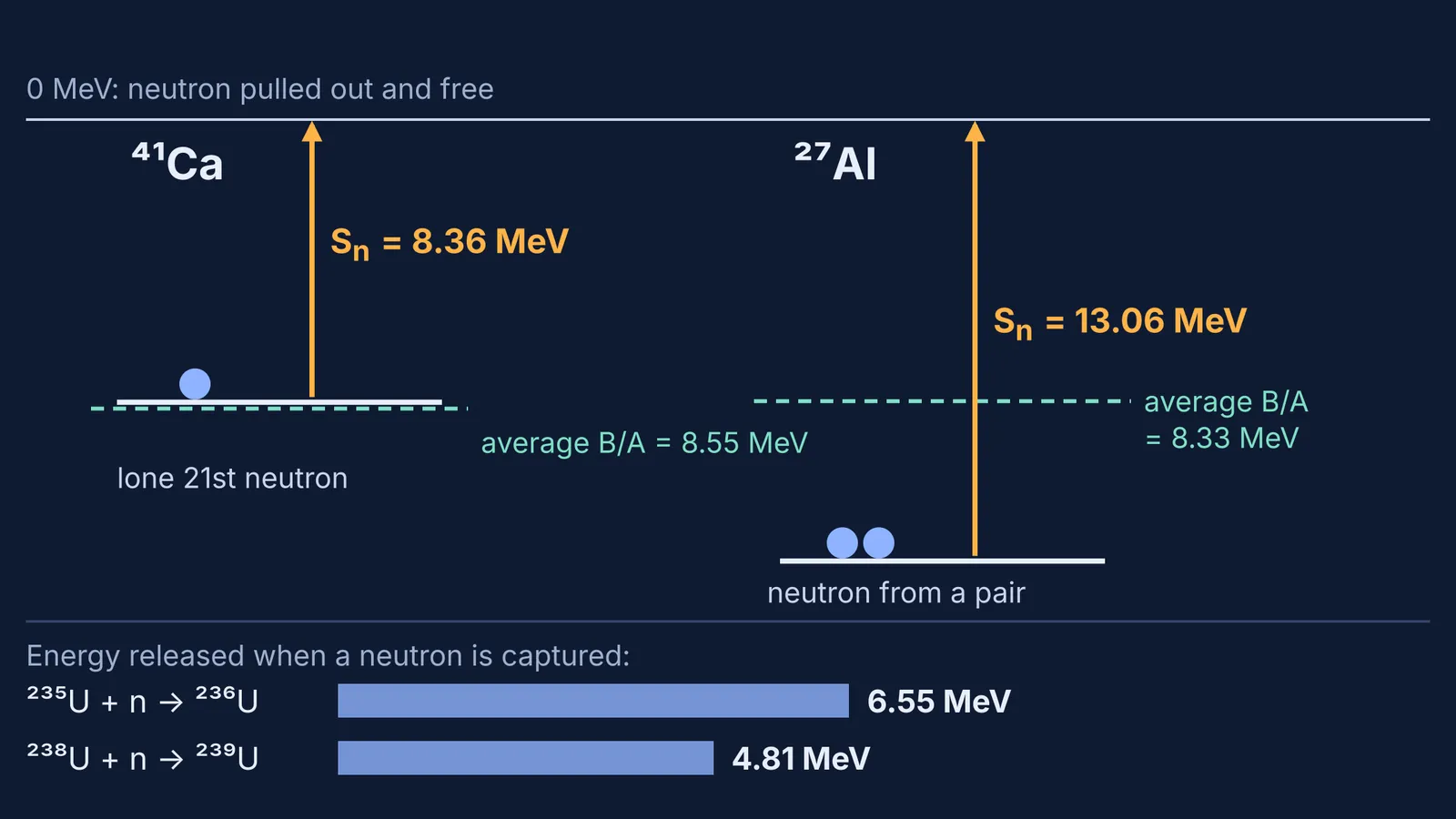
Binding energy per nucleon tells you how tightly a nucleus is held together on average. It does not tell you what it costs to pull out one particular neutron. That number is the neutron separation energy, and it can sit well above or below the average. A standard Class 12 Nuclei exercise asks for it in ⁴¹Ca and ²⁷Al, and the two answers, 8.36 MeV and 13.06 MeV, are far enough apart to show something real about how nuclei are built.
What is neutron separation energy?
The neutron separation energy Sₙ is the minimum energy needed to remove one neutron from a nucleus, leaving the rest of the nucleus in its ground state. You get it from the masses before and after:
Sₙ = [m(ᴬ⁻¹X) + mₙ − m(ᴬX)] c²
The right side is a mass defect, just like the one for total binding energy, but for a single neutron. If the masses of the pieces add up to more than the nucleus, you must supply that difference as energy. An equivalent form is Sₙ = B(A) − B(A−1): the drop in total binding energy when the neutron leaves.
You have already met one separation energy without the name. The 2.22 MeV needed to split a deuteron into a proton and a neutron, worked in minimum photon energy to break a deuteron, is the neutron separation energy of ²H. A proton separation energy works the same way, with the mass of a ¹H atom in place of mₙ.
Why can you use atomic masses instead of nuclear masses?
Tables list atomic masses, which include the electrons. Removing a neutron does not change Z, so ⁴¹Ca and ⁴⁰Ca both carry 20 electrons. The electron masses appear once on each side of the equation and cancel, and so do their tiny electronic binding energies. That is why you can put atomic masses straight into the formula. This is not true for beta decay or proton removal, where Z changes and you have to count electrons carefully.
How do you calculate Sₙ for ⁴¹Ca and ²⁷Al?
Data: atomic masses from the AME2020 atomic mass evaluation, hosted by the IAEA, rounded to six decimal places. Older textbook tables can differ in the last digit, which does not change the answers below.
mₙ = 1.008665 u
m(⁴⁰Ca) = 39.962591 u, m(⁴¹Ca) = 40.962278 u
m(²⁶Al) = 25.986892 u, m(²⁷Al) = 26.981538 u
1 u = 931.494 MeV/c²
Calcium-41.
Write the reaction: ⁴¹Ca → ⁴⁰Ca + n.
Mass of the products: 39.962591 + 1.008665 = 40.971256 u.
Subtract the mass of ⁴¹Ca: 40.971256 − 40.962278 = 0.008978 u.
Convert: 0.008978 × 931.494 = 8.363 MeV.
Answer: Sₙ(⁴¹Ca) ≈ 8.36 MeV.
Aluminium-27.
Reaction: ²⁷Al → ²⁶Al + n.
Products: 25.986892 + 1.008665 = 26.995557 u.
Mass difference: 26.995557 − 26.981538 = 0.014019 u.
Convert: 0.014019 × 931.494 = 13.059 MeV.
Answer: Sₙ(²⁷Al) ≈ 13.06 MeV.
Check the sign. Both differences are positive, so both nuclei are stable against losing a neutron, and you must put energy in. Check the size: a few MeV per nucleon is the right scale for nuclear binding.
How does Sₙ compare with binding energy per nucleon?
Work out B/A from the same table, using m(¹H) = 1.007825 u so that the electrons cancel.
⁴¹Ca (20 protons, 21 neutrons): 20 × 1.007825 + 21 × 1.008665 − 40.962278 = 0.376187 u, which is 350.4 MeV, or 8.55 MeV per nucleon.
²⁷Al (13 protons, 14 neutrons): 13 × 1.007825 + 14 × 1.008665 − 26.981538 = 0.241497 u, which is 225.0 MeV, or 8.33 MeV per nucleon.
So the last neutron in ⁴¹Ca is held about 0.19 MeV less tightly than the average nucleon. The last neutron in ²⁷Al is held about 4.7 MeV more tightly than average. The average is what the binding energy per nucleon curve plots, and it hides these differences between individual nucleons.
Why is the last neutron in ²⁷Al held so much more tightly?
The main reason is pairing. Neutrons in a nucleus bind more strongly when they form pairs, two neutrons in the same state with opposite spins. ²⁷Al has 14 neutrons, an even number, so its neutrons are all paired. Removing one breaks a pair and leaves ²⁶Al, which has 13 protons and 13 neutrons and so an unpaired particle of each kind. You pay for the broken pair. ⁴¹Ca has 21 neutrons. The 21st has no partner, so taking it out breaks nothing.
Shell structure adds to the effect in calcium. ⁴⁰Ca has 20 protons and 20 neutrons, both magic numbers, so it is a doubly magic, very tightly bound core. The 21st neutron has to sit in the next shell up, outside that closed core, which is another reason it is loosely held. Pairing and shells are two of several effects, but they are enough to explain these two numbers.
Why does ²³⁵U fission with slow neutrons and ²³⁸U does not?
The same calculation explains a fact you learn in the fission chapter. When a nucleus captures a neutron, the energy released is the separation energy of the neutron in the new nucleus. That energy is left in the nucleus as excitation.
²³⁵U + n → ²³⁶U: Sₙ(²³⁶U) = (235.043928 + 1.008665 − 236.045566) × 931.494 ≈ 6.55 MeV.
²³⁸U + n → ²³⁹U: Sₙ(²³⁹U) = (238.050787 + 1.008665 − 239.054292) × 931.494 ≈ 4.81 MeV.
Pairing again. ²³⁵U has 143 neutrons, an odd number, so the captured neutron completes a pair in ²³⁶U and releases extra energy. ²³⁸U has 146 neutrons, so the newcomer in ²³⁹U is unpaired. To split, the excited nucleus must get over a fission barrier of roughly 6 MeV; quoted values differ by a few tenths of an MeV between sources. 6.55 MeV is enough even when the neutron arrives with almost no kinetic energy. 4.81 MeV is not, so ²³⁸U fissions only with fast neutrons that bring in roughly an extra MeV or more.
If you want more problems like these, the Fermi Problem Library has a step-by-step solver that explains the reasoning at each stage. For total binding energy and Q-value practice, see mass defect and binding energy problems.
Quick checklist
Sₙ = [m(A−1) + mₙ − m(A)]c², the energy to remove one neutron.
Atomic masses work because Z does not change, so electrons cancel.
Sₙ(⁴¹Ca) ≈ 8.36 MeV and Sₙ(²⁷Al) ≈ 13.06 MeV with AME2020 masses.
Compare with B/A: 8.55 MeV for ⁴¹Ca and 8.33 MeV for ²⁷Al.
Even neutron number: removing one breaks a pair, so Sₙ is high.
Neutron capture releases 6.55 MeV in ²³⁵U and 4.81 MeV in ²³⁸U, which decides slow-neutron fission.


