

On this page
A deuteron is the nucleus of heavy hydrogen: one proton and one neutron held together by the nuclear force. Shine a photon of enough energy on it and it splits apart. This is called photodisintegration. In 1934 James Chadwick and Maurice Goldhaber reported doing exactly this with gamma rays in Nature, in a paper titled A Nuclear Photo-effect: Disintegration of the Diplon by γ-Rays. Today it is a standard nuclei-chapter question that joins mass defect with E = hc/λ.
What is the minimum photon energy to break a deuteron?
The photon has to supply at least the binding energy, the energy that holds the two nucleons together. You find it from the mass defect: the separate proton and neutron weigh more than the deuteron they form.
Use the CODATA 2022 values published by NIST:
Proton plus neutron gives 2.0159413826 u. Subtract the deuteron mass and the mass defect is 0.0023881701 u. Multiply by 931.494 MeV per u and the deuteron's binding energy comes out at 2.2246 MeV, which most textbooks round to 2.22 MeV.
That is a small number for a nucleus. Our post on the binding energy per nucleon curve shows why: with only two nucleons, the deuteron is about 1.1 MeV per nucleon, near the bottom of the curve.
How do you find the longest wavelength that can split it?
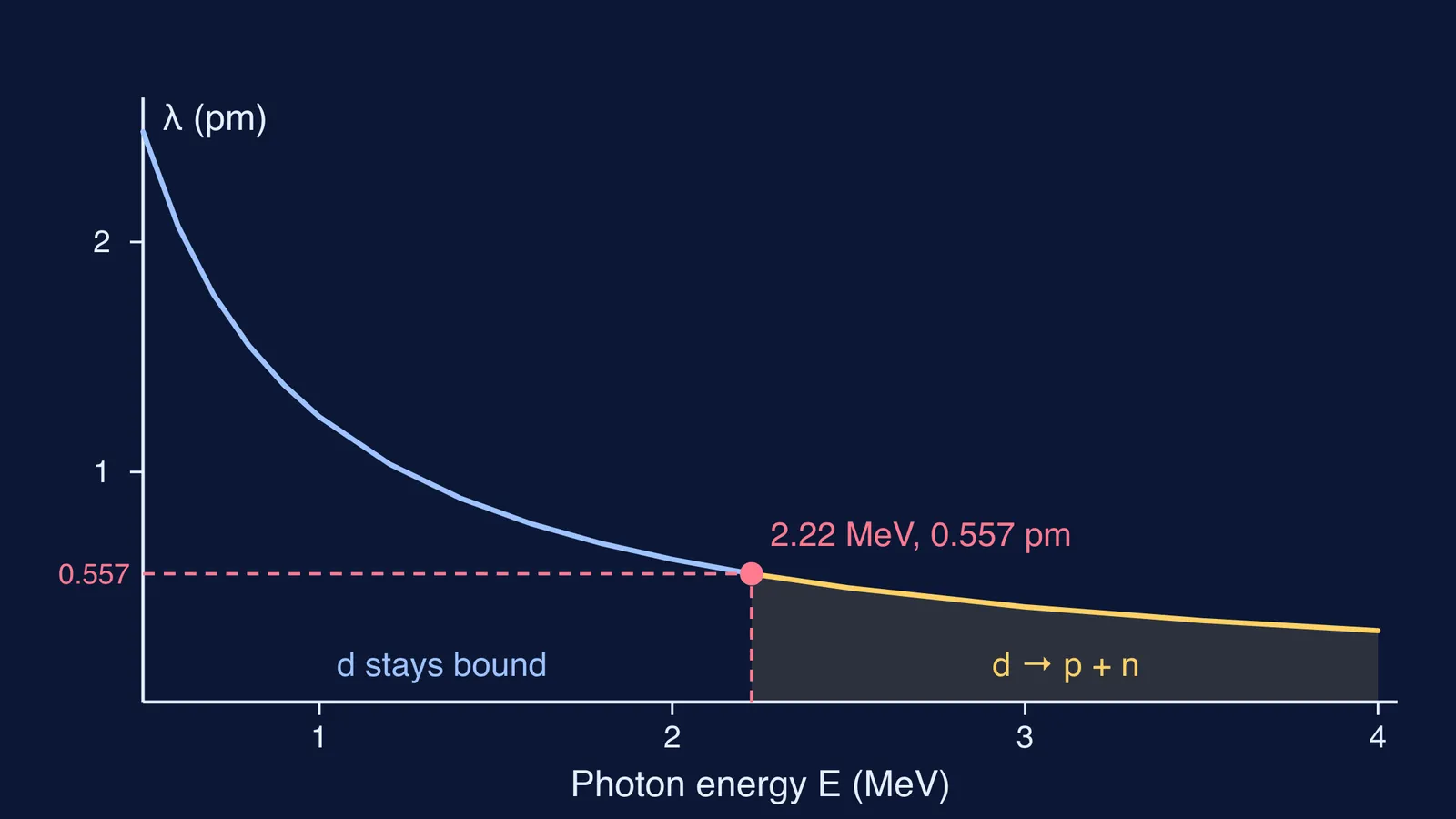
Photon energy and wavelength are linked by E = hc/λ. A smaller energy means a longer wavelength, so the minimum energy gives the maximum wavelength. NIST lists the Planck constant as 4.135667696 × 10⁻¹⁵ eV per hertz, and with c = 299792458 m/s this makes hc = 1239.84 eV nm. This is the familiar 1240 shortcut.
Worked example (exam-style numbers). Given m(p) = 1.007276 u, m(n) = 1.008665 u, m(d) = 2.013553 u and 1 u = 931.5 MeV, find the minimum photon energy to break a deuteron and the longest wavelength that can do it.
Add the parts: 1.007276 + 1.008665 = 2.015941 u.
Mass defect: 2.015941 − 2.013553 = 0.002388 u.
Binding energy: 0.002388 × 931.5 = 2.224 MeV, so E(min) ≈ 2.22 MeV.
Convert to eV: 2.22 MeV = 2.22 × 10⁶ eV.
Wavelength: λ(max) = 1240 eV nm ÷ 2.22 × 10⁶ eV = 5.59 × 10⁻⁴ nm = 5.59 × 10⁻¹³ m.
With the full NIST values the answer is 5.57 × 10⁻¹³ m, or 0.557 picometres. The small gap comes mostly from rounding 2.2246 MeV down to 2.22 MeV; using 1240 instead of 1239.84 adds a little more. Either answer is fine in an exam if your working shows the rounding.
The same "minimum energy means longest wavelength" step shows up in the X-ray cutoff wavelength from tube voltage, where λmin = hc/eV.
Why is the real threshold slightly above 2.22 MeV?
The board-exam answer is the binding energy, and you should write that. But a photon also carries momentum E/c. That momentum cannot disappear, so the proton and neutron must move off after the split, and their kinetic energy has to come from the photon too.
Conserving energy and momentum together gives E(threshold) = B + B²/(2 m(d)c²). NIST gives the deuteron's rest energy as 1875.61294500 MeV. The extra term is 2.2246² ÷ (2 × 1875.61) = 0.0013 MeV, so the true threshold is about 2.2259 MeV. That moves the longest wavelength from 0.5573 pm to 0.5570 pm. The correction is under 0.1%, so textbooks leave it out, but it is worth raising in a viva or olympiad answer.
If you want to practise reactions where the energy goes the other way, our guide on how to calculate the Q value of a nuclear reaction uses the same mass-defect bookkeeping.
What mistakes cost marks on this question?
Run through this checklist before you write the final answer:
Use nuclear masses for the proton and neutron. If you are given the hydrogen atom mass instead, the electron masses must cancel on both sides.
Subtract in the right order: parts minus whole. A negative mass defect means you swapped them.
Keep at least six decimal places in u; the defect sits in the third decimal place.
Convert MeV to eV before using 1240 eV nm (from the NIST Planck constant), or use 1240 MeV fm and convert femtometres at the end.
Answer what is asked: "minimum energy" goes with "maximum wavelength", never minimum wavelength.
If you keep getting the order of these steps wrong, the Fermi Problem Library has worked problems with a step-by-step solver that explains the reasoning rather than printing an answer. If the idea of binding energy itself feels shaky, the Fermi Concept Library gives each physics concept its own lesson and shows where it sits in the map of the subject.
Try the calculation again with the full NIST numbers and check that you land on 0.557 pm.


