

On this page
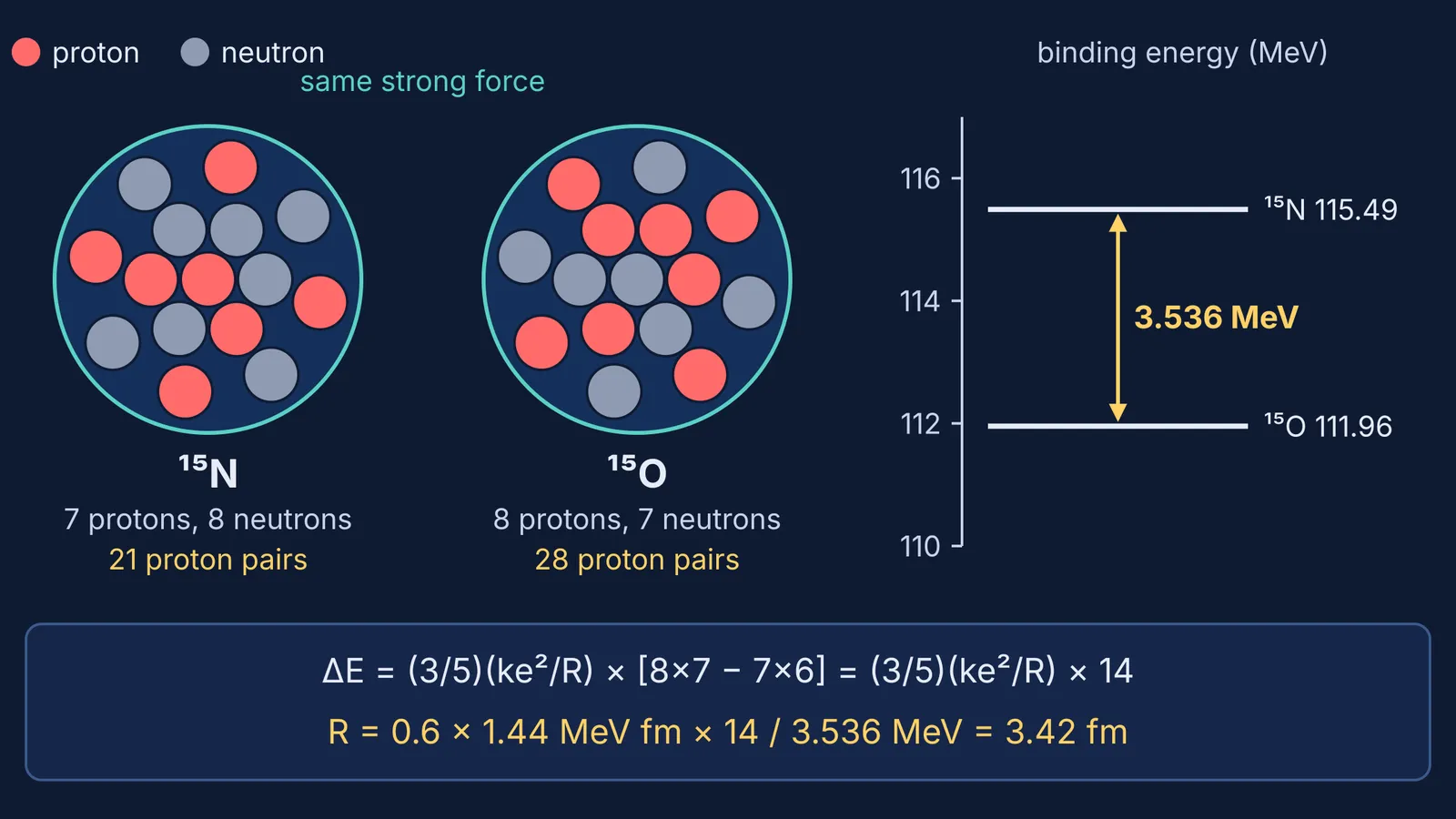
Nitrogen-15 and oxygen-15 both have 15 nucleons. Nitrogen-15 has 7 protons and 8 neutrons; oxygen-15 has 8 protons and 7 neutrons. Swap every proton for a neutron and one becomes the other. Yet oxygen-15 is held together less tightly, by about 3.5 MeV. That small gap is almost pure electrostatics, and it lets you measure the size of a nucleus with nothing more than a table of masses and the energy of a charged sphere. This is the idea behind a JEE Advanced 2016 question, and it is worth understanding rather than memorising.
What are mirror nuclei?
Two nuclei are mirror nuclei when they have the same mass number A and the proton number of one equals the neutron number of the other. ¹⁵N and ¹⁵O are a pair. So are ³H (1 proton, 2 neutrons) and ³He (2 protons, 1 neutron).
The strong nuclear force acts almost equally between proton and proton, neutron and neutron, and proton and neutron. Physicists call this charge symmetry. If the strong force were the only force, a pair of mirror nuclei would have the same binding energy. They do not, because protons also repel each other electrically and neutrons do not. So for mirror nuclei:
difference in binding energy ≈ difference in electrostatic (Coulomb) energy
That one approximation turns a nuclear-physics problem into an electrostatics problem.
How much electrostatic energy does a nucleus store?
Model the nucleus as a sphere of radius R with its charge spread uniformly through the volume. The work to assemble a total charge Q in such a sphere is (3/5)kQ²/R. The derivation, shell by shell, is in the self-energy of a uniformly charged sphere, so it is not repeated here.
For a nucleus, one change matters. kQ²/R with Q = Ze counts Z² interactions, which includes each proton "repelling itself". A proton does not repel itself. Counting only pairs of different protons gives Z(Z − 1)/2 pairs instead of Z²/2, so the formula used for nuclei is:
E_C = (3/5) Z(Z − 1) ke²/R, with ke² = 1.44 MeV fm
For nitrogen, Z(Z − 1) = 7 × 6 = 42. For oxygen, Z(Z − 1) = 8 × 7 = 56. Oxygen-15 has 28 proton pairs against nitrogen-15's 21. Both nuclei have the same A, so take the same R for both. The difference in Coulomb energy is:
ΔE_C = (3/5)(ke²/R)(56 − 42) = (3/5)(ke²/R) × 14
How do you get the binding energy difference from atomic masses?
Mass tables list atomic masses, which include the electrons. Binding energy is the mass of the separate parts minus the mass of the whole, times c². Using the hydrogen atom's mass m_H for each proton brings along exactly the right number of electrons, so the electron masses cancel.
B(¹⁵N) = [7m_H + 8m_n − M(¹⁵N)]c²
B(¹⁵O) = [8m_H + 7m_n − M(¹⁵O)]c²
Subtract:
B(¹⁵N) − B(¹⁵O) = [M(¹⁵O) − M(¹⁵N) + m_n − m_H]c²
The m_n − m_H term is there because oxygen-15 has one more proton and one fewer neutron to account for.
Worked example: the radius of ¹⁵O and ¹⁵N
Data (atomic masses as given in the JEE paper, which agree with the AME2020 atomic mass evaluation table published by the IAEA Nuclear Data Section to the sixth decimal place): m_n = 1.008665 u, m_H = 1.007825 u, M(¹⁵N) = 15.000109 u, M(¹⁵O) = 15.003065 u, 1 u = 931.5 MeV/c², ke² = 1.44 MeV fm. The question and its answer key are reproduced on this JEE Advanced 2016 Paper 2 solution page.
Mass difference of the nuclei. M(¹⁵O) − M(¹⁵N) = 15.003065 − 15.000109 = 0.002956 u.
Add the proton-for-neutron swap. m_n − m_H = 1.008665 − 1.007825 = 0.000840 u. Total: 0.003796 u.
Convert to energy. 0.003796 × 931.5 = 3.536 MeV. So ¹⁵O is less tightly bound than ¹⁵N by 3.536 MeV. (From the full tables, B(¹⁵N) ≈ 115.49 MeV and B(¹⁵O) ≈ 111.96 MeV, which agrees.)
Set it equal to the Coulomb difference. (3/5)(1.44 MeV fm)(14)/R = 3.536 MeV, so 12.096 MeV fm / R = 3.536 MeV.
Solve. R = 12.096/3.536 = 3.42 fm.
Check units. MeV fm divided by MeV leaves fm. Good.
So the radius of a 15-nucleon nucleus comes out at about 3.42 × 10⁻¹⁵ m, from nothing but masses and Coulomb's law.
What does this radius say about R = R₀A^(1/3)?
The usual rule is R = R₀A^(1/3), covered in nuclear radius and density. Here A = 15 and A^(1/3) = 2.466, so:
R₀ = 3.42/2.466 = 1.39 fm
NCERT and most textbooks quote R₀ ≈ 1.2 fm, from electron-scattering experiments. The two numbers are not in conflict so much as measuring different things. A real nucleus does not have a sharp edge; its charge density fades out over a skin a couple of femtometres thick. A uniform sphere with a sharp edge that stores the same electrostatic energy has to be somewhat larger than the radius quoted from scattering. The simple model also leaves out smaller quantum corrections. So the mirror-nucleus method gives the right size to within about 16 percent, but the exact R₀ depends on the model.
If you used R₀ = 1.2 fm instead, R = 2.96 fm and the predicted gap would be (3/5)(1.44)(14)/2.96 = 4.09 MeV, against the measured 3.54 MeV.
How big is the whole electrostatic energy?
With R = 3.42 fm, the full Coulomb energy of ¹⁵O is (3/5)(1.44)(56)/3.42 = 14.1 MeV, and of ¹⁵N it is 10.6 MeV. Compared with oxygen-15's total binding of about 112 MeV, the electric repulsion takes back roughly an eighth. This is the Coulomb term of the liquid-drop model, which Bohr and Wheeler used to explain fission. Because it grows roughly as Z²/A^(1/3), faster than the strong-force binding, which grows about as A, it is the term that makes heavy nuclei unstable.
Does the method work for other mirror pairs?
Try ³He and ³H. Atomic masses: M(³He) = 3.016029 u, M(³H) = 3.016049 u.
B(³H) − B(³He) = [3.016029 − 3.016049 + 0.000840] × 931.5 = 0.000820 × 931.5 = 0.764 MeV.
Z(Z − 1) is 2 for helium and 0 for hydrogen, a difference of 2.
R = (3/5)(1.44)(2)/0.764 = 2.26 fm.
That gives R₀ = 2.26/3^(1/3) = 1.57 fm, further from 1.2 fm. A three-nucleon nucleus is nothing like a uniform sphere, so the model is cruder here. Notice also that ³He is lighter than ³H, which is why tritium beta-decays into helium-3.
If you want more nuclear-binding problems worked this way, the Fermi Problem Library has a step-by-step solver that explains the reasoning at each stage.
Quick checklist
Mirror nuclei swap Z and N; the strong force binds them almost equally.
Their binding energy difference is the difference in Coulomb energy.
Use E_C = (3/5)Z(Z − 1)ke²/R, with ke² = 1.44 MeV fm.
With atomic masses: ΔB = [M(heavier-Z) − M(lower-Z) + m_n − m_H]c².
¹⁵N and ¹⁵O: ΔB = 3.536 MeV, R = 3.42 fm, R₀ ≈ 1.39 fm.
The uniform sharp-edged sphere is a model; scattering gives R₀ ≈ 1.2 fm.


