On this page
Square a complex number inside the unit circle and add 1: how large can the answer get? The maximum modulus principle says to look only at the edge. Here is why, with a full worked example.
What does the maximum modulus principle say?
Let f be holomorphic on a bounded, connected open set D. If |f(z₀)| ≥ |f(z)| for every z near some point z₀ in D, then f is constant on D. That is the formal statement in the maximum modulus principle article on Wikipedia.
The version you use in problems follows from it. If f is also continuous up to the boundary, then |f| attains its maximum at some point of the boundary of D, as the same article explains: a continuous function on a closed, bounded set has a maximum somewhere, and if that point were inside, f would be constant, so the same maximum is also reached on the boundary.
How do you prove it from the mean value property?
Cauchy's integral formula gives Gauss's mean value theorem: f(a) = (1/2π) ∫₀^2π f(a + re^(iθ)) dθ, so the value at the centre of a circle is the average of the values on it (Cauchy's integral formula, Wikipedia). It holds whenever the closed disc of radius r around a lies inside D.
Now suppose |f| has its largest value M at an interior point a.
Take the modulus of both sides: M = |f(a)| ≤ (1/2π) ∫ |f(a + re^(iθ))| dθ.
Every value on the circle is at most M, so the average is at most M. The two inequalities squeeze, and the average equals M.
A continuous function that never exceeds M and averages exactly M must equal M all round the circle. This holds for every small r, so |f| = M on a whole disc around a.
A holomorphic function with constant modulus on a disc is constant there; the Cauchy–Riemann equations force f′ = 0.
The identity theorem spreads f = f(a) from that disc to all of the connected set D.
So a non-constant f has no interior peak of |f|.
What is the maximum of |z²+1| on the closed unit disc?
Take f(z) = z² + 1 on |z| ≤ 1. It is a polynomial, so it is holomorphic everywhere, and the principle sends us to the circle |z| = 1.
Upper bound. By the triangle inequality, |z² + 1| ≤ |z|² + 1 ≤ 2.
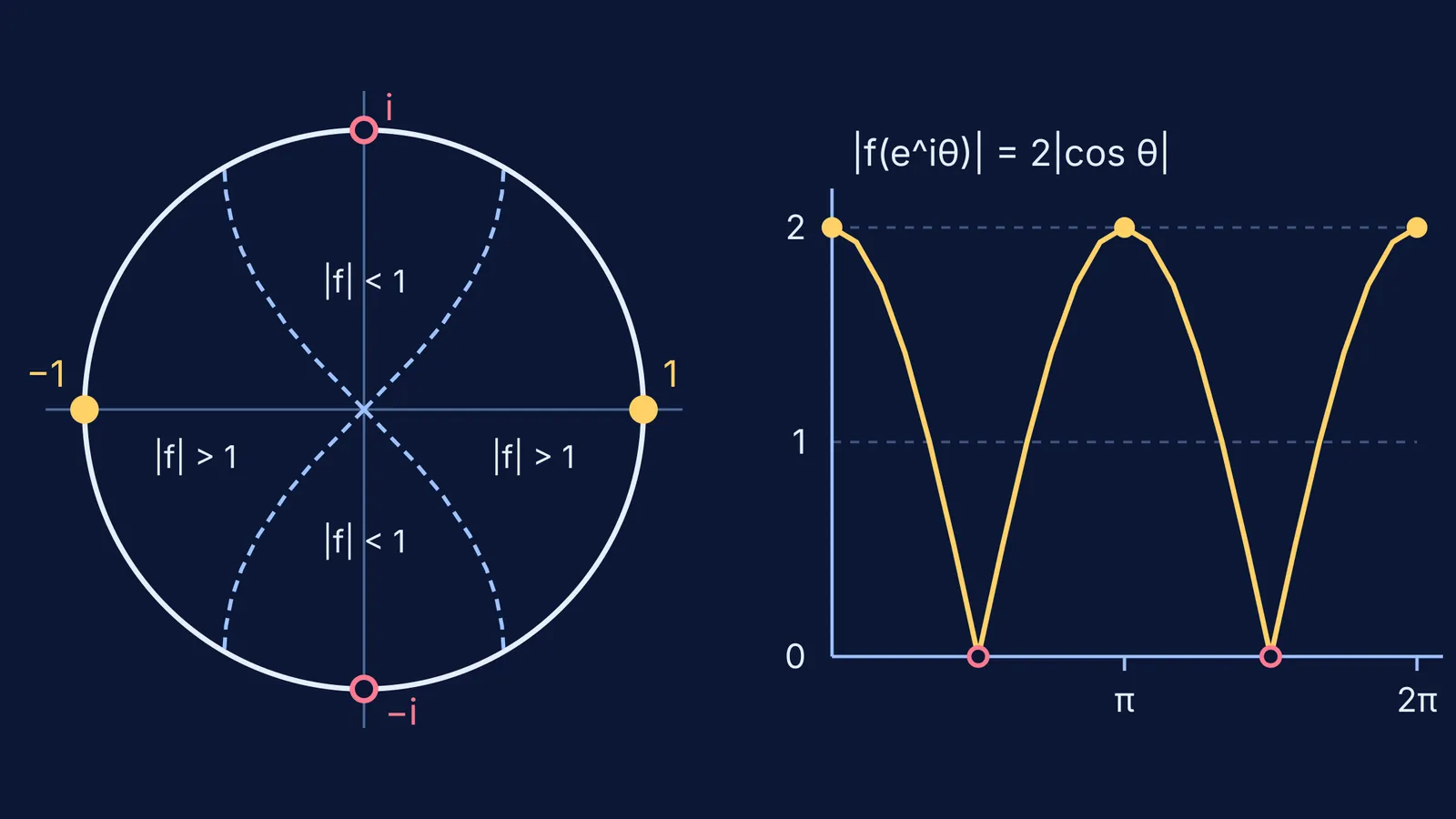
Parametrise the boundary. Put z = e^(iθ). Then z² + 1 = e^(iθ)(e^(iθ) + e^(−iθ)) = 2cos θ · e^(iθ), so |f(e^(iθ))| = 2|cos θ|.
Read off the maximum. 2|cos θ| is largest at θ = 0 and θ = π, so the maximum is 2, reached at z = 1 and z = −1.
Check inside. f(0) = 1 and f(0.5) = 1.25, both below 2, as they must be.
The mean value property checks out too. Averaging z² + 1 over the unit circle removes the e^(2iθ) term and leaves 1, exactly f(0). The average of |f| on the circle is 4/π, about 1.27, at least |f(0)| = 1, as step 1 of the proof predicts.
What is the minimum modulus principle?
Apply the maximum principle to 1/f. If f is holomorphic on a connected open set and |f| has a local minimum at z₀ with f(z₀) ≠ 0, then f is constant (minimum modulus principle, Wikipedia).
The condition f(z₀) ≠ 0 matters. The function f(z) = z on the unit disc has minimum modulus 0 at the centre, and nothing breaks, because 1/z is not holomorphic there. In our example the zeros of z² + 1 are i and −i, both on the boundary, so the minimum of |z² + 1| on the closed disc is 0, reached on the edge at θ = ±π/2.
How does it prove the fundamental theorem of algebra?
This is the argument given in the fundamental theorem of algebra article, in three steps.
Let p be a non-constant polynomial. Since |p(z)| grows without bound, choose r so that |p(z)| > |p(0)| whenever |z| ≥ r.
On the closed disc |z| ≤ r, |p| has a minimum at some z₀. Boundary values exceed |p(0)|, so z₀ is an interior point.
If p(z₀) ≠ 0, the minimum modulus principle makes p constant, which it is not. So p(z₀) = 0: every non-constant polynomial has a complex root.
The same article gives a close cousin that uses Liouville's theorem on bounded entire functions: if p had no zero, 1/p would be bounded and entire, hence constant. For the theorem itself, read what the fundamental theorem of algebra says and why it matters.
A checklist for maximum-modulus questions
Check that f is holomorphic inside the region and continuous up to the edge.
Parametrise the boundary (z = re^(iθ) for a disc) and maximise a real function of θ.
Use the triangle inequality for a quick upper bound, then find where it is attained.
For a minimum, first look for zeros inside; if there is one, the minimum is 0.
If the identity theorem or Cauchy's formula feels shaky, revisit it in the Fermi Concept Library, which covers every concept in physics, chemistry, biology, mathematics and computing. Then try the maximum of |z² − z| on the closed unit disc and compare your reasoning with the step-by-step solver in the Fermi Problem Library.