

On this page
This set follows our first magnetism JEE Main practice set and tests the sub-topics it skipped. Eight original questions, easy to hard: six single-correct and two numerical (Q3, Q7), each with a "Trap" naming the most tempting wrong answer.
What does set 2 cover that set 1 did not?
Unit 13 of NTA's Syllabus for JEE (Main) - 2027 lists the force on a moving charge in magnetic and electric fields, the force on a conductor, the current loop as a dipole, and para-, dia- and ferromagnetic substances. Set 2 tests these and finite wires, all inside the 2026-27 reprints of NCERT Class 12 Physics Chapter 4, Moving Charges and Magnetism and Chapter 5, Magnetism and Matter.
Take μ₀ = 4π × 10⁻⁷ T m A⁻¹, e = 1.6 × 10⁻¹⁹ C, electron mass 9.1 × 10⁻³¹ kg and g = 10 m/s².
Easy: can you match each formula to its situation?
Q1 (easy). A proton moves with velocity 4.0 × 10⁵ î m/s through a region where E = 2.0 × 10⁴ ĵ V/m and B = 0.10 k̂ T. The net force on it is:
(A) 3.2 × 10⁻¹⁵ N along +y
(B) 3.2 × 10⁻¹⁵ N along −y
(C) 6.4 × 10⁻¹⁵ N along −y
(D) 9.6 × 10⁻¹⁵ N along +y
Answer: (B). F = q(E + v × B). Since î × k̂ = −ĵ, v × B = −4.0 × 10⁴ ĵ V/m, so E + v × B = −2.0 × 10⁴ ĵ V/m and F = 1.6 × 10⁻¹⁹ × 2.0 × 10⁴ = 3.2 × 10⁻¹⁵ N along −y. Trap: (D), which takes î × k̂ as +ĵ.
Q2 (easy). An electromagnet's core must lose its magnetism as soon as the current stops. The best choice is:
(A) alnico
(B) soft iron
(C) lodestone
(D) aluminium
Answer: (B). NCERT Chapter 5 calls soft iron a soft ferromagnet: its magnetisation disappears when the external field is removed. Trap: (A). Alnico is a hard ferromagnet that keeps its magnetisation, as permanent magnets need.
Q3 (easy, numerical). A thin rod of volume 5.0 cm³ lies along the axis of a long solenoid with 20 turns per cm carrying 2.0 A. The rod's magnetic moment becomes 6.0 A m². Find the relative permeability of its material.
Answer: 301. H = nI = 4000 A/m. M = m/V = 6.0/(5.0 × 10⁻⁶) = 1.2 × 10⁶ A/m, so χ = M/H = 300 and μr = 1 + χ = 301. Trap: 300, which stops at the susceptibility.
Medium: can you add fields and balance forces?
Q4 (medium). Two circular coils share a centre, with their planes perpendicular. One has 30 turns of radius 10 cm carrying 1.0 A; the other has 20 turns of radius 10 cm carrying 2.0 A. The field at the common centre is closest to:
(A) 0.10 mT
(B) 0.063 mT
(C) 0.31 mT
(D) 0.44 mT
Answer: (C). The coils give μ₀NI/(2R) = 0.188 mT and 0.251 mT along perpendicular axes, so B = √(0.188² + 0.251²) = 0.314 mT. Trap: (D), which adds them as if parallel.
Q5 (medium). A metal rod 0.50 m long and of mass 0.20 kg lies across two smooth rails inclined at 30° to the horizontal, in a uniform vertical field of 0.40 T. The current that holds the rod at rest is closest to:
(A) 5.0 A
(B) 5.8 A
(C) 10 A
(D) 17.3 A
Answer: (B). The force BIL is horizontal. Along the slope, BIL cos 30° = mg sin 30°, so I = mg tan 30°/(BL) = 0.20 × 10 × 0.577/(0.40 × 0.50) = 5.8 A. Trap: (A), which takes the magnetic force as acting along the slope.
Q6 (medium). A small coil of 50 turns and radius 1.0 cm carries 0.50 A. The field on its axis, 10 cm from its centre, is closest to:
(A) 0.79 μT
(B) 1.55 μT
(C) 3.1 μT
(D) 1.57 mT
Answer: (B). m = NIπR² = 7.85 × 10⁻³ A m². At 10 radii the coil is a dipole: B = (μ₀/4π)2m/x³ = 1.57 μT, and the exact loop formula gives 1.55 μT. Trap: (A), the equatorial formula m/x³.
Hard: can you build a field from pieces and bound a path?
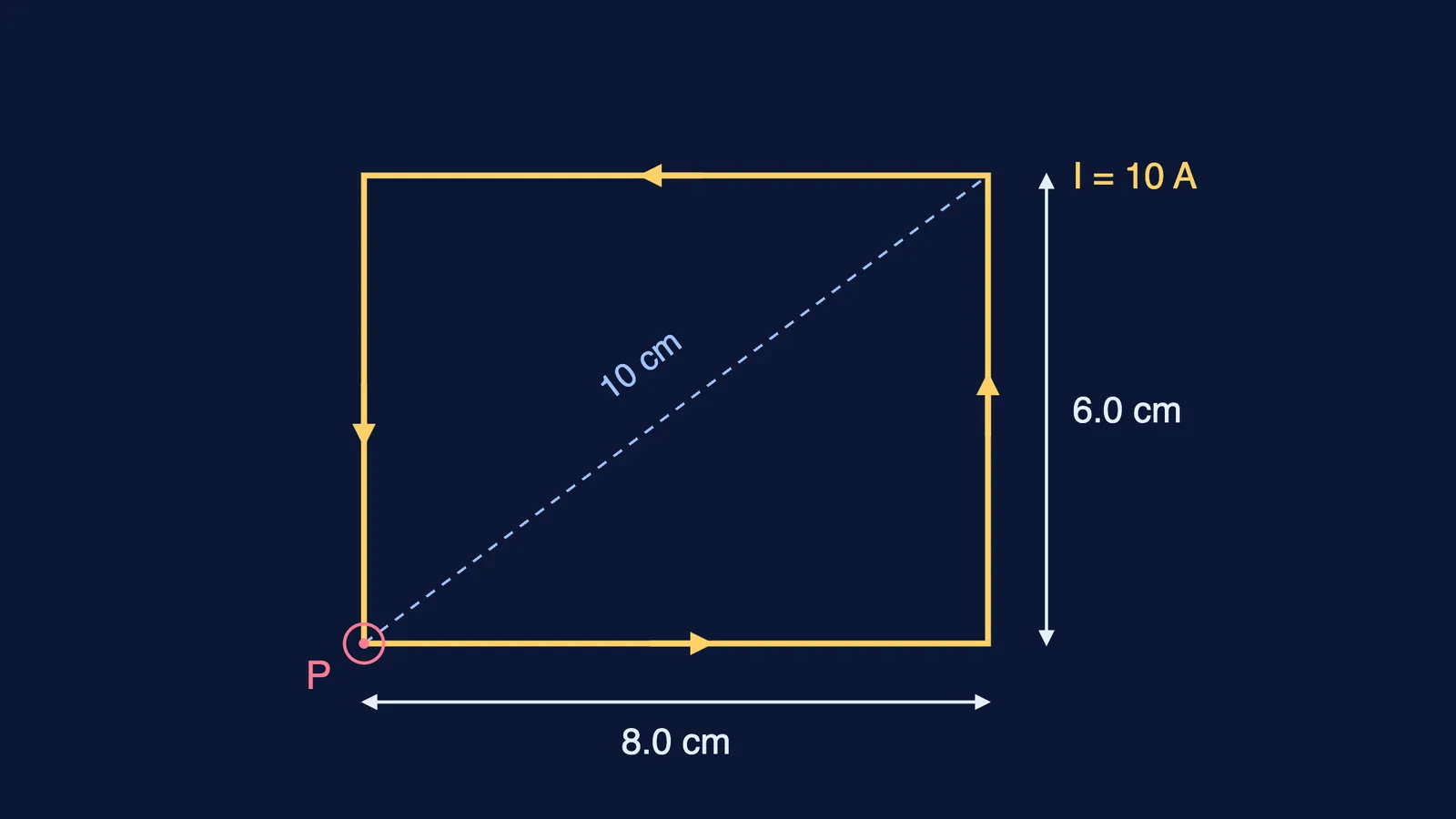
Q7 (hard, numerical). A rectangular loop 8.0 cm × 6.0 cm carries 10 A. Find the magnetic field at one of its corners, in μT, to the nearest integer.
Answer: 21. Sides through the corner give zero. For a segment, B = (μ₀I/4πa)(sin α + sin β), with a the perpendicular distance. The 8.0 cm side, 6.0 cm away, gives 10⁻⁷ × 10/0.060 × 0.8 = 13.3 μT. The 6.0 cm side, 8.0 cm away, gives 10⁻⁷ × 10/0.080 × 0.6 = 7.5 μT. They add: B = 20.8 μT. Trap: 29, which treats both far sides as semi-infinite (sin = 1).
Q8 (hard). A long solenoid of radius 4.0 cm has 10 turns per cm and carries 2.0 A. An electron starts on the axis, moving perpendicular to it. The largest speed it can have without striking the solenoid wall is closest to:
(A) 4.4 × 10⁶ m/s
(B) 8.8 × 10⁶ m/s
(C) 1.8 × 10⁷ m/s
(D) 8.8 × 10⁴ m/s
Answer: (B). B = μ₀nI = 4π × 10⁻⁷ × 1000 × 2.0 = 2.51 mT. Its circle passes through the axis, so its farthest point is 2r away; 2r = R gives v = eBR/(2m) = 8.8 × 10⁶ m/s. Trap: (C), which sets r = R.
How should you use set 2 before JEE Main?
Do all eight in 24 minutes, no calculator.
Mark each one sure, unsure or guessed before you check.
For every miss, name the trap: a cross-product sign, χ versus μr, vector addition, sin versus cos, or a factor of 2.
Three days later, redo the misses with your own numbers.
If a topic trips you, see our guide on how to prepare moving charges and magnetism for JEE Main. For Q2 and Q3, see the key terms of Magnetism and Matter. For more practice, the Fermi Problem Library has worked problems with a step-by-step solver that explains the reasoning rather than printing an answer.


