

On this page
Eight original numerical-value questions on magnetic effects of current and magnetism, easy to hard, each with a worked solution and the wrong number students most often type. Use μ₀ = 4π × 10⁻⁷ T m/A, e = 1.6 × 10⁻¹⁹ C, 1 u = 1.67 × 10⁻²⁷ kg, g = 10 m/s².
What does the JEE Main numerical section look like?
The Information Bulletin for JEE (Main) 2027 from NTA says each subject in Paper 1 has Section A (MCQs) and Section B, whose answers are filled in as a numerical value. Physics has 5 Section B questions. A correct answer gets +4 and an incorrect one −1, so Section B carries negative marking. You enter an integer on an on-screen keypad, and the answer should be rounded off to the nearest integer.
All eight sit inside Unit 13, Magnetic Effects of Current and Magnetism, of NTA's Syllabus for JEE (Main) 2027, and inside NCERT Class 12 Chapter 4, Moving Charges and Magnetism and Chapter 5, Magnetism and Matter. For theory first, see our guide on how to prepare Moving Charges and Magnetism for JEE Main.
Easy: can you get these right first time?
Q1 (easy). A long straight cable carries a steady 15 A. At what distance from it, in cm, is its magnetic field 60 μT?
Answer: 5. For a long wire, B = μ₀I/(2πr), so r = (4π × 10⁻⁷ × 15)/(2π × 60 × 10⁻⁶) = 0.050 m = 5 cm.
Trap: 16, from using the loop-centre formula μ₀I/(2r), which gives 15.7 cm.
Q2 (easy). A length of wire is bent into a single circular loop and carries a current I. The same wire is then rewound into a flat, tight coil of 3 turns, carrying the same current. By what factor does the field at the centre increase?
Answer: 9. Three turns make the radius a third. B = Nμ₀I/(2R) gains 3 from N and 3 from R: 3 × 3 = 9.
Trap: 3, from keeping the old radius.
Q3 (easy). A short solenoid of 500 turns and radius 1.0 cm carries 2.0 A. Its axis, like a bar magnet's, makes 30° with a uniform 0.20 T field. What torque acts on it, in mN m, to the nearest integer?
Answer: 31. m = NIA = 500 × 2.0 × π × (0.010)² = 0.314 A m², so τ = mB sin 30° = 0.0314 N m, about 31 mN m.
Trap: 54, from using cos 30°. The given angle is already between the moment (the axis) and B.
Medium: where do the steps pile up?
Q4 (medium). A moving coil galvanometer has 100 turns of area 2.0 cm² in a radial field of 0.25 T. Its spring's torsion constant is 5.0 × 10⁻⁸ N m per radian. What deflection does a current of 10 μA produce, in degrees, to the nearest integer?
Answer: 57. In equilibrium kφ = NIAB, so φ = (100 × 2.0 × 10⁻⁴ × 0.25 × 10 × 10⁻⁶)/(5.0 × 10⁻⁸) = 1.0 rad, which is 57.3°.
Trap: 1, the deflection in radians. The question asks for degrees.
Q5 (medium). Two long parallel wires 20 cm apart carry 10 A and 30 A in opposite directions. On the straight line through both wires, how far from the 10 A wire, in cm, is the net magnetic field zero?
Answer: 10. Opposite currents make the fields add between the wires, so the zero lies outside, beside the smaller current: 10/s = 30/(s + 20) gives s = 10 cm.
Trap: 5, the point between the wires, which applies only to currents in the same direction.
Q6 (medium). A long horizontal wire on a table carries 40 A. A second wire, of mass 3.0 g per metre, lies directly above it and parallel to it. What current, in A, must it carry so that it hangs in equilibrium 4.0 mm above the lower wire?
Answer: 15. The force must repel, so the currents are opposite. Per metre, μ₀I₁I₂/(2πd) = λg: (2 × 10⁻⁷ × 40 × I₂)/0.004 = 0.003 × 10, so 2.0 × 10⁻³ I₂ = 0.030 and I₂ = 15 A.
Trap: 30, from writing μ₀I/(4πd) for the lower wire's field.
Hard: can you handle the geometry and the two stages?
Q7 (hard). A wire bent into a regular hexagon of side 10 cm carries 5.0 A. What is the magnetic field at its centre, in μT, to the nearest integer?
Answer: 35. Each side is a finite wire at distance d = a√3/2 = 8.66 cm whose ends subtend ±30° at the centre. One side gives μ₀I/(4πd) × 2 sin 30° = μ₀I/(4πd). All six add in the same direction: B = 6 × 10⁻⁷ × 5.0/0.0866 = 3.46 × 10⁻⁵ T, about 35 μT.
Trap: 69, from treating each side as an infinite wire.
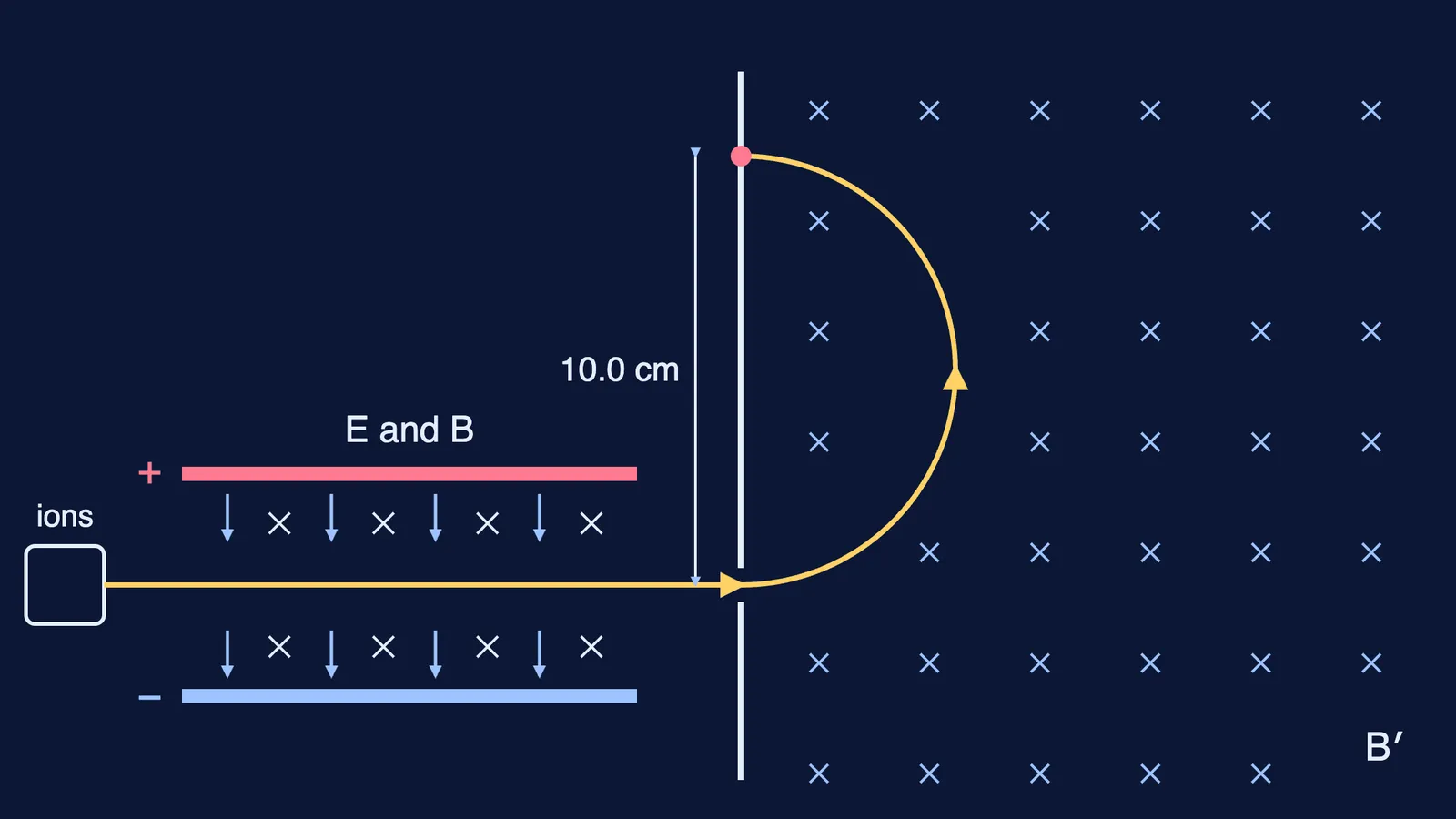
Q8 (hard). Singly charged positive ions pass undeflected through crossed fields, E = 2.0 × 10⁴ V/m and B = 0.20 T. They then enter a uniform field B′ = 0.50 T alone, perpendicular to their velocity, and strike a detector 10.0 cm from the entry slit after half a circle. What is the ions' mass number?
Answer: 24. Undeflected means qE = qvB, so v = E/B = 1.0 × 10⁵ m/s. The detector is a diameter away, so r = 5.0 cm. m = qB′r/v = (1.6 × 10⁻¹⁹ × 0.50 × 0.050)/(1.0 × 10⁵) = 4.0 × 10⁻²⁶ kg, which is 23.95 u, so the mass number is 24.
Trap: 48, from taking the 10.0 cm as the radius.
For more mixed practice, try our Magnetism JEE Main practice questions with full solutions.
How do you get the number right in magnetism?
Convert cm, mm, μT and mA to SI units before substituting.
Match the formula to the shape: long wire μ₀I/(2πr), loop centre μ₀I/(2R), finite segment μ₀I/(4πd)(sin α + sin β), solenoid μ₀nI.
Measure torque angles from the magnetic moment, which is the coil's normal or the solenoid's axis.
Check what is asked: degrees or radians, mN m or N m, radius or diameter.
Carry unrounded values (0.0866 m, 23.95 u); round only the final answer.
Not sure which step slipped? The Fermi Problem Library has worked problems with a step-by-step solver that explains the reasoning rather than printing an answer.


