

On this page
After our first set of limits, continuity and differentiability practice questions with solutions, try these eight original medium-to-hard questions. None repeats the first set.
What does JEE Main 2027 test in this chapter?
Unit 7 of NTA's JEE (Main) 2027 syllabus lists "Limits, continuity and differentiability", the differentiation of inverse trigonometric, composite and implicit functions, and "derivatives of order upto two".
The JEE (Main) 2027 Information Bulletin gives Mathematics 20 MCQs and 5 numerical-value questions in Paper 1. A correct MCQ earns +4 and a wrong one −1, so choosing the trap over the answer costs five marks.
Medium: can you see past the first-order shortcut?
Q1. The limit as x → 0 of (x tan 2x − 2x tan x)/(1 − cos 2x)² is: (A) 2 (B) 1/2 (C) 0 (D) 1/4
Answer: (B). With tan u = u + u³/3 + …, x tan 2x − 2x tan x = (2x² + 8x⁴/3) − (2x² + 2x⁴/3) = 2x⁴. The denominator is (2 sin²x)², about 4x⁴, so the limit is 1/2. Trap: (C) replaces tan u by u, which cancels everything.
Q2. The limit as x → π/4 of (tan x)^(tan 2x) is: (A) 1 (B) e (C) 1/e (D) e²
Answer: (C). This is 1^∞, so the limit is e^L with L = lim (tan x − 1) tan 2x. With t = tan x, tan 2x = 2t/(1 − t²), so L = lim −2t/(1 + t) = −1. Trap: (A) treats 1^∞ as 1. Check: just below π/4, a number below 1 is raised to a large positive power.
Q3. f(x) = (e^(ax) − 1)/sin 2x for x < 0, f(0) = b, and f(x) = ln(1 + 3x)/x for x > 0. If f is continuous at 0, a + b equals: (A) 9 (B) 6 (C) 4.5 (D) 7.5
Answer: (A). The left limit is a/2 and the right limit is 3, so b = 3 and a = 6. Trap: (C) takes the left limit as 2a, giving a = 1.5.
Q4. If f(2) = 3 and f′(2) = 4, the limit as h → 0 of [f(2 + 3h) − f(2 − h)]/h is: (A) 8 (B) 16 (C) 12 (D) 4
Answer: (B). f(2 + 3h) ≈ 3 + 12h and f(2 − h) ≈ 3 − 4h, so the difference is 16h. Trap: (A) uses the step 3h − h = 2h instead of the span 4h.
Hard: can you mix differentiability with other chapters?
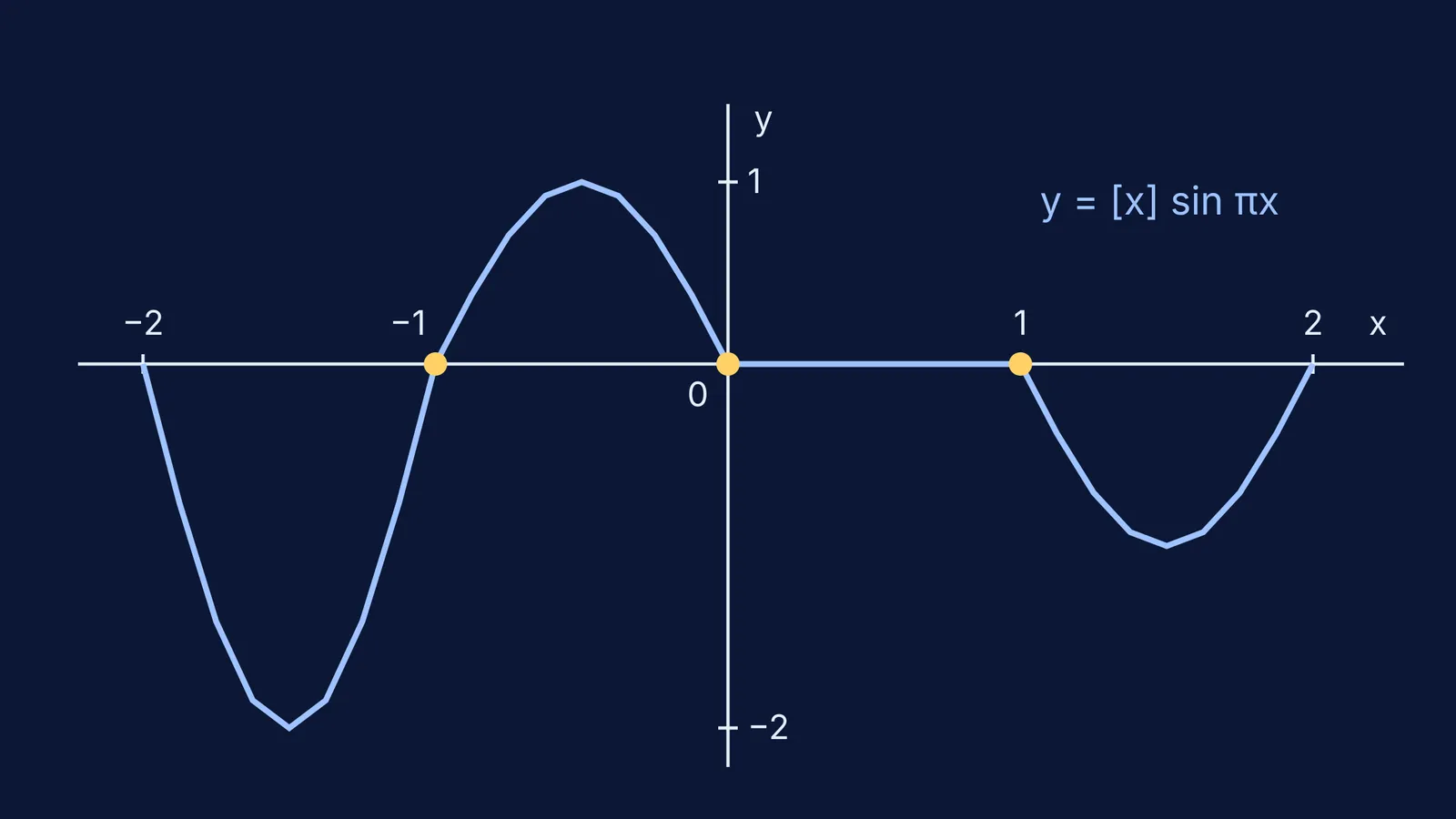
Q5. With [·] the greatest integer function, f(x) = [x] sin πx on (−2, 2) is: (A) discontinuous at x = −1, 0, 1 (B) continuous, and not differentiable at exactly 3 points (C) continuous, and not differentiable at exactly 2 points (D) differentiable everywhere
Answer: (B). sin πx is 0 at every integer, so f is continuous. At an integer n the slopes are (n − 1)π cos nπ on the left and nπ cos nπ on the right, which always differ, so f fails at −1, 0 and 1. Trap: (C) skips 0, forgetting [x] = −1 just left of 0.
Q6. If y = sin⁻¹(2x√(1 − x²)), dy/dx at x = 0.8 is: (A) 10/3 (B) −10/3 (C) 5/3 (D) −5/3
Answer: (B). Put x = sin θ. Since 0.8 > 1/√2, 2θ lies beyond π/2, so y = π − 2 sin⁻¹x and dy/dx = −2/√(1 − x²) = −2/0.6. Trap: (A) uses y = 2 sin⁻¹x, true only for |x| ≤ 1/√2.
Q7. If x = t² and y = t³, then d²y/dx² at t = 1 is: (A) 3/2 (B) 3/4 (C) 3 (D) 3/8
Answer: (B). dy/dx = 3t/2. Differentiate with respect to t and divide by dx/dt = 2t: (3/2)/(2t) = 3/4. Trap: (A) forgets the division. Check: y = x^(3/2), so y″ = (3/4)x^(−1/2) = 3/4 at x = 1.
Q8. Let f(x) = lim as n → ∞ of (x^(2n) − 1)/(x^(2n) + 1) and g(x) = (x² − 1) f(x). Then g is: (A) discontinuous at x = ±1 (B) continuous everywhere, not differentiable at x = ±1 (C) differentiable everywhere (D) not differentiable only at x = 0
Answer: (B). f = −1 for |x| < 1, 0 at |x| = 1 and 1 for |x| > 1, so g(x) = |x² − 1|, with corners at ±1 (slopes −2 and +2 either side of x = 1). Trap: (A) carries f's jumps over to g, but x² − 1 is 0 exactly there.
How should you use this second set?
Do all eight in one timed sitting, without notes.
Label each miss with its trap: stopped expanding too early, 1^∞ read as 1, wrong branch of sin⁻¹, or a lost division by dx/dt.
Then try our eight numerical-value questions on this chapter, and see how to prepare limits, continuity and differentiability for JEE Main.
If you can follow a solution but could not have started it, the Fermi Problem Library has a step-by-step solver that explains the reasoning. Fermi Test Prep is our hub for JEE Main and Advanced preparation.


