

On this page
Lead can be extracted without coke. Heat galena, PbS, in a limited supply of air, then shut the air off and keep heating, and the ore reduces itself to molten lead. The JEE Advanced syllabus lists this as the self-reduction (or auto-reduction) method, with copper and lead as its examples. The chapter on isolation of metals was dropped from the rationalised NCERT Class 12 book, so many students now meet it only in coaching notes. Here is the lead half, with the numbers.
What is galena and how is it concentrated?
Galena is lead(II) sulphide, PbS, the main ore of lead. Like other sulphide ores, it is concentrated by froth flotation: the sulphide grains stick to oily air bubbles and rise in the froth, while the rocky gangue is wetted by water and sinks. The skimmed, dried froth goes to the furnace.
Why is galena roasted only partly?
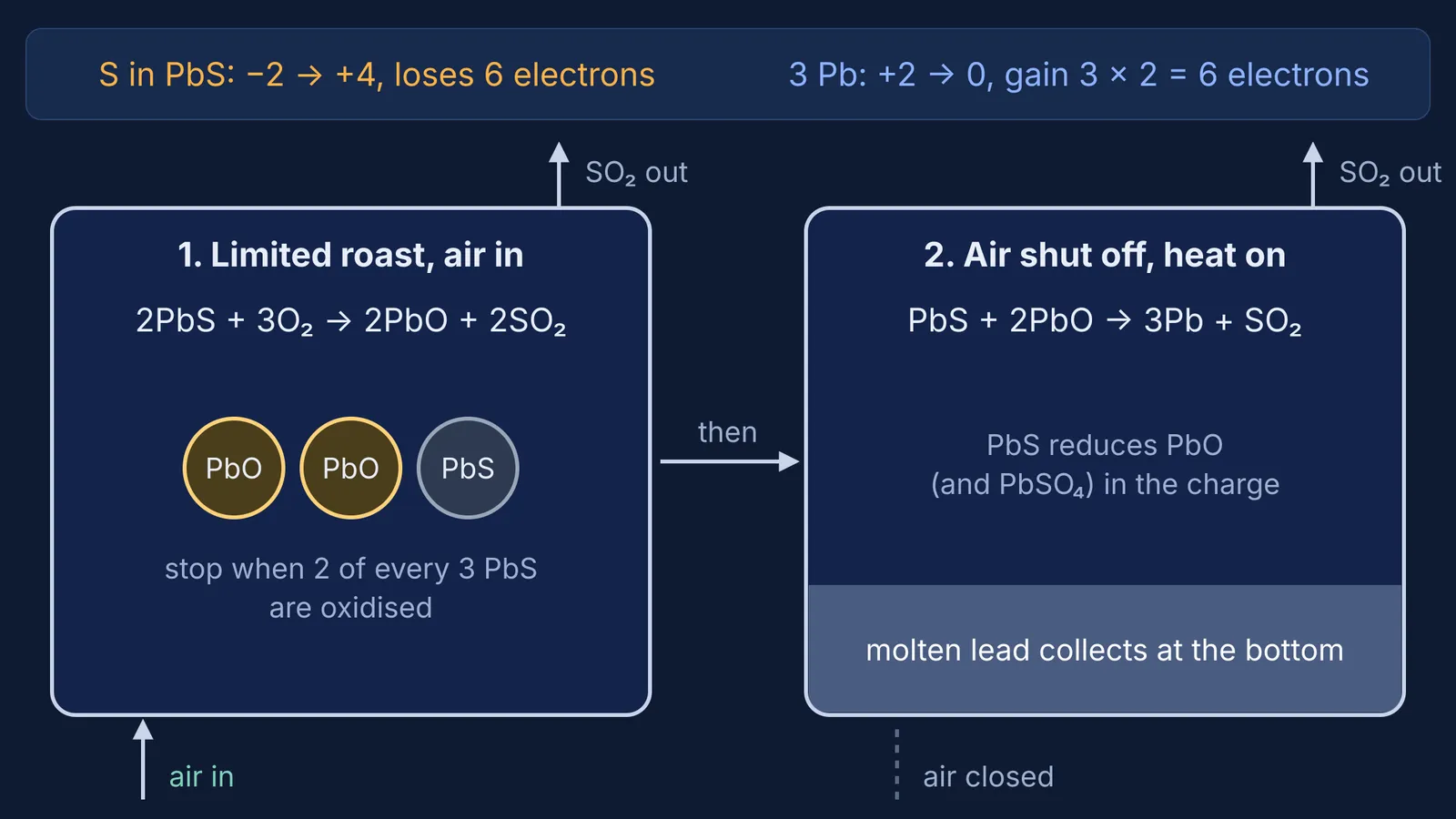
In the first stage, the concentrate is heated in a controlled, limited supply of air. Part of the PbS is oxidised to lead(II) oxide:
2PbS + 3O₂ → 2PbO + 2SO₂
Some of the sulphide is oxidised further, to lead(II) sulphate:
PbS + 2O₂ → PbSO₄
The key word is partly. The PbS that is not roasted is the reducing agent for the next stage. If you roasted all of it, nothing would be left to reduce the oxide, and you would have to add carbon. The overall equation (below) shows that two of every three PbS units should be roasted to PbO, leaving one to do the reducing.
How does PbS reduce PbO to lead?
In the second stage, the air is shut off and the temperature is raised. The unroasted sulphide now reacts with the oxide and the sulphate:
PbS + 2PbO → 3Pb + SO₂
PbS + PbSO₄ → 2Pb + 2SO₂
Lead melts at about 327 °C, so it forms as a dense liquid that runs to the bottom of the furnace and is tapped off.
Add the roast and the self-reduction and the intermediates cancel:
PbO route: 2PbS + 3O₂ → 2PbO + 2SO₂, plus PbS + 2PbO → 3Pb + SO₂, gives 3PbS + 3O₂ → 3Pb + 3SO₂.
PbSO₄ route: PbS + 2O₂ → PbSO₄, plus PbS + PbSO₄ → 2Pb + 2SO₂, gives 2PbS + 2O₂ → 2Pb + 2SO₂.
Both simplify to the same net change: PbS + O₂ → Pb + SO₂. Some books show only the PbO equation and some show both; learn both. The pattern is the same as in the self-reduction of copper matte, where 2Cu₂O + Cu₂S → 6Cu + SO₂.
Why does the second stage need a hot furnace?
A rough estimate from standard 298 K data (approximate; tables differ slightly) explains it. For PbS + 2PbO → 3Pb + SO₂, ΔH° is about +242 kJ mol⁻¹, so the reaction is endothermic. But three solids give three solids and a gas, so ΔS° is large and positive, about +218 J K⁻¹ mol⁻¹. ΔG° = ΔH° − TΔS° becomes negative above roughly 242 000 ÷ 218 ≈ 1100 K. This ignores melting and the drift of ΔH and ΔS with temperature, but the point stands: the escaping gas drives the reaction, and only when it is hot.
Worked example 1: does the electron count balance?
Check PbS + 2PbO → 3Pb + SO₂ as a redox equation.
Assign oxidation numbers. In PbS: Pb +2, S −2. In PbO: Pb +2, O −2. In Pb: 0. In SO₂: S +4, O −2.
Sulphur goes from −2 to +4, so it loses 6 electrons.
Three Pb atoms (one from PbS, two from PbO) go from +2 to 0. Each gains 2 electrons, so 6 in total.
Electrons lost = electrons gained = 6. Oxygen does not change.
Atoms: Pb 3 = 3, S 1 = 1, O 2 = 2. The equation balances.
So the reducing agent is the sulphur of PbS, not carbon. Now the sulphate version, PbS + PbSO₄ → 2Pb + 2SO₂:
S in PbS: −2 to +4, loses 6 electrons.
S in PbSO₄: +6 to +4, gains 2 electrons.
Two Pb: +2 to 0, gain 4 electrons.
Gained: 2 + 4 = 6. Lost: 6. Atoms: Pb 2, S 2, O 4 on each side.
If a step like this keeps tripping you up, the Fermi Problem Library has a step-by-step solver that explains the reasoning, not just the balanced equation.
Worked example 2: how much lead and SO₂ from a tonne of PbS?
Take 1.00 t (1.00 × 10⁶ g) of pure PbS. Use Pb = 207.2, S = 32.06, O = 16.00.
Molar masses: PbS = 239.26 g mol⁻¹, SO₂ = 64.06 g mol⁻¹, O₂ = 32.00 g mol⁻¹.
Moles of PbS: 1.00 × 10⁶ ÷ 239.26 = 4180 mol.
The net equation PbS + O₂ → Pb + SO₂ is 1 : 1 : 1 : 1.
Lead: 4180 × 207.2 g = 866 kg.
SO₂: 4180 × 64.06 g = 268 kg.
Oxygen used: 4180 × 32.00 g = 134 kg.
Mass check: 1000 + 134 = 866 + 268 = 1134 kg.
Split by stage (PbO route): two thirds of the PbS, about 667 kg, is roasted and releases about 178 kg of SO₂; the self-reduction releases the other 89 kg.
A real concentrate is not pure PbS, so it gives less.
How is self-reduction different from carbon reduction of PbO?
The other route roasts the galena fully, 2PbS + 3O₂ → 2PbO + 2SO₂, and then reduces the oxide with coke:
PbO + C → Pb + CO
PbO + CO → Pb + CO₂
Many lead smelters work this way, in a blast furnace. In an exam, if the question names self-reduction or auto-reduction, give the PbS + PbO and PbS + PbSO₄ equations; if it asks about carbon, give these. For practice at picking the right method for each metal, try these solved metallurgy questions for JEE Advanced.
A school lab gets lead a different way, by passing current through molten PbBr₂, as in electrolysis of molten lead bromide. That is useful for learning electrode reactions but is not how lead is extracted from its ore.
Why is lead smelting a pollution problem?
Every route above makes SO₂, which causes acid rain if released, so modern smelters collect it and turn it into sulphuric acid. Lead is toxic too: furnace fumes and dust can reach workers and settle around the plant, so smelters need filters and enclosed furnaces.
Quick checklist
Ore: galena, PbS. Concentrate by froth flotation.
Stage 1, partial roast in limited air: 2PbS + 3O₂ → 2PbO + 2SO₂ (some PbS → PbSO₄).
Stage 2, air shut off: PbS + 2PbO → 3Pb + SO₂ and PbS + PbSO₄ → 2Pb + 2SO₂.
Net: PbS + O₂ → Pb + SO₂. Two of every three PbS are roasted.
Electrons: S −2 → +4 loses 6; three Pb +2 → 0 gain 6.
One tonne of PbS gives about 866 kg of lead and 268 kg of SO₂.
Carbon route: PbO + C → Pb + CO. Both routes produce SO₂ that must be captured.


