

On this page
Isotope questions on carboxylic acids look hard but test one idea: which carbon leaves. If you label the carboxyl carbon with ¹³C or ¹⁴C and then make CO₂, the label tells you whether that CO₂ came from the acid or from somewhere else. In some reactions the acid's own carbon leaves. In the most familiar one, the NaHCO₃ test, it does not move at all. This post shows how to decide in each case.
Why does the CO₂ in the NaHCO₃ test come from the bicarbonate?
When a carboxylic acid fizzes with sodium bicarbonate, the acid only supplies H⁺:
RCOOH + NaHCO₃ → RCOONa + H₂O + CO₂
The real change is H⁺ + HCO₃⁻ → H₂CO₃ → H₂O + CO₂.
No bond to the carboxyl carbon breaks, and the acid's carbon chain is untouched. The CO₂ is made from the bicarbonate. A labelling experiment shows it directly: CH₃COOH + NaH¹³CO₃ gives ¹³CO₂, while the acid's carbons stay in sodium acetate.
So do not say the acid "is decarboxylated" by NaHCO₃. It is only neutralised. One small caution: in water, dissolved CO₂, H₂CO₃ and HCO₃⁻ slowly exchange carbon with one another. They never exchange with the acid's carboxyl carbon, though, so CO₂ collected promptly, on the time scale of the test, carries the bicarbonate's label. Which compounds give this test in the first place is covered in which compounds react with Na, NaOH and NaHCO₃.
Where does the carboxyl carbon go in soda-lime decarboxylation?
Heating a sodium carboxylate with soda lime (NaOH with CaO) breaks the C–C bond between R and the carboxyl group. R picks up a hydrogen and the carboxyl carbon leaves:
R¹⁴COONa + NaOH → R–H + Na₂¹⁴CO₃
Two points to notice. The label ends up in sodium carbonate, a solid left in the tube, not in a gas. In a mixture full of NaOH, any CO₂ would be trapped as carbonate anyway. And the alkane has one carbon fewer than the acid, with none of its carbons labelled. For example, C₆H₅¹⁴COONa + NaOH → C₆H₆ + Na₂¹⁴CO₃. The "one carbon fewer" pattern is shown in preparing benzene from sodium benzoate and phenol; the label simply tells you which carbon that is.
Which other reactions lose the carboxyl carbon as CO₂?
The same carbon leaves whenever the R–COO bond breaks.
Kolbe electrolysis. At the anode, 2RCOO⁻ → R–R + 2CO₂ + 2e⁻. The two R groups join; both carboxyl carbons leave as CO₂. At the cathode, 2H₂O + 2e⁻ → H₂ + 2OH⁻.
Hunsdiecker reaction. RCOOAg + Br₂ → R–Br + CO₂ + AgBr. The carboxyl carbon leaves as CO₂ and bromine takes its place.
β-keto acids. On warming, CH₃COCH₂COOH → CH₃COCH₃ + CO₂. The COOH carbon leaves; the ketone keeps the other three carbons.
Malonic acid. HOOC–CH₂–COOH → CH₃COOH + CO₂ on heating. Either carboxyl can leave. If only one of them is labelled, about half the molecules lose the labelled carbon (ignoring the small isotope effect).
The rule: if the acid turns into R–H, R–R or R–X plus CO₂ or carbonate, the carboxyl carbon is the one that leaves. If the acid only neutralises a carbonate or bicarbonate, the CO₂ belongs to the carbonate.
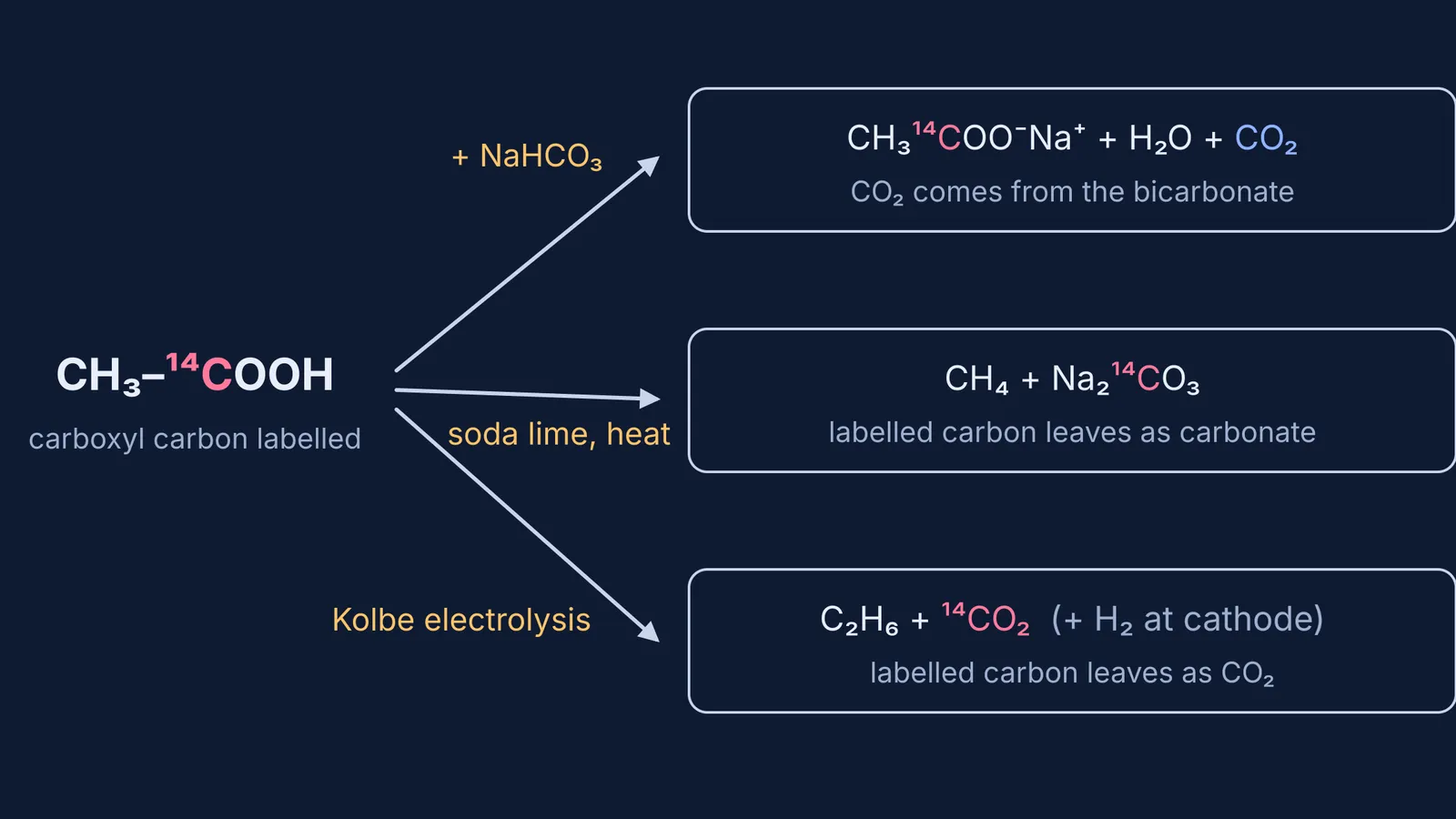
Worked example: CH₃¹⁴COOH three ways
Question: acetic acid labelled at the carboxyl carbon, CH₃¹⁴COOH, is (a) treated with NaHCO₃, (b) converted to its sodium salt and heated with soda lime, (c) converted to its sodium salt and electrolysed (Kolbe). Where does ¹⁴C end up each time?
(a) NaHCO₃. CH₃¹⁴COOH + NaHCO₃ → CH₃¹⁴COONa + H₂O + CO₂. No C–C bond breaks. The label stays in sodium acetate in solution. The gas is ordinary CO₂, molar mass about 44 g/mol.
(b) Soda lime. CH₃¹⁴COONa + NaOH → CH₄ + Na₂¹⁴CO₃. The C–C bond breaks. Methane is unlabelled; the label sits in the solid sodium carbonate. If you later add acid to that residue, Na₂¹⁴CO₃ + 2HCl → 2NaCl + H₂O + ¹⁴CO₂, and only then does the label appear as a gas.
(c) Kolbe. Overall: 2CH₃¹⁴COONa + 2H₂O → CH₃–CH₃ + 2¹⁴CO₂ + H₂ + 2NaOH. Ethane is unlabelled. The label leaves at the anode as ¹⁴CO₂, molar mass about 46 g/mol instead of 44. Some of that CO₂ can dissolve in the NaOH formed at the cathode, but it is still the old carboxyl carbon.
Check the equations. Count atoms on both sides of each one. In (c), for example, there are 4 C, 10 H, 6 O and 2 Na on each side.
Twist: label the methyl carbon instead. With ¹⁴CH₃COOH, (a) keeps the label in acetate, (b) gives ¹⁴CH₄ with unlabelled carbonate, and (c) gives ¹⁴CH₃–¹⁴CH₃ with both ethane carbons labelled and unlabelled CO₂.
How is this like the ¹⁸O test for ester hydrolysis?
It is the same tracer logic with a different atom. In ester hydrolysis, labelling the ester oxygen with ¹⁸O shows which C–O bond breaks: the label stays with the alcohol, so the acyl–oxygen bond is the one that breaks. That experiment is explained in acid vs base hydrolysis of esters and the ¹⁸O test. In both cases the question is never "what are the products?" alone. It is "which bond broke, and so where did each atom go?"
If tracer questions still feel slippery, the Fermi Problem Library has a step-by-step solver that explains the reasoning, including which bond breaks at each step.
Which mistakes cost marks here?
Saying the acid's carbon ends up in the CO₂ from the NaHCO₃ test.
Writing CO₂ gas as the product of soda-lime decarboxylation. The product is Na₂CO₃.
Labelling the alkane in soda-lime or Kolbe reactions when only the carboxyl carbon was labelled.
Forgetting that Kolbe electrolysis joins two R groups, so a methyl label appears twice in ethane.
Quick checklist
NaHCO₃ test: the acid gives H⁺; the CO₂ comes from the bicarbonate.
Soda lime: the carboxyl carbon leaves as Na₂CO₃; R–H keeps the rest.
Kolbe, Hunsdiecker and β-keto acids: the carboxyl carbon leaves as CO₂.
Ask which bond breaks before deciding where the label goes.
Labelled CO₂ is heavier: ¹³CO₂ about 45, ¹⁴CO₂ about 46, ordinary CO₂ about 44 g/mol.


