

On this page
This is set 2 of our Kinetic Theory practice for NEET; it follows set 1 of kinetic theory NEET practice questions, which covered rms speed ratios, mean free path and isothermal work. These 8 new questions test what set 1 left out: when a gas is ideal, gas density, Avogadro's hypothesis, pressure from molecular motion, mixing gases, Cp − Cv per kilogram, constant-pressure compression and the specific heat of solids.
The gas questions sit in Physics Unit 9 of the NEET (UG)-2026 syllabus (Q8's solid uses specific heat capacity, Unit 7), and all eight are in NCERT Class 11 Physics, Chapter 12, Kinetic Theory (Reprint 2026-27), with compression work from Chapter 11, Thermodynamics. Take R = 8.3 J mol⁻¹ K⁻¹.
How should you use this set?
As in NEET-UG 2026, each question has four options and one correct answer, scored +4 if right and −1 if wrong, per the NTA information bulletin.
Cover the answers and give yourself 8 minutes for all 8.
Check each answer and its trap line, then note which trap caught you.
If the formulas feel shaky, read our guide on how to prepare Kinetic Theory of Gases for NEET first.
Easy: do you know the ideal gas law in all its forms?
Q1 (easy). Under which conditions does a real gas behave most like an ideal gas?
(A) High pressure, low temperature (B) Low pressure, high temperature (C) High pressure, high temperature (D) Low pressure, low temperature
Answer: (B). NCERT Section 12.3 explains that at low pressure and high temperature the molecules are far apart, so their interactions are negligible. Trap: (D) gets the pressure right, but near its liquefying temperature a gas strays from ideal behaviour.
Q2 (easy). What is the density of carbon dioxide (M = 44 g/mol) at 2.0 × 10⁵ Pa and 127 °C?
(A) 0.38 kg/m³ (B) 2.65 kg/m³ (C) 8.35 kg/m³ (D) 2650 kg/m³
Answer: (B). From P = ρRT/M, ρ = PM/RT = (2.0 × 10⁵ × 0.044)/(8.3 × 400) = 2.65 kg/m³. Trap: (C) leaves T as 127; (D) keeps M in grams; (A) is RT/PM, the volume per kilogram.
Q3 (easy). Two identical flasks at the same temperature and pressure hold hydrogen (M = 2 g/mol) and oxygen (M = 32 g/mol). What is the ratio of the mass of oxygen to the mass of hydrogen?
(A) 1 (B) 4 (C) 8 (D) 16
Answer: (D). By Avogadro's hypothesis, equal volumes at the same T and P hold equal numbers of molecules, so the mass ratio is the molar-mass ratio, 32/2 = 16. Trap: (A) is the ratio of molecule numbers, not masses; (B) takes a square root that belongs to speed questions.
Medium: can you go from molecules to pressure and heat capacity?
Q4 (medium). Gas B's molecules are 4 times as heavy as gas A's, have half the rms speed, and are twice as many per cubic metre. What is P_B / P_A?
(A) 1/2 (B) 1 (C) 2 (D) 4
Answer: (C). P = (1/3)nmv², so the ratio is 2 × 4 × (1/2)² = 2. Trap: (D) halves the speed without squaring it; (B) forgets the number density.
Q5 (medium). A 2.0 L flask of nitrogen at 3.0 × 10⁵ Pa and a 3.0 L flask of oxygen at 1.0 × 10⁵ Pa, both at the same temperature, are joined by a thin tube of negligible volume. Once the gases have mixed at that temperature, what is the total pressure?
(A) 1.8 × 10⁵ Pa (B) 2.0 × 10⁵ Pa (C) 2.2 × 10⁵ Pa (D) 4.0 × 10⁵ Pa
Answer: (A). Each gas now fills 5.0 L, so nitrogen's partial pressure is 3.0 × 10⁵ × 2/5 = 1.2 × 10⁵ Pa and oxygen's is 1.0 × 10⁵ × 3/5 = 0.6 × 10⁵ Pa. Dalton's law of partial pressures (NCERT Section 12.3) adds them: 1.8 × 10⁵ Pa. Trap: (B) averages the two pressures; (C) swaps the volumes; (D) adds the starting pressures as if each gas still had its own flask.
Q6 (medium). For a gas of rigid molecules, the specific heats are c_v = 650 J kg⁻¹ K⁻¹ and c_p = 910 J kg⁻¹ K⁻¹. Which gas could it be?
(A) Helium (B) Nitrogen (C) Oxygen (D) Carbon dioxide
Answer: (C). Per kilogram, c_p − c_v = R/M, so M = 8.3/260 = 0.032 kg/mol. Also γ = 910/650 = 1.4, which fits a diatomic gas. Oxygen matches both. Trap: (B) has γ = 1.4 too, but nitrogen's R/M is about 296, not 260.
Hard: compression work and the specific heat of solids
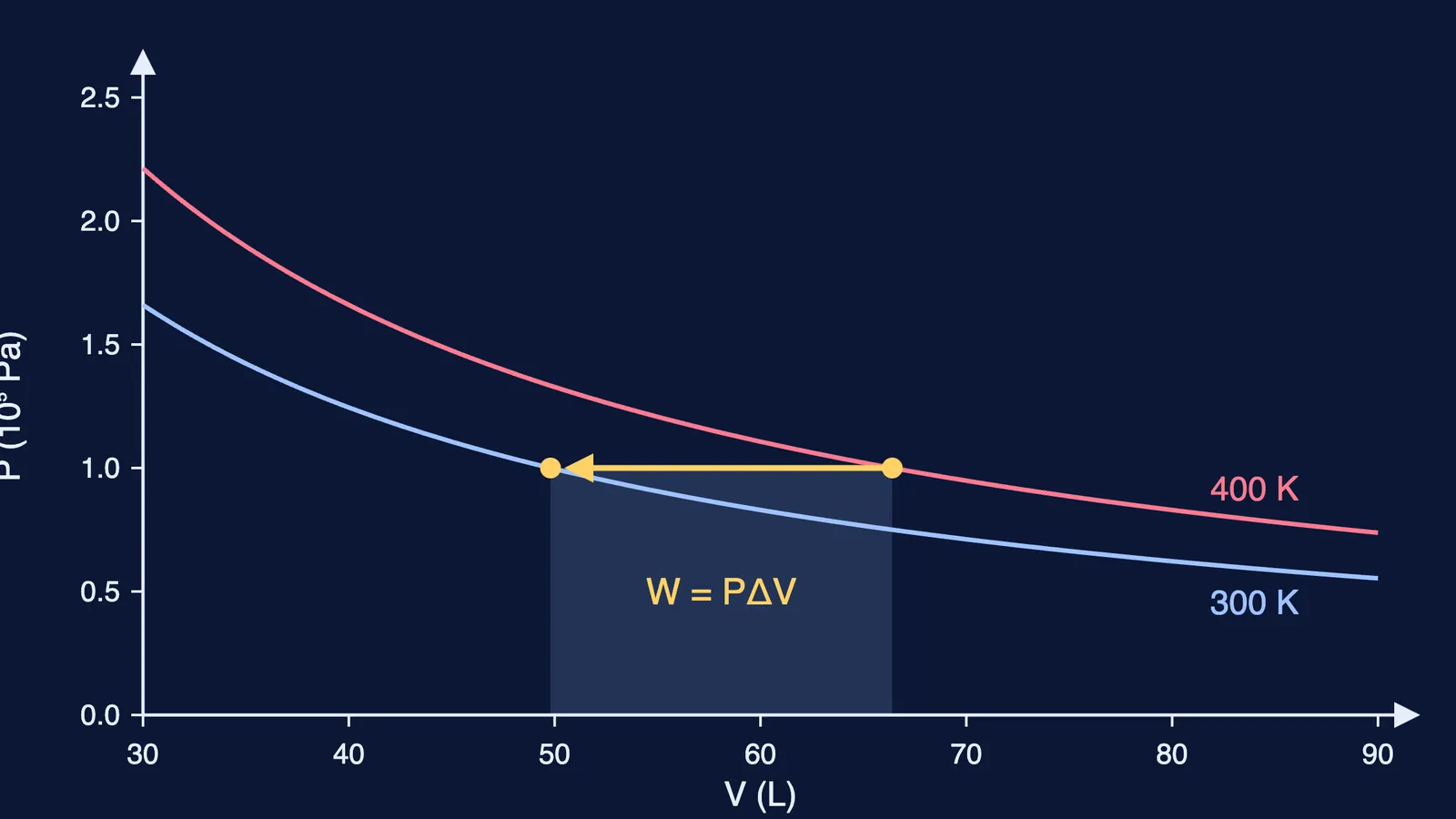
Q7 (hard). Two moles of a rigid diatomic ideal gas at 1.0 × 10⁵ Pa are cooled at constant pressure from 400 K to 300 K. How much heat is removed, and how much work is done on the gas?
(A) 5810 J removed, 1660 J on the gas (B) 4150 J removed, 1660 J on the gas (C) 5810 J removed, 4150 J on the gas (D) 4150 J removed, no work
Answer: (A). Heat = nC_pΔT = 2 × (7/2) × 8.3 × 100 = 5810 J. Work on the gas = PΔV = nRΔT = 2 × 8.3 × 100 = 1660 J, the shaded area in the graph above (66.4 L to 49.8 L). Trap: (B) uses C_v, which applies only at constant volume.
Q8 (hard). The same small amount of heat is given to 1 mol of a metal at room temperature and, separately, to 1 mol of a rigid diatomic gas at constant pressure. What is ΔT_metal / ΔT_gas?
(A) 5/6 (B) 6/7 (C) 7/6 (D) 7/3
Answer: (C). By equipartition, NCERT Section 12.6.4 gives a solid C = 3R: each atom vibrates in three directions with k_BT each. ΔT ∝ 1/C, so the ratio is C_p(gas)/C(solid) = (7/2)R/3R = 7/6. Trap: (A) uses the gas's C_v; (D) gives the solid only (3/2)R, as if its atoms were a monatomic gas.
What should you do after this set?
Score yourself at +4 and −1. If the same trap shows up twice, our list of kinetic theory mistakes in JEE and NEET explains how to stop making it. For more practice with each method, the Fermi Problem Library has worked problems with a step-by-step solver that explains the reasoning rather than printing an answer.


