

On this page
This is the second kinetic theory set; it follows set 1 of our JEE Main kinetic theory practice questions and covers what set 1 skipped: the rms average itself, a P-T graph, atoms hitting a wall at an angle, gas mixtures, bulk motion turning into heat and energy shared between two gases.
Every question is original and sits inside Unit 9, Kinetic Theory of Gases, of NTA's Syllabus for JEE (Main) - 2027. The theory is NCERT Class 11 Physics Chapter 12, Kinetic Theory (Reprint 2026-27), with the first law from Chapter 11, Thermodynamics. Take R = 8.3 J mol⁻¹ K⁻¹.
How should you use this practice set?
Hide the answers; allow 16 minutes.
Q6 is numerical-value: write a number, not a letter.
Commit to an option, then read the trap line even when right.
Redo every question that caught you after three days.
New to the chapter? Start with how to prepare Kinetic Theory of Gases for JEE Main.
Easy: can you read the gas equation and the rms average?
Q1 (easy). Four gas molecules have speeds of 200, 400, 500 and 700 m/s. What is their rms speed?
(A) 450 m/s (B) 485 m/s (C) 560 m/s (D) 970 m/s
Answer: (B). Root mean square means square, average, then root: v_rms = √[(200² + 400² + 500² + 700²)/4] = √235000 = 485 m/s. Trap: (A) is the plain mean speed; (C) divides by 3 instead of 4; (D) forgets to divide by 4 at all.
Q2 (easy). An open flask of air is heated from 27 °C to 177 °C while the pressure stays at 1 atm. What fraction of the air molecules originally inside leaves the flask?
(A) 1/3 (B) 2/3 (C) 0.85 (D) 1/2
Answer: (A). With P and V fixed, PV = μRT makes μT constant, so μ₂/μ₁ = 300/450 = 2/3. One third of the molecules leave. Trap: (B) is the fraction that stays; (C) uses Celsius; (D) divides the temperature rise by the initial temperature.
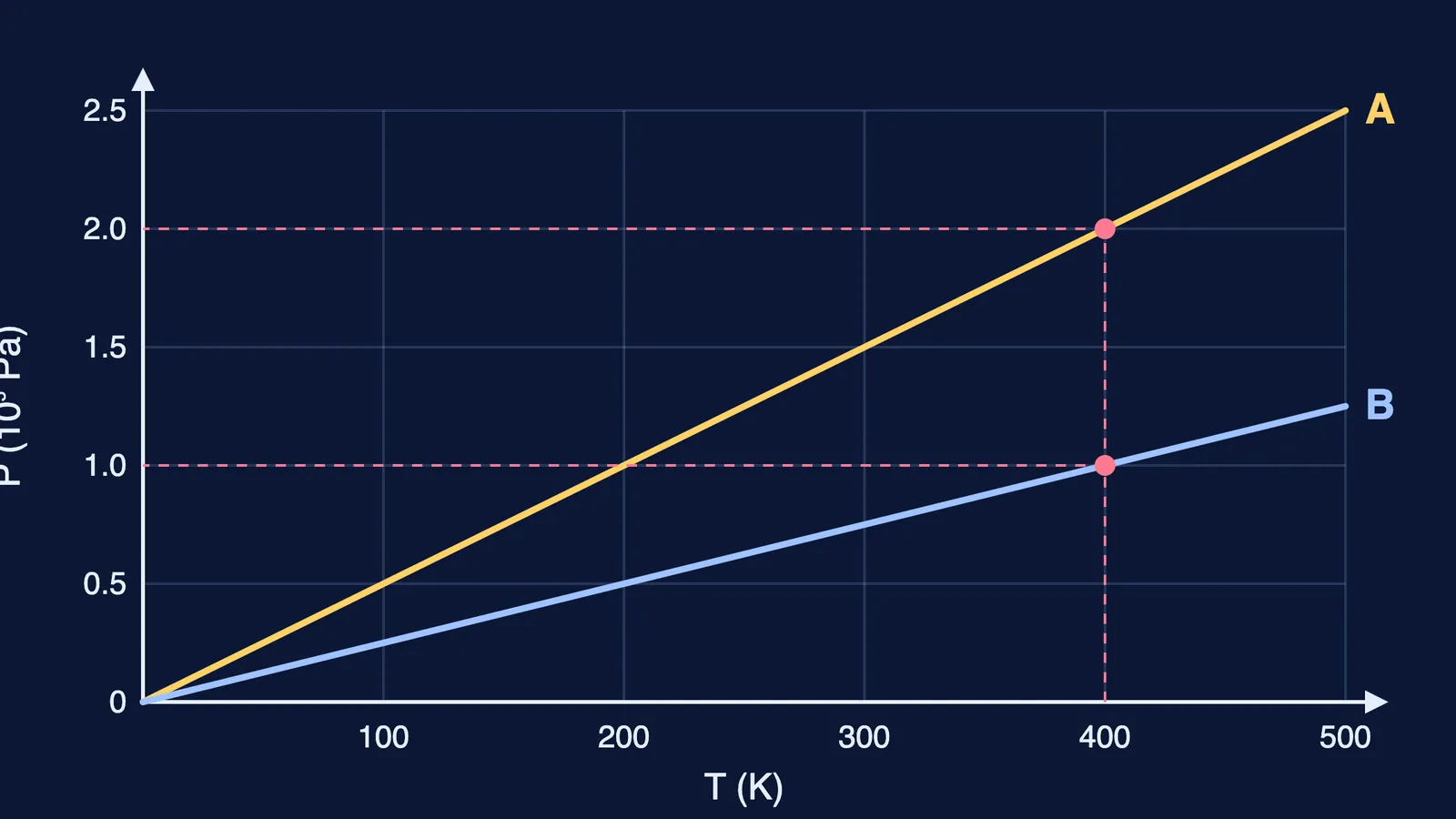
Q3 (easy). Two rigid vessels, A with 2 mol and B with 3 mol of the same ideal gas, are heated. Their P-T graphs are straight lines through the origin. At 400 K, A is at 2.0 × 10⁵ Pa and B at 1.0 × 10⁵ Pa. What is V_A/V_B?
(A) 1/2 (B) 1/3 (C) 4/3 (D) 3
Answer: (B). Each slope is μR/V, so V = μRT/P. V_A/V_B = (2/2.0)/(3/1.0) = 1/3. Trap: (A) compares slopes but ignores the different amounts of gas; (D) inverts the ratio.
Medium: can you link molecular motion to pressure and heat?
Q4 (medium). A beam of helium atoms, each of mass 6.6 × 10⁻²⁷ kg and speed 1200 m/s, strikes a wall at 37° to the normal and rebounds elastically. The wall feels a 0.038 N force. How many atoms hit the wall each second? (Take cos 37° = 0.8.)
(A) 2.4 × 10²¹ (B) 3.0 × 10²¹ (C) 4.0 × 10²¹ (D) 6.0 × 10²¹
Answer: (B). As in NCERT's pressure derivation, only the normal component reverses, so each atom delivers 2mv cos 37° = 2 × 6.6 × 10⁻²⁷ × 1200 × 0.8 = 1.27 × 10⁻²³ kg m/s. Rate = force ÷ momentum per hit = 0.038 / (1.27 × 10⁻²³) = 3.0 × 10²¹ per second. Trap: (C) uses sin 37°; (D) drops the factor 2 of the rebound; (A) ignores the angle.
Q5 (medium). A mixture holds 3 mol of argon and 1 mol of hydrogen, with hydrogen treated as rigid molecules. What is γ = Cp/Cv for the mixture?
(A) 1.53 (B) 1.57 (C) 1.60 (D) 1.67
Answer: (B). By equipartition (NCERT Section 12.5), Cv(mix) = (3 × 3R/2 + 1 × 5R/2)/4 = 7R/4, so Cp = 11R/4 and γ = 11/7 = 1.57. Trap: (C) takes the mole-weighted average of 5/3 and 7/5; (A) averages them without weights.
Q6 (medium, numerical value). A thermally insulated box of argon (M = 40 g/mol) moves at 100 m/s and is suddenly stopped. If all the bulk kinetic energy of the gas becomes internal energy, by how many kelvin does its temperature rise (nearest integer)?
Answer: 16. Per mole, (1/2)Mv² = (3/2)RΔT for a monatomic gas, so ΔT = Mv²/(3R) = 0.040 × 100²/(3 × 8.3) = 16.1 K. Trap: 10 uses the diatomic 5/2; 32 drops the 1/2 in the kinetic energy.
Hard: can you handle a new process and shared energy?
Q7 (hard). One mole of a rigid diatomic ideal gas goes through a process in which P is directly proportional to V. How much heat must it absorb for its temperature to rise by 40 K?
(A) 664 J (B) 830 J (C) 996 J (D) 1162 J
Answer: (C). With P = aV, the work done by the gas is the area under the line: a(V₂² − V₁²)/2 = (P₂V₂ − P₁V₁)/2 = RΔT/2. The first law, ΔQ = ΔU + ΔW from NCERT Chapter 11, gives ΔQ = (5R/2 + R/2)ΔT = 3R × 40 = 996 J. Trap: (B) is ΔU alone, as if the volume were fixed; (D) assumes constant pressure; (A) subtracts the work instead of adding it.
Q8 (hard). An insulated vessel holds 2 mol of helium at 300 K; a second holds 1 mol of oxygen (rigid) at 600 K. They are joined by a valve and the gases mix without doing outside work. What is the final temperature?
(A) 400 K (B) 424 K (C) 436 K (D) 450 K
Answer: (C). Total internal energy is conserved: 2(3R/2)(300) + 1(5R/2)(600) = (3R + 5R/2)T, so T = 2400/5.5 = 436 K. Trap: (A) averages by moles, as if both gases had the same Cv; (B) uses Cp; (D) is the plain average.
What should you do after this set?
Sort each miss into a bin: wrong average (Q1), wrong quantity held fixed (Q2, Q3, Q7), lost geometry factor (Q4) or energy bookkeeping (Q5, Q6, Q8). If you keep reaching the right numbers by the wrong method, the Fermi Problem Library has worked problems with a step-by-step solver that explains the reasoning rather than printing an answer.
For the slips that cost marks across this chapter, read common kinetic theory of gases mistakes in JEE and NEET.


