

On this page
These eight kinetic theory of gases questions are written for Section B of JEE Main Physics, where you type a number instead of picking an option. We wrote all eight; none comes from NCERT, the exemplar or a past paper.
How are numerical-value questions marked in JEE Main?
The Information Bulletin for JEE (Main) 2027 gives Physics 20 multiple-choice questions in Section A and 5 numerical-value questions in Section B. In Section B you enter an integer on an on-screen keypad, and the answer "should be rounded off to the nearest integer". A correct answer earns +4, a wrong one −1 and a blank 0.
All eight questions stay inside Unit 9, Kinetic Theory of Gases, of the Syllabus for JEE (Main) - 2027 and Chapter 12, Kinetic Theory, of the NCERT Class 11 Physics Part II textbook (Reprint 2026-27). Take R = 8.3 J mol⁻¹ K⁻¹ and k_B = 1.38 × 10⁻²³ J K⁻¹. All gases are ideal.
New to the chapter? Start with how to prepare Kinetic Theory of Gases for JEE Main, then try the multiple-choice kinetic theory JEE Main practice questions, set 1.
Easy: rms speed, a leak and rotation
Q1 (easy). At what temperature, in °C, is the rms speed of hydrogen molecules (M = 2 g/mol) equal to 2.0 km/s? Give the nearest integer.
Answer: 48. From v_rms = √(3RT/M), T = Mv²/(3R) = 0.002 × (2000)²/(3 × 8.3) = 321.3 K. In Celsius that is 321.3 − 273 = 48.3 °C.
Trap: 321, the kelvin value typed where the question asks for °C.
Q2 (easy). A 0.50 L glass bulb of gas is at 47 °C. A slow leak lowers its pressure from 1.20 × 10⁵ Pa to 0.95 × 10⁵ Pa at constant temperature. How many molecules escaped, in units of 10²⁰? Give the nearest integer.
Answer: 28. PV = Nk_BT, so ΔN = ΔP·V/(k_BT) = (0.25 × 10⁵ × 5.0 × 10⁻⁴)/(1.38 × 10⁻²³ × 320) = 12.5/(4.416 × 10⁻²¹) = 2.83 × 10²¹, which is 28.3 × 10²⁰.
Trap: 193, from putting T = 47 instead of 320 K.
Q3 (easy). Ammonia (NH₃) is a non-linear molecule; treat it as rigid. Find the total rotational kinetic energy of 0.50 mol of ammonia at 360 K, in joules.
Answer: 2241. A non-linear molecule has three rotational degrees of freedom, each carrying ½k_BT per molecule, or ½RT per mole. So E_rot = 0.50 × (3/2) × 8.3 × 360 = 2241 J.
Trap: 1494, which gives ammonia only two rotations, as if it were linear.
Medium: collisions, pressure and heating a rigid vessel
Q4 (medium). At 350 K, at what pressure, in pascals, is the mean free path of molecules of diameter 2.5 × 10⁻¹⁰ m equal to 0.50 mm? Give the nearest integer.
Answer: 35. NCERT's l = 1/(√2 nπd²) with n = P/(k_BT) gives P = k_BT/(√2 πd²l) = (4.83 × 10⁻²¹)/(1.414 × 3.142 × 6.25 × 10⁻²⁰ × 5.0 × 10⁻⁴) = 34.8 Pa.
Trap: 49, from dropping the √2.
Q5 (medium). A 6.0 L cylinder holds gas at 2.0 × 10⁵ Pa, and the rms speed of its molecules is 600 m/s. What mass of gas, in grams, does the cylinder hold? Give the nearest integer.
Answer: 10. Kinetic theory gives P = (1/3)ρv_rms², with ρ = m/V. So m = 3PV/v_rms² = 3 × 2.0 × 10⁵ × 6.0 × 10⁻³/(600)² = 3600/360000 = 0.010 kg, which is 10 g.
Trap: 3, from P = ρv_rms² without the 1/3.
Q6 (medium). A rigid sealed vessel holds 2.0 mol of nitrogen (M = 28 g/mol, rigid molecules) at 300 K. It absorbs 2000 J of heat. By how many m/s does the rms speed of the molecules rise? Give the nearest integer.
Answer: 40. At constant volume, ΔT = Q/(nC_v) = 2000/(2.0 × 2.5 × 8.3) = 48.2 K. Then v_rms = √(3RT/M) goes from √(3 × 8.3 × 300/0.028) = 516.5 m/s to √(3 × 8.3 × 348.2/0.028) = 556.5 m/s, a rise of 39.9 m/s.
Trap: 29, which uses C_p = 7R/2 although a rigid vessel cannot expand.
Hard: a mixture and an adiabatic squeeze
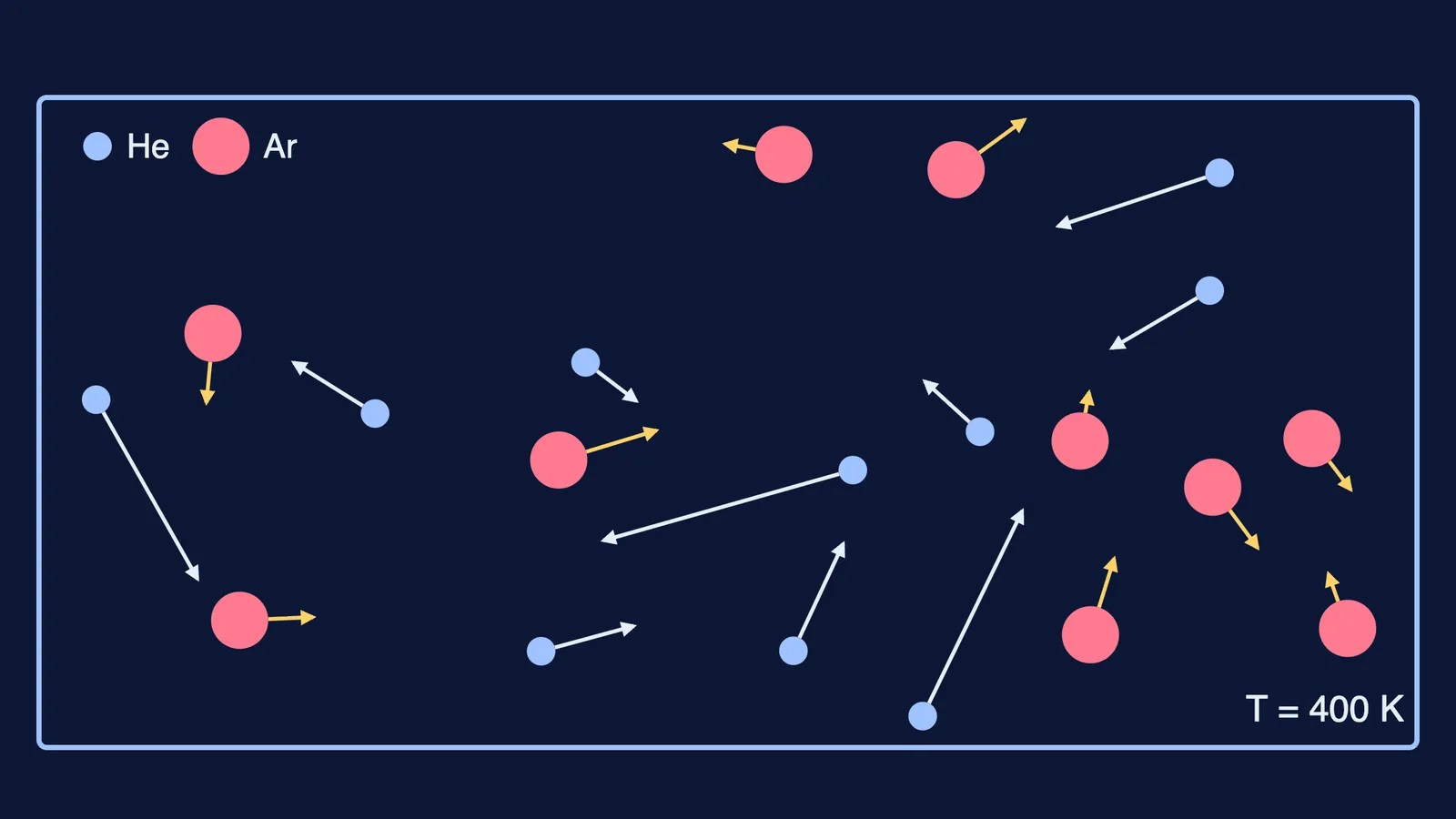
Q7 (hard). A vessel holds 1 mol of helium (4 g/mol) and 1 mol of argon (40 g/mol) at 400 K. Find the rms speed of all the atoms taken together, in m/s: square each atom's speed, average over every atom, then take the root. Give the nearest integer.
Answer: 1170. Half the atoms are helium and half argon, so ⟨v²⟩ = ½(3RT/M_He + 3RT/M_Ar). With 3RT = 9960 J/mol, ⟨v²⟩ = ½ × 9960 × (250 + 25) = 1.37 × 10⁶ m²/s², and the root is 1170 m/s.
Trap: 673, from √(3RT/M) with the average molar mass, 22 g/mol: it averages masses, not squared speeds.
Q8 (hard). Nitrogen (rigid molecules) is compressed adiabatically and reversibly, and the rms speed of its molecules rises from 500 m/s to 600 m/s. Find 100 × P₂/P₁, where P₂ is the final pressure. Give the nearest integer.
Answer: 358. Since v_rms ∝ √T, T₂/T₁ = (600/500)² = 1.44. For a rigid diatomic gas γ = 7/5, and an adiabatic process keeps P^(1−γ)T^γ constant, so P₂/P₁ = (T₂/T₁)^(γ/(γ−1)) = 1.44^3.5 = 3.583. Times 100, that is 358.3.
Trap: 249, from γ = 5/3, which treats nitrogen as a monatomic gas.
How do you get the number right in kinetic theory?
Kelvin inside, Celsius only if asked. Every formula needs absolute temperature; convert back only when asked, as in Q1.
Molar mass in kg/mol. In Q6, putting 28 into √(3RT/M) instead of 0.028 gives nitrogen a starting speed of about 16 m/s, not 517 m/s.
Square speeds before you average them. In Q7 and Q8, work with v_rms² (it tracks T), and take a root only at the end.
Read the container. A rigid vessel means C_v; a free piston means C_p; an insulated, sudden change means Q = 0.
Round once, at the end. Carry four significant figures; in Q8, rounding 1.44^3.5 to 3.6 before multiplying gives 360, not 358.
Stuck on why a step works? The Fermi Problem Library has worked problems with a step-by-step solver that explains the reasoning rather than printing an answer.
Redo every miss two days later.


