

On this page
After our first set of indefinite integrals JEE Main practice questions with solutions, here are eight new ones, leaning medium to hard. Most need two moves in a row: a substitution and then parts, or an identity and then a standard form. Each has a worked solution, the tempting wrong option and a one-line check. Fermi Test Prep is our hub for JEE Main and Advanced preparation.
What does JEE Main 2027 test in indefinite integrals?
Unit 8 of NTA's Syllabus for JEE (Main) 2027 lists integral as an anti-derivative, integration by substitution, by parts and by partial fractions, integration using trigonometric identities, and standard forms such as ∫dx/(x² + a²).
The JEE (Main) 2027 Information Bulletin gives Mathematics 20 MCQs and 5 numerical-value questions in Paper 1, with +4 for a correct answer and −1 for a wrong one, so marking the trap costs you five marks against the right answer.
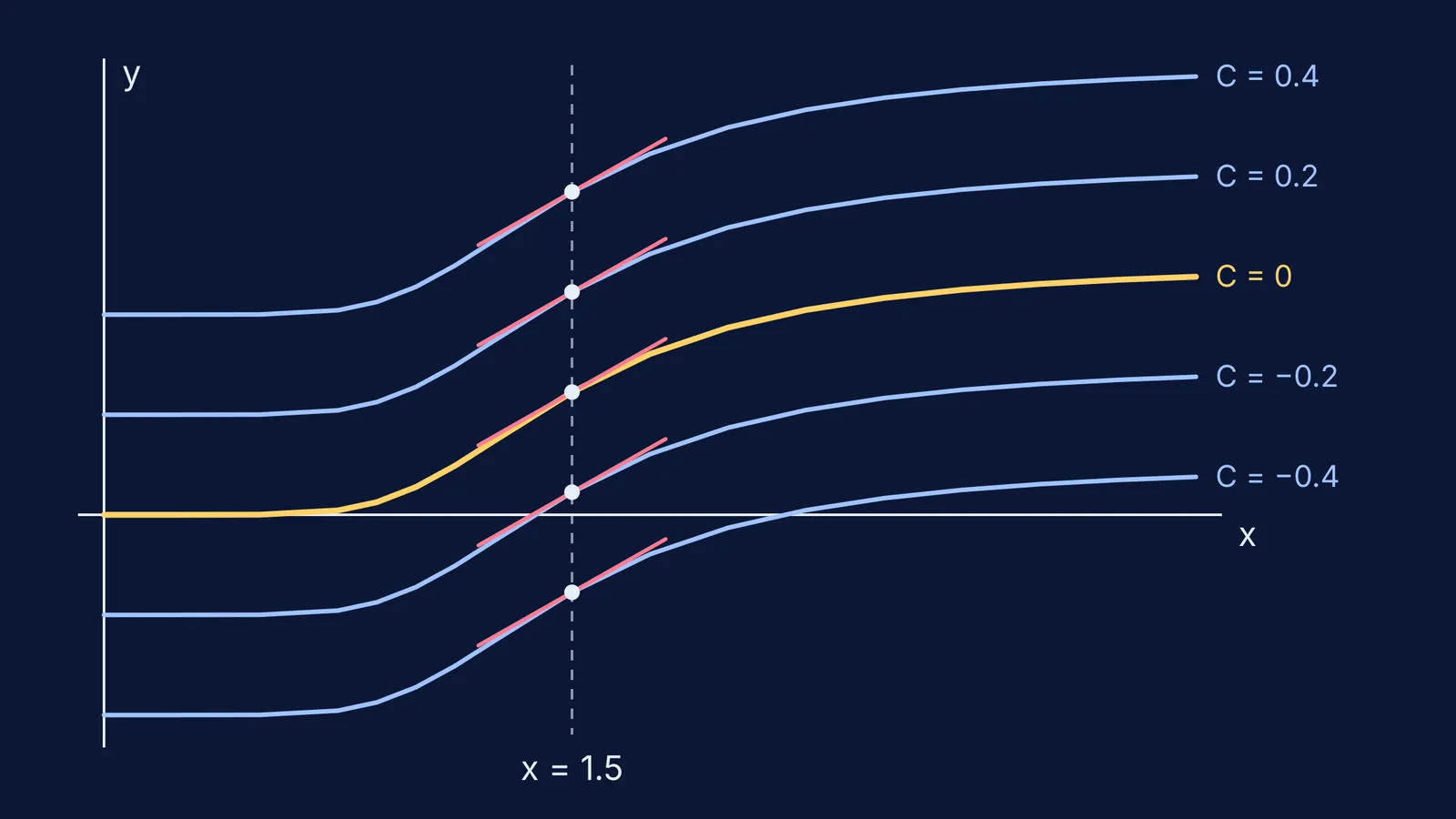
In every answer, C is the constant of integration.
Medium: can you see the substitution hiding in each integral?
Q1. For x > 0, ∫ dx/(x²(x⁴ + 1)^(3/4)) equals: (A) −(1 + 1/x⁴)^(1/4) + C (B) (1 + 1/x⁴)^(1/4) + C (C) −(1/4)(1 + 1/x⁴)^(1/4) + C (D) −(x⁴ + 1)^(1/4) + C
Answer: (A). Take x³ out of the bracket: the integrand is x⁻⁵(1 + x⁻⁴)^(−3/4). Put t = 1 + x⁻⁴, so dt = −4x⁻⁵ dx and the integral is −(1/4)∫t^(−3/4) dt = −t^(1/4) + C. Trap: (C) keeps the −1/4 but forgets that integrating t^(−3/4) divides by 1/4. Check: differentiating (A) returns x⁻⁵(1 + x⁻⁴)^(−3/4).
Q2. ∫ dx/(1 + 3 sin²x) equals: (A) tan⁻¹(2 tan x) + C (B) (1/2) tan⁻¹(2 tan x) + C (C) (1/4) tan⁻¹(2 tan x) + C (D) (1/2) tan⁻¹((tan x)/2) + C
Answer: (B). Divide top and bottom by cos²x: sec²x/(sec²x + 3tan²x) = sec²x/(1 + 4tan²x). With t = tan x, ∫dt/(1 + 4t²) = (1/2)tan⁻¹(2t) + C. Trap: (C) writes 4(t² + 1/4), takes out the 1/4 and forgets the 1/a = 2 of the standard form. Check: at x = 0 the integrand is 1; (B) has slope 1 there, (C) only 1/2.
Q3. ∫ eˣ(1 + sin x)/(1 + cos x) dx equals: (A) eˣ tan(x/2) + C (B) eˣ cot(x/2) + C (C) eˣ/(1 + cos x) + C (D) eˣ sec(x/2) + C
Answer: (A). Half-angle forms turn the fraction into tan(x/2) + (1/2)sec²(x/2), which is f + f′ with f = tan(x/2). Since ∫eˣ(f + f′) dx = eˣf + C, the answer is eˣ tan(x/2) + C. Trap: (C) is eˣ times (1/2)sec²(x/2): it keeps f′ in place of f. Check: the derivative of (A) is eˣ[tan(x/2) + (1/2)sec²(x/2)], the split form.
Q4. ∫ dx/(x(x⁵ + 1)) equals: (A) (1/5) ln|x⁵/(x⁵ + 1)| + C (B) ln|x⁵/(x⁵ + 1)| + C (C) (1/5) ln|(x⁵ + 1)/x⁵| + C (D) ln|x| − ln|x⁵ + 1| + C
Answer: (A). Multiply top and bottom by x⁴ and put t = x⁵, dt = 5x⁴ dx: (1/5)∫dt/(t(t + 1)) = (1/5) ln|t/(t + 1)| + C. Trap: (B) loses the 1/5 from dt. Check: (A) is ln|x| − (1/5)ln|x⁵ + 1|, whose derivative 1/x − x⁴/(x⁵ + 1) simplifies to the integrand.
Hard: what do you do when one integral mixes two methods?
Q5. ∫ sin⁻¹x/(1 − x²)^(3/2) dx equals: (A) x sin⁻¹x/√(1 − x²) + (1/2)ln(1 − x²) + C (B) x sin⁻¹x/√(1 − x²) − (1/2)ln(1 − x²) + C (C) sin⁻¹x/√(1 − x²) + C (D) (sin⁻¹x)²/2 + C
Answer: (A). Put x = sin θ: dx = cos θ dθ and (1 − x²)^(3/2) = cos³θ, so the integral is ∫θ sec²θ dθ. By parts, θ tan θ − ∫tan θ dθ = θ tan θ + ln|cos θ| + C. Back in x, tan θ = x/√(1 − x²) and ln cos θ = (1/2)ln(1 − x²). Trap: (B) takes ∫tan θ dθ as +ln|cos θ|. Check: differentiate (A); the x/(1 − x²) terms cancel.
Q6. If ∫ f(x) dx = ψ(x), then ∫ x⁵ f(x³) dx equals: (A) (1/3)x³ψ(x³) − ∫x²ψ(x³) dx + C (B) (1/3)[x³ψ(x³) − ∫x²ψ(x³) dx] + C (C) x³ψ(x³) − 3∫x²ψ(x³) dx + C (D) (1/3)x³ψ(x³) − 3∫x³ψ(x³) dx + C
Answer: (A). Put t = x³, so x⁵ dx = (1/3)t dt and the integral is (1/3)∫t f(t) dt = (1/3)[tψ(t) − ∫ψ(t) dt]. Changing back, ∫ψ(t) dt = ∫ψ(x³)·3x² dx, and that 3 cancels the 1/3. Trap: (B) forgets the 3x² in dt. Check: differentiating (A) gives x²ψ(x³) + x⁵f(x³) − x²ψ(x³) = x⁵f(x³).
Q7. If Iₙ = ∫ tanⁿx dx, then I₄ + I₆ equals: (A) (1/5)tan⁵x + C (B) (1/6)tan⁵x + C (C) (1/7)tan⁷x + C (D) (1/5)tan⁵x + x + C
Answer: (A). I₄ + I₆ = ∫tan⁴x(1 + tan²x) dx = ∫tan⁴x sec²x dx, and t = tan x gives t⁵/5 + C. This is the reduction formula Iₙ + Iₙ₋₂ = tanⁿ⁻¹x/(n − 1) with n = 6. Trap: (B) divides by n = 6 instead of n − 1 = 5. Check: the derivative of (1/5)tan⁵x is tan⁴x sec²x = tan⁴x + tan⁶x.
Q8. ∫ (3x¹¹ + 5x⁹)/(x⁵ + x² + 1)³ dx equals: (A) x¹⁰/(2(x⁵ + x² + 1)²) + C (B) x¹⁰/(x⁵ + x² + 1)² + C (C) −x¹⁰/(2(x⁵ + x² + 1)²) + C (D) x⁵/(2(x⁵ + x² + 1)) + C
Answer: (A). Divide top and bottom by x¹⁵: (3x⁻⁴ + 5x⁻⁶)/(1 + x⁻³ + x⁻⁵)³. With t = 1 + x⁻³ + x⁻⁵, dt = −(3x⁻⁴ + 5x⁻⁶) dx, so the integral is −∫dt/t³ = 1/(2t²) + C, which is (A). Trap: (C) drops the minus sign in dt. Check: at x = 1 the integrand is 8/27, and the slope of (A) there is 16/54 = 8/27.
How should you use this second set?
Do all eight in one timed sitting, without notes.
Before solving, write the method in two or three words beside each question.
For each miss, redo the check line until you could have caught the error yourself.
A few days later, redo your misses with one number changed.
If the methods themselves feel shaky, go back to our guide on how to prepare indefinite integrals for JEE Main, then practise entering exact answers with the indefinite integrals numerical value questions.
If you can follow a solution but could not have started it, the Fermi Problem Library has a step-by-step solver that explains the reasoning rather than printing an answer.


