

On this page
The pressure difference across an air filter, a fan or a chimney flue is tiny, often a few tens of pascals. Put that across a vertical water manometer and the column moves about 5 mm. You cannot read 5 mm to better than about 10% with your eye. The fix is simple: tilt the reading tube. The vertical height still sets the pressure, but now that small height is spread along a much longer length of tube. This post works through the numbers, including a correction many students miss: the liquid level in the reservoir also drops.
Why is a vertical manometer bad at small pressures?
A liquid column of height h balances a pressure difference Δp = ρgh. That is the whole rule behind the vertical U-tube, covered in how to read an open tube manometer. For small pressures, h is small.
Take Δp = 50 Pa, well inside the range of the filter gauges described below, with water (ρ = 1000 kg/m³, g = 9.81 m/s²):
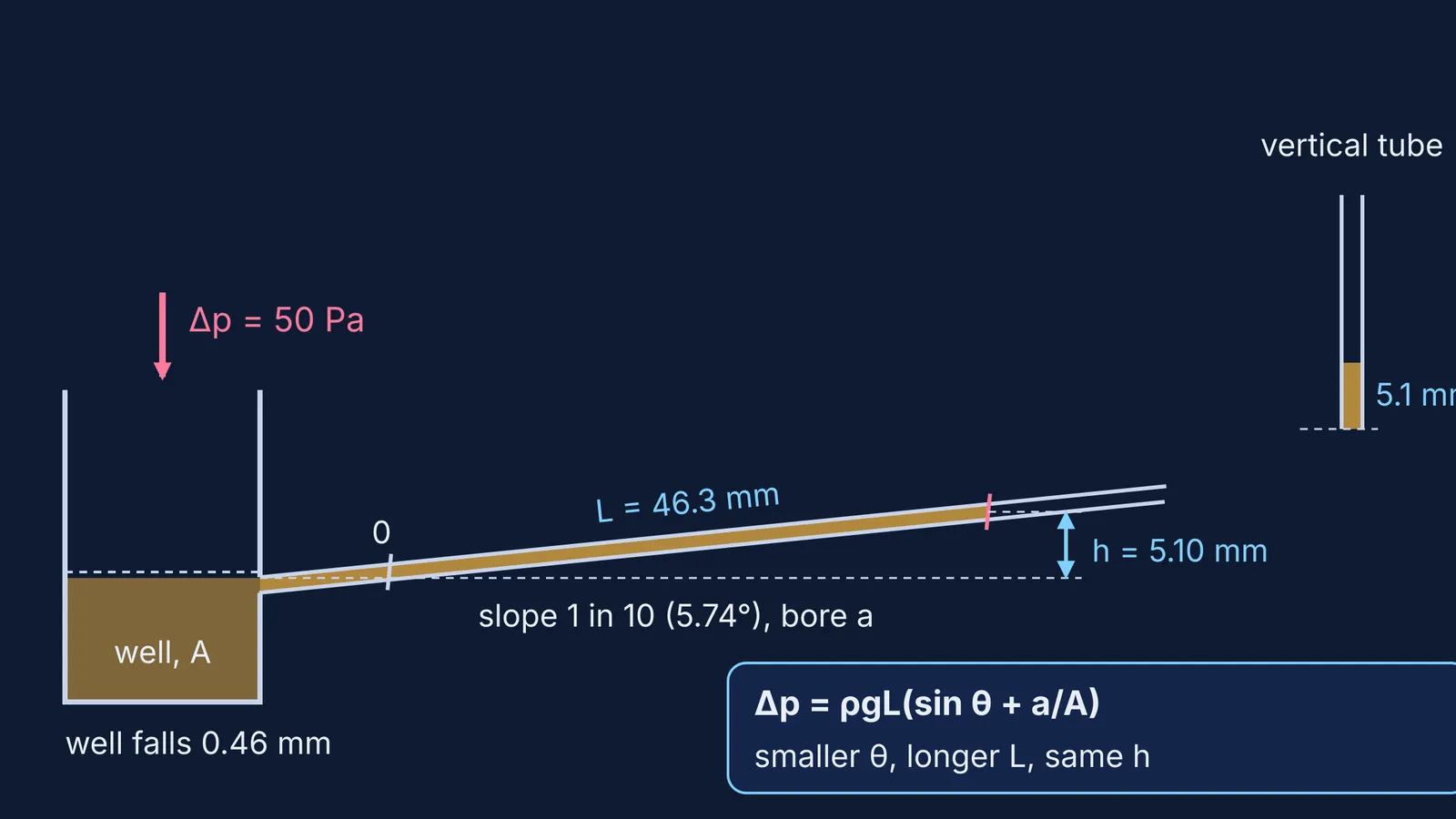
h = 50 ÷ (1000 × 9.81) = 5.10 × 10⁻³ m = 5.10 mm
If you can read the meniscus to ±0.5 mm, the reading error is 0.5 ÷ 5.10 = 9.8%, about 10%.
How does tilting the tube magnify the reading?
Pressure in a liquid depends only on vertical depth. The tube's direction does not matter. Tilt the reading tube to an angle θ above the horizontal and the liquid still has to rise the same vertical height h. To do that it must travel a length L along the tube, where
h = L sin θ, so L = h ÷ sin θ
A slope of "1 in 10" means sin θ = 0.1, which is θ = 5.74°. Then the ideal reading is
L = 5.10 mm ÷ 0.1 = 51.0 mm
The same ±0.5 mm reading error is now 0.5 ÷ 51.0 = 0.98%, about 1%. Tilting did not change the pressure or the vertical height. This is the same point that explains why a tilted barometer tube fills to a longer length but the same height, as in Torricelli's first barometer.
Why does the reservoir level matter in an inclined manometer?
A practical inclined manometer is not a U-tube with one arm tilted. It is a wide reservoir, called a well, joined to one long thin tube. The higher pressure is connected to the well. It pushes liquid out of the well and up the tube.
Here is the catch. The liquid that moves up the tube had to come from the well, so the well's level falls. Let the tube's bore area be a and the well's area be A.
Liquid moves a length L along the tube. The volume moved is a × L.
That volume leaves the well, so the well level drops by a × L ÷ A.
The tube's surface rises L sin θ above the starting level.
The total vertical height between the two surfaces is L sin θ + aL ÷ A.
So the correct relation is
Δp = ρgL(sin θ + a/A)
If a/A is tiny you get back L = h ÷ sin θ, but sin θ is itself small, so even a modest a/A matters.
Worked example: 50 Pa on a 1 in 10 inclined manometer
Data: Δp = 50 Pa, water, sin θ = 0.1, and a/A = 1/100 (a 2 mm bore with a 20 mm wide well, for example).
Ideal reading, ignoring the well. L = Δp ÷ (ρg sin θ) = 50 ÷ (1000 × 9.81 × 0.1) = 51.0 mm.
Actual reading. L = Δp ÷ [ρg(sin θ + a/A)] = 50 ÷ (1000 × 9.81 × 0.11) = 46.3 mm.
Where the height comes from. Along the tube: 46.3 × 0.1 = 4.63 mm. Well drop: 46.3 ÷ 100 = 0.46 mm. Total: 5.10 mm, the same height as the vertical tube.
Error if the scale ignores the well. A scale marked using sin θ alone would turn 46.3 mm into 1000 × 9.81 × 0.0463 × 0.1 = 45.5 Pa. That is 9.1% low.
With a lighter oil. With ρ = 800 kg/m³, L = 50 ÷ (800 × 9.81 × 0.11) = 57.9 mm.
Check units. Pa ÷ (kg/m³ × m/s²) = m. The bracket (sin θ + a/A) has no units.
A well correction of this size is normal in real instruments. Dwyer, a manometer maker, says in its primer on how manometers work that its well-type manometers use a precision bored well needing approximately a 10% scale correction for the drop in the well, and that the scale is compensated so it reads directly. The same page notes that the inclined manometer is often called a draft gage, from its use on boiler flues.
Which liquid is an inclined manometer filled with, and why does it matter?
Real inclined gauges are usually filled with a gauge oil of stated density, and the scale is printed for that oil. Dwyer's Mark II Model 40 bulletin, for example, specifies red gauge fluid of specific gravity 0.826 for its 0 to 250 Pa model, with a scale about 21 cm long and accuracy of ±3% of full scale.
Two consequences follow from Δp = ρgL(sin θ + a/A):
Using the wrong liquid. The reading L is inversely proportional to ρ. Fill an oil-scaled gauge with water (ρ = 1000 instead of 826 kg/m³) and L shrinks by the factor 0.826, so the gauge reads about 17% low.
Effective slope. With 0.826 oil, 250 Pa is a vertical height of 250 ÷ (826 × 9.81) = 30.9 mm. Spread over a 21 cm scale, that is an overall ratio near 1 in 7, which already includes the well term.
For two liquids that meet inside one U-tube, the balance is different; see the manometer with two immiscible liquids.
What can go wrong when you read an inclined manometer?
The gauge is not level. The scale assumes the marked angle. If the bench tilts the tube from 5.74° to 6.24°, sin θ rises from 0.100 to 0.109 and the same 50 Pa reads 42.9 mm instead of 46.3 mm, about 7% low. That is why the Dwyer bulletin tells you to centre the bubble in the built-in spirit level before reading.
The slope is too shallow. Halving sin θ doubles L, but the meniscus also stretches into a long, smeared curve that is harder to read. There is a practical limit.
To see how a liquid column responds as you change the angle and the density, try the Simulation Lab, which has interactive simulations for ideas that are easier to see than read.
Quick checklist
Pressure depends on vertical height: Δp = ρgh, whatever the tube's angle.
Tilting spreads h along L = h ÷ sin θ; a 1 in 10 slope is 5.74°.
With a well: Δp = ρgL(sin θ + a/A).
50 Pa of water: 5.10 mm vertical, 51.0 mm ideal along a 1 in 10 tube, 46.3 mm with a/A = 1/100.
Ignoring the well term reads about 9% low.
Use the liquid the scale was made for, and level the gauge first.


