

On this page
If a biology quiz asks which bone in your body is not attached to any other bone, the answer is the hyoid. It sits in the front of your neck, and it moves every time you swallow a sip of chai. Here is where it sits, what holds it, what it does, and how it fits NCERT's skull count.
Which bone is not attached to any other bone?
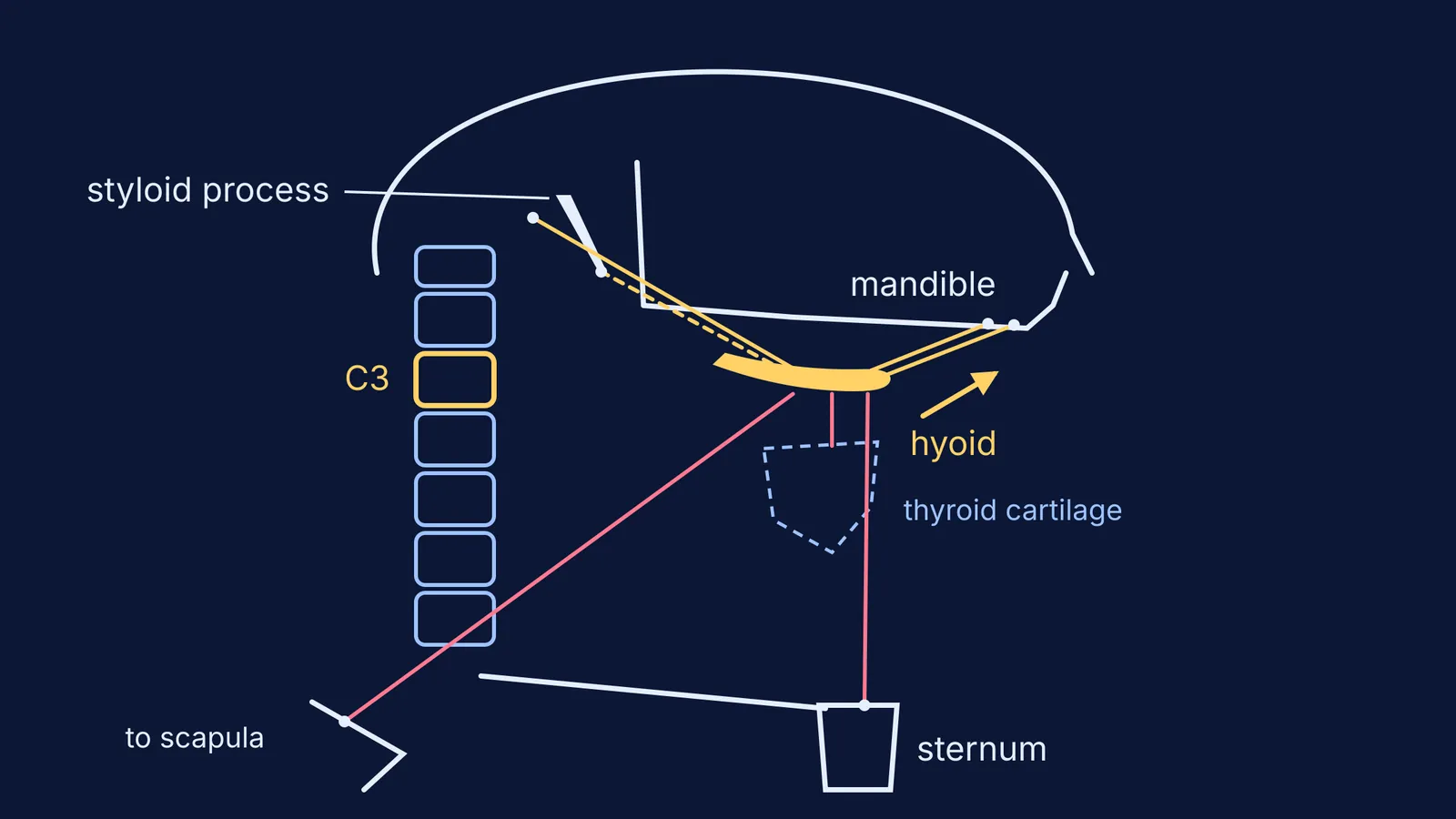
The hyoid is the only bone in the human body that does not articulate with any other bone; it is held in place by the muscles and ligaments attached to it (TeachMeAnatomy). The same source places it in the front of the neck at the base of the mandible, at about the level of the third cervical vertebra (C3).
The hyoid is a small U-shaped bone made of a body, two greater horns and two lesser horns (Kenhub). Kenhub places it between the mandible (the lower jaw) and the thyroid cartilage.
Not being attached to a bone does not make it loose. A 2020 review in the journal CRANIO notes that the hyoid is classed as a sesamoid, a 'freely floating' bone, yet is 'anything but freely floating', because it is attached to the base of the skull, the mandible, the tongue, the larynx and the shoulder girdle (Auvenshine and Pettit, CRANIO).
What holds the hyoid bone in place?
Kenhub groups the muscles that hold it into two sets (Kenhub):
Suprahyoid muscles, above the bone: digastric, mylohyoid, geniohyoid and stylohyoid.
Infrahyoid muscles, below the bone: thyrohyoid, sternohyoid and omohyoid.
Between them, these muscles and ligaments tie the hyoid to the mandible, the styloid processes of the temporal bone, the sternum and the thyroid cartilage, according to Kenhub. Three ligaments also attach to it: the stylohyoid, thyrohyoid and hyoepiglottic ligaments (TeachMeAnatomy).
What does the hyoid do when you swallow and speak?
When you swallow, the suprahyoid muscles lift the hyoid (Kenhub). A classic 1989 study in Gastroenterology filmed 8 healthy volunteers with X-ray video (videofluoroscopy) and pressure sensors while they swallowed 1, 5, 10 and 20 ml of liquid barium (Jacob and colleagues, Gastroenterology). The researchers found that the upper oesophageal sphincter, at the top of the food pipe, is pulled apart through its muscular attachments to the hyoid. It stayed open longer when the hyoid's forward-and-upward movement lasted longer. They concluded that the sphincter opening is 'an active mechanical event'.
NCERT notes that during swallowing a thin flap called the epiglottis can cover the glottis, so food does not enter the larynx (NCERT Class 11 Biology, Breathing and Exchange of Gases).
The hyoid is also an anchor for the tongue. Three tongue muscles attach to it: genioglossus, hyoglossus and chondroglossus (Kenhub). The CRANIO review lists speech, breathing, chewing and swallowing among its jobs, along with keeping the airway open between the throat and the windpipe (Auvenshine and Pettit).
Is the hyoid one of NCERT's 22 skull bones?
No. NCERT's Class 11 chapter Locomotion and Movement says the skull has 22 bones: 8 cranial and 14 facial (NCERT Class 11 Biology, Chapter 17). Straight after that, it describes 'a single U-shaped bone called hyoid' at the base of the buccal cavity, and three ear ossicles (malleus, incus and stapes) in each middle ear. The hyoid is described alongside the skull but is not one of the 22.
The same chapter says the human skeleton has 206 bones, 80 of them in the axial skeleton. This check makes those numbers fit together:
Skull: 8 cranial + 14 facial = 22
Hyoid: 1
Ear ossicles: 3 in each ear, so 6
Vertebral column: 26 (7 cervical, 12 thoracic, 5 lumbar, 1 fused sacral, 1 fused coccygeal)
Sternum: 1
Ribs: 12 pairs, so 24
Total: 22 + 1 + 6 + 26 + 1 + 24 = 80, which matches NCERT's axial count. If your sum comes to 79, you have left out the hyoid.
A two-minute recall check
Cover the answers and say each one aloud.
Which bone does not articulate with any other bone? (Hyoid)
At about which vertebral level does it sit? (C3)
Which muscle group lifts it during swallowing? (Suprahyoid)
How does NCERT split the 22 skull bones? (8 cranial + 14 facial)
How many bones are in the axial skeleton? (80)
For the rest of the chapter, our Locomotion and Movement Class 11 guide covers muscles, bones and joints, and NCERT numbers for Locomotion and Movement lists the chapter's counts in one place. If you wonder why 206 is an adult figure, read why babies have more bones than adults.
If a word like 'articulation' is the real gap, the Fermi Concept Library covers every concept in physics, chemistry, biology, mathematics and computing, each with its own lesson and its place in the map, so you can see how joints connect to the topics around them.


