

On this page
Nobody loses bones while growing up. What changes is the count: several small pieces join into one bigger bone, so the total drops even though the skeleton gets larger and stronger.
How many bones does a baby have compared with an adult?
A baby's body has about 300 bones at birth, while adults have 206, according to Nemours KidsHealth. The same page explains that some of a baby's bones are made entirely of cartilage, which is soft and flexible.
The "about" matters. A newborn's skeleton is a mix of hard bone, cartilage and pieces still partway between the two, so the birth figure is an estimate rather than an exact count. The adult figure of 206 describes the finished, fully fused skeleton.
Why do babies have more bones than adults?
Two things happen as a child grows: cartilage turns into bone, and neighbouring pieces fuse.
In the embryo, the skeleton consists of fibrous membranes and hyaline cartilage, according to the open textbook OpenStax Anatomy and Physiology. Bone then forms in two ways:
Intramembranous ossification: bone develops directly from sheets of connective tissue (this is how most cranial bones and the flat bones of the face form).
Endochondral ossification: bone develops by replacing hyaline cartilage (this is how long bones and the bones at the base of the skull form).
If the difference between the two tissues is fuzzy, our post on cartilage vs bone: matrix, cells and blood supply lays them side by side.
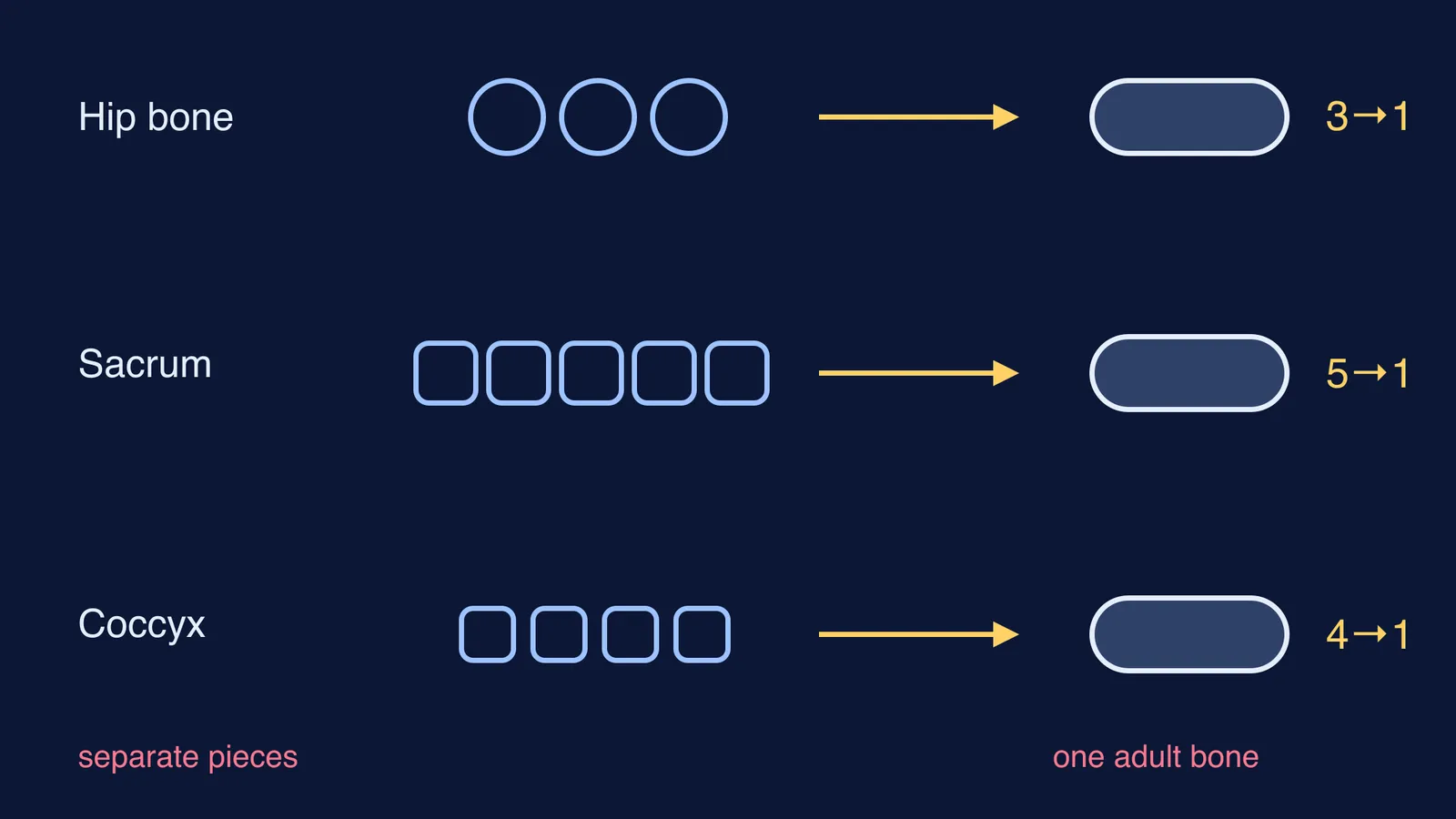
When pieces that were separate finally fuse, the count goes down. Each adult hip bone, for example, is formed by three separate bones, the ilium, ischium and pubis, that fuse during the late teenage years (OpenStax, pelvic girdle).
Worked example: where do some of the extra pieces go?
You can check part of the arithmetic yourself with three fusions from OpenStax's chapter on the vertebral column and its pelvic girdle chapter linked above. The rule is simple: when n pieces fuse into one bone, the count drops by n − 1.
The vertebral column develops as 33 vertebrae and ends up as 24 vertebrae plus the sacrum and coccyx, which is 26.
The sacrum forms from 5 sacral vertebrae, so the count drops by 4.
The coccyx (tailbone) forms from 4 small vertebrae, so the count drops by 3. Together that is 7, which matches 33 − 26.
Each hip bone forms from 3 pieces, so each drops the count by 2. You have two hip bones, so that is 4 more.
Those three sites alone account for 11 fewer pieces. The rest of the gap from about 300 to 206 comes from fusions elsewhere, such as the ends of long bones joining their shafts, which this simple sum does not cover.
One honest wrinkle: OpenStax notes that sacral and coccygeal fusion does not start until age 20 and is not complete until middle age. So "206" describes the finished adult skeleton, not a number every 20-year-old has already reached.
What are the soft spots on a baby's head?
The skull is the clearest place to see why separate pieces help a newborn. An infant's skull is made of 6 separate cranial bones joined by fibrous sutures, with soft spots called fontanelles between them, according to MedlinePlus.
MedlinePlus explains that flexible sutures let the skull bones overlap so the head can pass through the birth canal, and that the sutures and fontanelles give the brain room to grow. The posterior fontanelle usually closes by 1 to 2 months, and the anterior one usually closes sometime within 7 to 19 months of age. If a parent has a question about a particular baby's soft spot, a paediatrician is the right person to ask. For the adult count of skull bones, see how many bones are in the human skull.
When do growth plates close and bones stop growing?
Long bones grow in length at the epiphyseal plate, a layer of hyaline cartilage where ossification happens in immature bones. When bone replaces that cartilage, growth in length stops and only an epiphyseal line remains (OpenStax).
An MRI study of the wrists, knees and ankles of 958 healthy people aged 14 to 21.5 years found that complete growth plate fusion happened about two years earlier in females than in males, in order from foot to wrist. By 17 most females, and by 19 most males, showed complete fusion at the sites studied (Kvist et al., Acta Paediatrica, 2021). The same study linked fusion closely to pubertal development; our explainer on growth hormone at different ages covers what happens when hormones that drive growth go wrong.
Fusion is a process in time, and a moving picture often makes it click faster than a labelled diagram. The Fermi Simulation Lab has interactive simulations for ideas that are easier to see than to read, and the Fermi Concept Library gives each biology concept its own lesson if ossification or cartilage needs a fresh start.


