

On this page
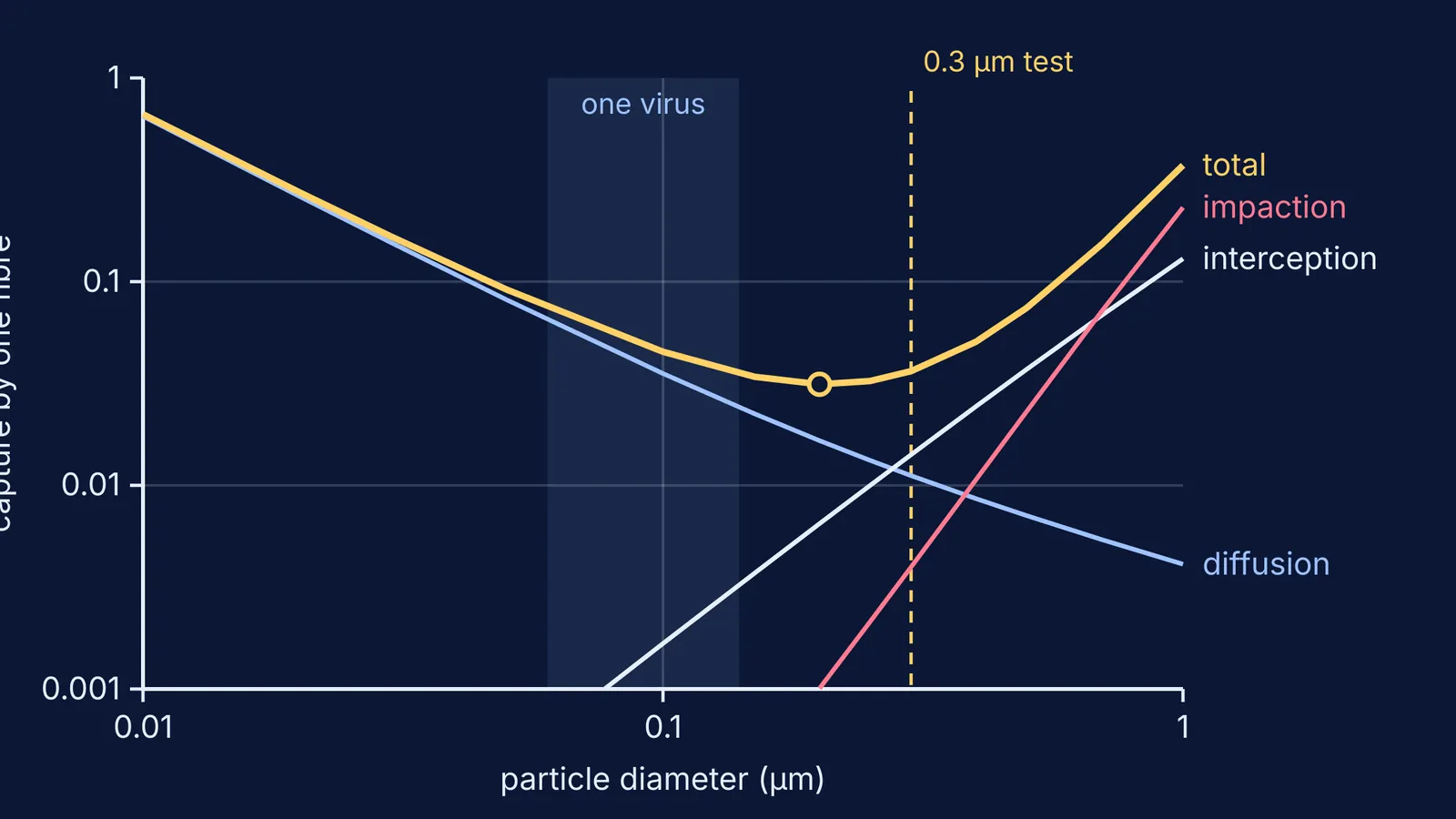
A single coronavirus is tiny. So how can a mask stop it? A mask is not a sieve but a thick tangle of fibres that air must wind through. Particles get caught in four ways, and which one works best depends on size. That is also why the N95 rating uses 0.3 micrometre particles.
How does a mask stop viruses if the gaps are bigger than the virus?
In electron microscope images, the SARS-CoV-2 virus particle has a diameter of about 60 to 140 nanometres, according to Bar-On and colleagues in eLife (2020). That is 0.06 to 0.14 micrometres (µm).
But viruses ride inside the droplets and smaller aerosols we breathe, talk and cough out. A 2021 review in Science by Wang and colleagues explains that several respiratory pathogens spread through small aerosols that float in the air, and suggests this airborne route may be the main one for some of them, including SARS-CoV-2.
The US National Institute for Occupational Safety and Health (NIOSH) puts the key point bluntly in its science bulletin on N95 respirators and surgical masks: "Filters do NOT act as sieves." Once a particle touches a fibre, the bulletin explains, it is held there by molecular attractive forces.
What are the four ways a mask fibre catches a particle?
A 2020 review in Bioactive Materials by Tcharkhtchi and colleagues sets out the mechanisms and the sizes where each one matters:
Inertial impaction. Air swerves around a fibre, but a heavy particle keeps going straight and crashes into it. The review says particles of around 1 µm or larger can be removed effectively this way.
Interception. A particle follows the air stream exactly, but its stream passes within one particle radius of a fibre, so its edge brushes the fibre and sticks. The review links this mechanism to particles of up to about 0.6 µm.
Diffusion. Very small particles are knocked about by air molecules, the same random jiggle that Robert Brown saw in tiny particles from pollen grains. This zigzag makes them hit fibres they would otherwise pass. The review calls diffusion the most effective mechanism for particles smaller than 0.2 µm.
Electrostatic attraction. Filters with charged fibres are called "electret" filters, the review explains. NIOSH notes that this extra mechanism helps collect both larger and smaller particles.
As particles grow, diffusion weakens while interception and impaction strengthen, so mechanical capture dips in between. If that is hard to picture, the Fermi Simulation Lab has interactive simulations for ideas that are easier to see than to read.
Why is the N95 rating tested with 0.3 micrometre particles?
NIOSH explains in its bulletin that there is a particle size at which none of the mechanical mechanisms (impaction, interception, diffusion) works particularly well. This "most penetrating particle size" is the best point at which to measure a filter, because a filter that performs well there collects both smaller and larger particles even better. NIOSH's test aerosol has a mass median aerodynamic diameter of about 0.3 µm, which the bulletin says is in that range for most filters.
The details are in NIOSH's standard test procedure for N95 filters (TEB-APR-STP-0059):
The challenge is a charge-neutralised sodium chloride aerosol.
A single filter is tested at an airflow of 85 litres per minute.
A sample of 20 filters is tested.
Every one of the 20 must capture at least 95% of the aerosol to pass.
So the "95" in N95 means at least 95% capture at a size close to the hardest to catch. Room air cleaners use the same idea; see how a HEPA air purifier removes PM2.5.
Why does fit matter as much as the filter?
NIOSH's bulletin says the most important aspect of a respirator's performance is how well it fits the face and limits leakage around the facepiece. A made-up example shows the logic.
Suppose the filter lets through 5% of particles at the hardest size, the most an N95 is allowed.
If all the air goes through the filter, 5 particles in every 100 get in.
Now suppose 10% of the air leaks around a gap at the nose. That air is not filtered at all.
Particles getting in: 10 from the leak, plus 5% of the other 90, which is 4.5. Total: 14.5 in every 100.
Here a small gap nearly triples what gets through. In the same idealised arithmetic, two layers that each pass 5% would let through 5% of 5%, or 0.25%. If your glasses fog up when you wear a mask, warm breath is escaping around the nose, unfiltered.
For advice on which mask suits a particular person or illness, ask a doctor or follow your local health authority.


