

On this page
When the air quality index outside climbs into the poor or severe range in winter, many families switch on an air purifier and trust the number on the display. Here is the physics inside the box, and its limits.
The US Environmental Protection Agency describes HEPA, short for high efficiency particulate air, as a type of pleated mechanical air filter. For a refresher on the readings themselves, see what PM2.5 and AQI numbers actually mean.
Is a HEPA filter just a very fine sieve?
No. People tend to imagine filtration as straining, where anything bigger than the holes is stopped. A NASA technical memorandum by J.L. Perry and colleagues says high-efficiency air filtration is unlike that: particles much smaller than the gaps in the filter are readily captured.
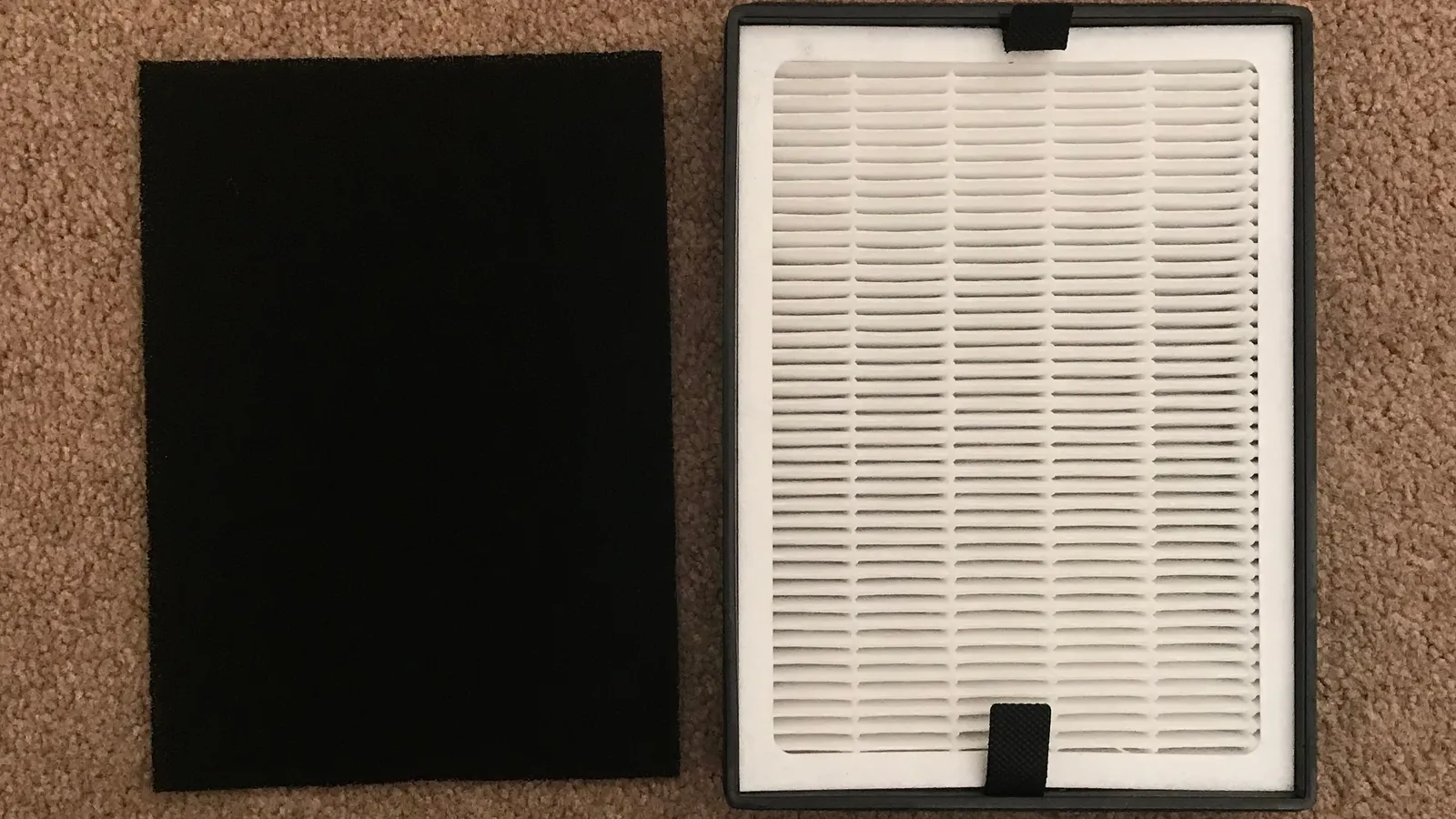
The same report describes HEPA media as borosilicate glass microfibres from 2 to 500 nanometres across, in a sheet usually under 0.508 mm thick that holds several hundred layers of fibres. Even if one layer has a gap, the layers behind it block the path.
How do fibres catch particles they could slip past?
The NASA report names three main capture mechanisms, each strongest at a different size.
Inertial impaction (big particles): the air curves around a fibre, but a heavy particle cannot turn as fast, so it hits the fibre.
Interception (middle sizes): the particle follows the air, but passes within one particle radius of the fibre, so its edge brushes the fibre and is held.
Diffusion (very small particles): tiny particles are knocked about by air molecules in Brownian motion, so they wander off their streamline and eventually bump into a fibre.
Once a particle touches a fibre, van der Waals, electrostatic and capillary forces hold it there, the report says. For the history of that random jiggling, read how Robert Brown spotted jiggling particles.
Bending streamlines are hard to picture from text. The Fermi Simulation Lab has interactive simulations for ideas like this that are easier to see than to read.
Why is 0.3 micron the hardest size to catch?
The EPA says a HEPA filter can theoretically remove at least 99.97% of particles 0.3 microns across, and calls this size the most penetrating particle size; larger and smaller particles are trapped with even higher efficiency.
In plain numbers, 99.97% means about 3 particles in every 10,000 at that worst size get through.
The NASA report puts this weak point for typical HEPA filters at 200 to 300 nanometres, depending on flow rate. As a rule of thumb, it says, halving the air speed through the media cuts the particles getting through by nearly ten times, because slow air gives small particles more time to diffuse onto fibres. Pleating helps here: the report measures media velocity as the airflow divided by the area of media, so more media area means slower air through each part.
How does a HEPA purifier clean the air in a whole room?
The filter only cleans air the fan pushes through it, so what matters is how much clean air the machine delivers. The EPA's guide to air cleaners in the home uses the clean air delivery rate, or CADR: the higher it is, the larger the room it can serve.
A worked example with the EPA's sizing chart, which assumes an 8-foot ceiling:
Measure the room. A bedroom 10 ft by 20 ft is 200 square feet.
Read the chart. The EPA lists a minimum CADR of 130 cubic feet per minute for 200 square feet.
Convert for metric labels. One cfm is about 1.7 cubic metres per hour, so 130 cfm is about 221 m³/h.
Check the turnover. The room holds 1,600 cubic feet and 130 cfm delivers 7,800 cubic feet an hour, roughly 5 room volumes an hour.
Adjust. For ceilings above 8 feet, the EPA suggests a cleaner sized for a larger area.
A checklist before you rely on a purifier
From the same EPA guide:
Put it in the room you use most, with nothing blocking the airflow.
Run it longer and at higher fan speeds; both increase the air filtered.
Replace filters regularly; a dirty, overloaded filter will not work well.
Avoid devices that deliberately produce ozone, a lung irritant.
HEPA traps particles, not gases; for gases you need activated carbon or another gas filter.
No air cleaner removes every pollutant, so cut indoor sources such as smoke too.
Some cleaners use charged plates instead of fibres; compare with how electrostatic precipitators remove smoke.
The WHO's 2021 air quality guidelines announcement explains why this is worth the effort.
Next time the display drops, you will know why: layers of glass fibre and three kinds of capture.


