

On this page
Your blood sits in a narrow pH window, and two systems keep it there. Buffers in the blood react at once. The kidneys work over hours to days, but they are the main route for getting rid of fixed (non-volatile) acid and for replacing the bicarbonate the buffer used up. Below are the three things a kidney tubule does, and a diagram you can redraw before a test.
What does the blood buffer do, and why is it not enough?
Normal arterial blood pH is 7.36 to 7.44, according to a review by Hamm, Nakhoul and Hering-Smith in the Clinical Journal of the American Society of Nephrology (2015). The same review names the bicarbonate/carbon dioxide pair as the body's most important buffer system.
Metabolism adds acid every day: about 1 mEq per kg of body weight, roughly 70 mEq a day for a 70 kg adult (Hamm et al., 2015). Each H+ the buffer soaks up uses one bicarbonate ion, which leaves as CO2 through the lungs. The lungs cannot make bicarbonate, so without a way to replace it the buffer would slowly run down. For the buffer equation itself, see how the bicarbonate buffer keeps blood pH at 7.4.
How do kidneys reclaim bicarbonate?
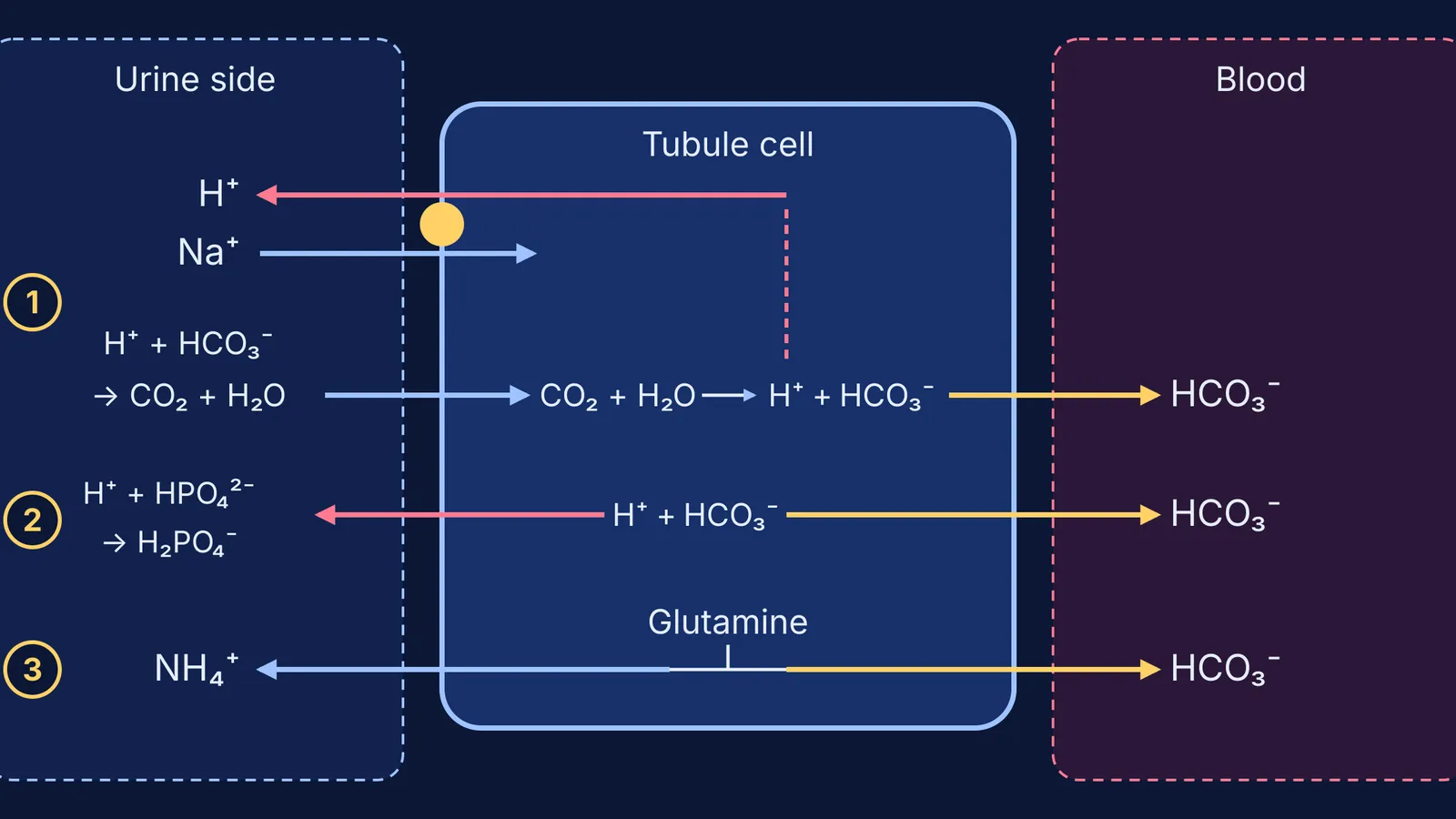
This is step 1 in the diagram. About 4.5 mol of bicarbonate is filtered each day, and 70 to 80% of it is reabsorbed in the proximal tubule (Hamm et al., 2015).
The tubule cell cannot pull bicarbonate straight across its membrane, so it does a swap:
The cell pushes H+ into the tubule fluid, mostly through a sodium-hydrogen exchanger (NHE3) that brings Na+ in.
In the fluid, H+ meets filtered HCO3- and forms CO2 and water, helped by the enzyme carbonic anhydrase.
CO2 diffuses into the cell, where carbonic anhydrase turns it back into H+ and HCO3-.
HCO3- leaves on the blood side, and the H+ goes round again.
The catch: this only rescues bicarbonate that was already in the blood. No new bicarbonate is made. Each tubule segment's role is set out in our post on the functions of the PCT and DCT.
How do kidneys secrete H+ and ammonia?
Steps 2 and 3 make new bicarbonate by excreting acid in two forms (Hamm et al., 2015).
Titratable acid. In the collecting duct, intercalated cells pump H+ into the urine with an H+-ATPase that can lower urine pH to about 4.5. Free H+ alone would hit that limit fast, so urinary buffers, chiefly phosphate, carry much of the secreted acid.
Ammonium. Proximal tubule cells break down the amino acid glutamine, and each glutamine yields a net of two ammonia and two bicarbonate, according to Imenez Silva and Mohebbi in Pflügers Archiv (2022). The bicarbonate goes to the blood. In the urine, secreted H+ turns NH3 into NH4+, a charged ion that is trapped and cannot diffuse back.
Under normal conditions, ammonium makes up one-half to two-thirds of the acid the kidneys excrete, and titratable acid the remaining one-third to one-half (Hamm et al., 2015). Each H+ excreted this way adds one new HCO3- to the blood. That is how the kidney tops the buffer back up.
How fast do kidneys correct blood pH?
The buffers act immediately, full breathing compensation takes 12 to 24 hours, and the kidneys need 3 to 5 days to reach their maximum response to an acid load (Hamm et al., 2015). Think of the blood buffer as cash in your pocket and the kidney as the bank that refills it.
How do you redraw the kidney pH diagram?
Use the diagram at the top of this post as your model, then draw it from memory:
Three columns: urine side, tubule cell, blood.
Step 1: H+ out of the cell and Na+ in. In the fluid, H+ + HCO3- gives CO2 + H2O; CO2 enters the cell and splits back into H+ and HCO3-. Send HCO3- to the blood.
Step 2: H+ pumped out and caught by phosphate (HPO4 2- becomes H2PO4-), with a new HCO3- sent to the blood.
Step 3: glutamine in the cell, NH4+ to the urine, HCO3- to the blood.
Mark step 1 as reclaiming bicarbonate and steps 2 and 3 as making new bicarbonate.
Then quiz yourself: why can urine pH not drop much below about 4.5? Why does the kidney need phosphate and ammonia at all? If an answer stalls, the Fermi Concept Library has a lesson for every concept in biology and chemistry, with its place in the map, so you can see how buffers connect to the nephron. For pH and buffer numericals, the Fermi Problem Library has worked problems with a step-by-step solver that explains the reasoning rather than printing an answer.
To see where these steps sit in the whole nephron, read urine formation step by step. Questions about your own kidneys or test results belong with a doctor.


