

On this page
Sit in a completely dark room for half an hour and your eyes become sensitive enough to notice a flash carrying less than a ten-millionth of a billionth of a joule. In 1942 three scientists in New York, Selig Hecht, Simon Shlaer and Maurice Pirenne, measured exactly how little light that is. Their answer is one of the cleanest uses of E = hc/λ you will meet, and it shows that a single rod in your retina can respond to a single photon.
What did Hecht, Shlaer and Pirenne measure in 1942?
They flashed dim blue-green light at dark-adapted observers and asked each time: did you see it? By changing the flash energy, they found the energy seen on most trials. Their paper, Energy, quanta, and vision (Journal of General Physiology, 1942), reports that this threshold was 2.1 to 5.7 × 10⁻¹⁰ erg at the cornea, which they converted to 54 to 148 photons.
The conditions matter, because the threshold changes if you change them. A 2018 review of the experiment by Edward Pugh lists them:
Light of wavelength 510 nm, close to the peak sensitivity of rods.
A flash lasting about 1 ms.
A small spot placed 20° from the centre of vision, on the temporal side, where rods are densely packed.
Observers fully adapted to the dark.
Why off-centre? The fovea, at the centre of the retina, has almost no rods, and rods are the cells that work in dim light (see the difference between rods and cones). To catch the faintest flash, you look slightly to one side of it.
How much energy is there in the faintest flash you can see?
Here is the worked example. Take the wavelength as 510 nm.
Energy of one photon. E = hc/λ = (6.626 × 10⁻³⁴ J s × 2.998 × 10⁸ m/s) / (510 × 10⁻⁹ m) = 3.90 × 10⁻¹⁹ J.
Convert to eV. 3.90 × 10⁻¹⁹ J / 1.602 × 10⁻¹⁹ J per eV = 2.43 eV. The shortcut E (eV) = 1240/λ (nm) gives 1240/510 = 2.43 eV as well.
Check the paper's conversion. 1 erg = 10⁻⁷ J, so 2.1 × 10⁻¹⁰ erg = 2.1 × 10⁻¹⁷ J. Dividing by 3.90 × 10⁻¹⁹ J gives 54 photons. The upper value, 5.7 × 10⁻¹⁷ J, gives 146, which matches the paper's 148 to within rounding.
Average flash. Pugh's review gives an average of about 90 photons at the cornea. That is 90 × 3.90 × 10⁻¹⁹ J = 3.5 × 10⁻¹⁷ J.
Power during the flash. Spread over 1 ms, the power is 3.5 × 10⁻¹⁷ J / 10⁻³ s = 3.5 × 10⁻¹⁴ W.
Units: J s × m/s ÷ m = J, and J ÷ s = W. This is the method used for the number of photons a lamp or laser emits each second, run in reverse.
Where do 9 out of 10 photons go before reaching a rod?
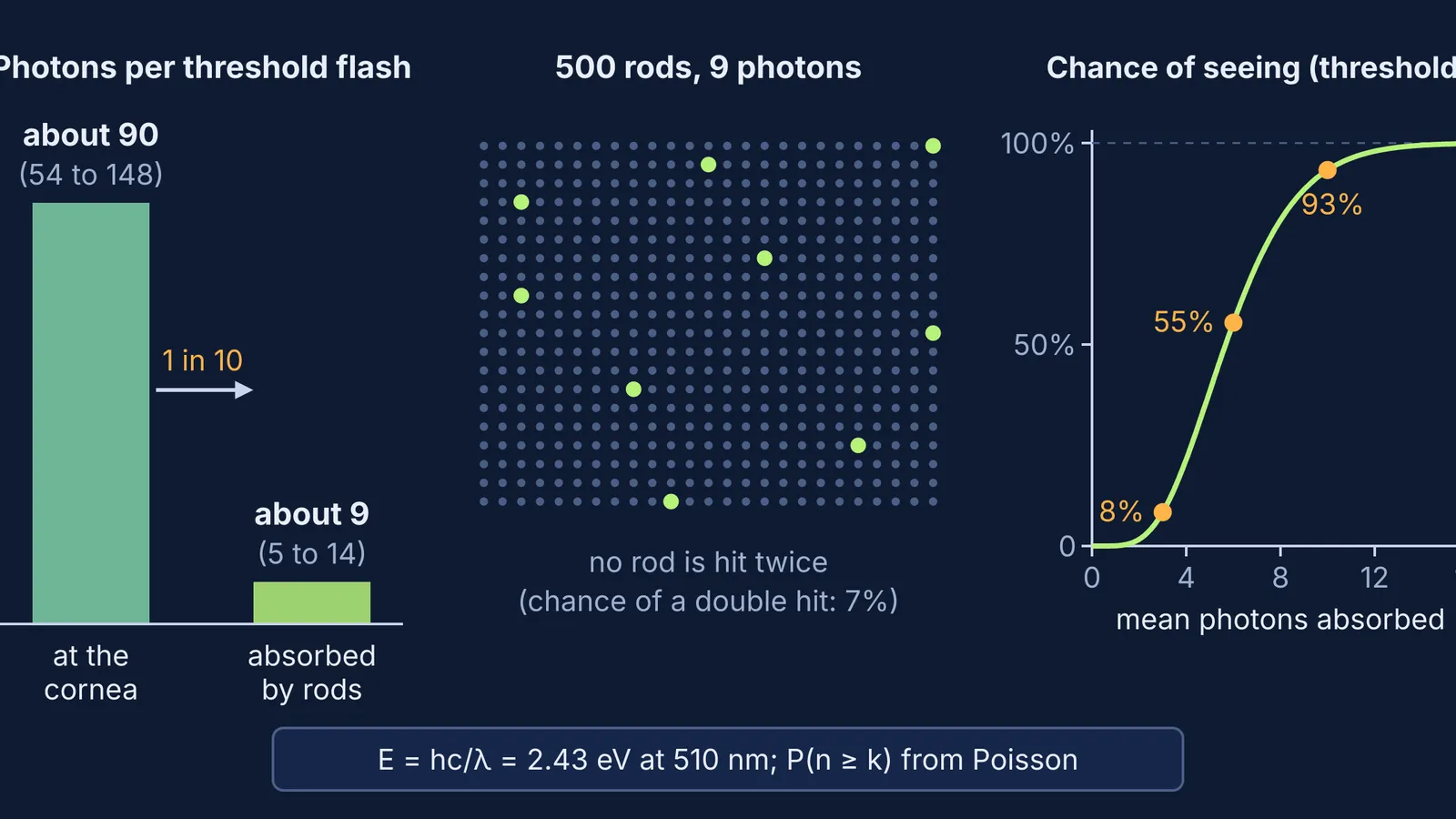
Not every photon reaching the eye is caught. Hecht, Shlaer and Pirenne corrected for three losses: some light is reflected at the cornea, some is absorbed in the lens and the fluids of the eye, and much of what reaches the retina passes straight through the rods without being absorbed by their pigment, rhodopsin. After these corrections, the 54 to 148 photons at the cornea became only 5 to 14 photons actually absorbed by rods.
That is about 9%, roughly 1 in 10. Of the average 90 photons, only about 8 or 9 do anything at all. Compare a silicon detector in photodiode responsivity and quantum efficiency: the eye loses most of its light before the detector.
Why must a single rod respond to a single photon?
The flash fell on a small patch of retina that Hecht, Shlaer and Pirenne estimated held about 500 rods. Suppose 10 photons are absorbed and each one lands on a random rod. What is the chance that some rod gets two?
The first photon can land anywhere.
The chance that the second misses the first rod is 499/500, that the third misses both is 498/500, and so on.
The chance that all 10 land on different rods is (500 × 499 × ... × 491) / 500¹⁰ = 0.913.
So the chance that any rod gets two photons is 1 − 0.913 = 0.087, or 8.7%.
In more than 9 flashes out of 10, every absorbed photon lands on a different rod, yet the observers saw the flash. So each rod must signal after absorbing one photon, and the brain adds up signals from several rods. Pugh's review re-estimates the patch at about 240 rods; even then the chance of a double hit is only 17%, so the conclusion stands.
Why do you need several photons to say "I saw it"?
Light from a steady source does not arrive in a fixed number of photons. The count in each flash is random and follows a Poisson distribution. If the average number absorbed is m, the probability of exactly n absorptions is P(n) = e⁻ᵐ mⁿ / n!.
Suppose you report "seen" only when at least 6 photons are absorbed. Then the chance of seeing a flash is P(n ≥ 6) = 1 − [P(0) + P(1) + ... + P(5)]. Working this out:
A flash that averages 3 absorbed photons is seen 8% of the time.
A flash that averages 6 is seen 55% of the time, not 100%.
A flash that averages 10 is seen 93% of the time.
So the chance of seeing rises along an S-shaped curve, and a bigger threshold number gives a steeper curve. Hecht, Shlaer and Pirenne fitted Poisson shapes to their curves and found a threshold of about 5 to 8 absorbed photons, from the shape alone, without needing the eye's losses.
Why not 1? Rods also fire occasionally in total darkness, because the rhodopsin molecule sometimes changes shape on its own through heat. If the brain reported every single event, you would keep seeing flashes that are not there. Asking for several events at almost the same time keeps false alarms rare.
If the Poisson sums feel abstract, the Fermi Problem Library has a step-by-step solver that explains the reasoning behind each probability term.
Can a person see just one photon?
This is still debated. In 2016 a team using a source that emits one photon at a time reported that people chose correctly slightly more often than chance, in Direct detection of a single photon by humans (Nature Communications). The effect was small. What is well established is the 1942 result: single rods respond to single photons, and a seen flash needs a handful of them.
Never test any of this with a laser pointer; lasers can damage the retina.
Quick checklist
Threshold flash (Hecht, Shlaer and Pirenne, 1942): 54 to 148 photons at the cornea, about 5 to 14 absorbed by rods.
At 510 nm one photon carries 3.90 × 10⁻¹⁹ J, which is 2.43 eV.
Only about 1 in 10 photons at the cornea is absorbed by a rod.
With about 10 photons on about 500 rods, a double hit has only an 8.7% chance, so single rods respond to single photons.
Photon counts are Poisson; with a threshold of 6, a flash averaging 6 is seen only 55% of the time.


