

On this page
If a test taken a few days after a possible HIV exposure says "non-reactive", that may not be the final word. Every HIV test looks for a marker, and each marker takes time to build up to a level the test can see. That delay is the window period, and it tells you when to go back.
What is the window period in an HIV test?
The window period is "the time between HIV exposure and when a test can detect HIV in your body", according to the US Centers for Disease Control and Prevention (CDC).
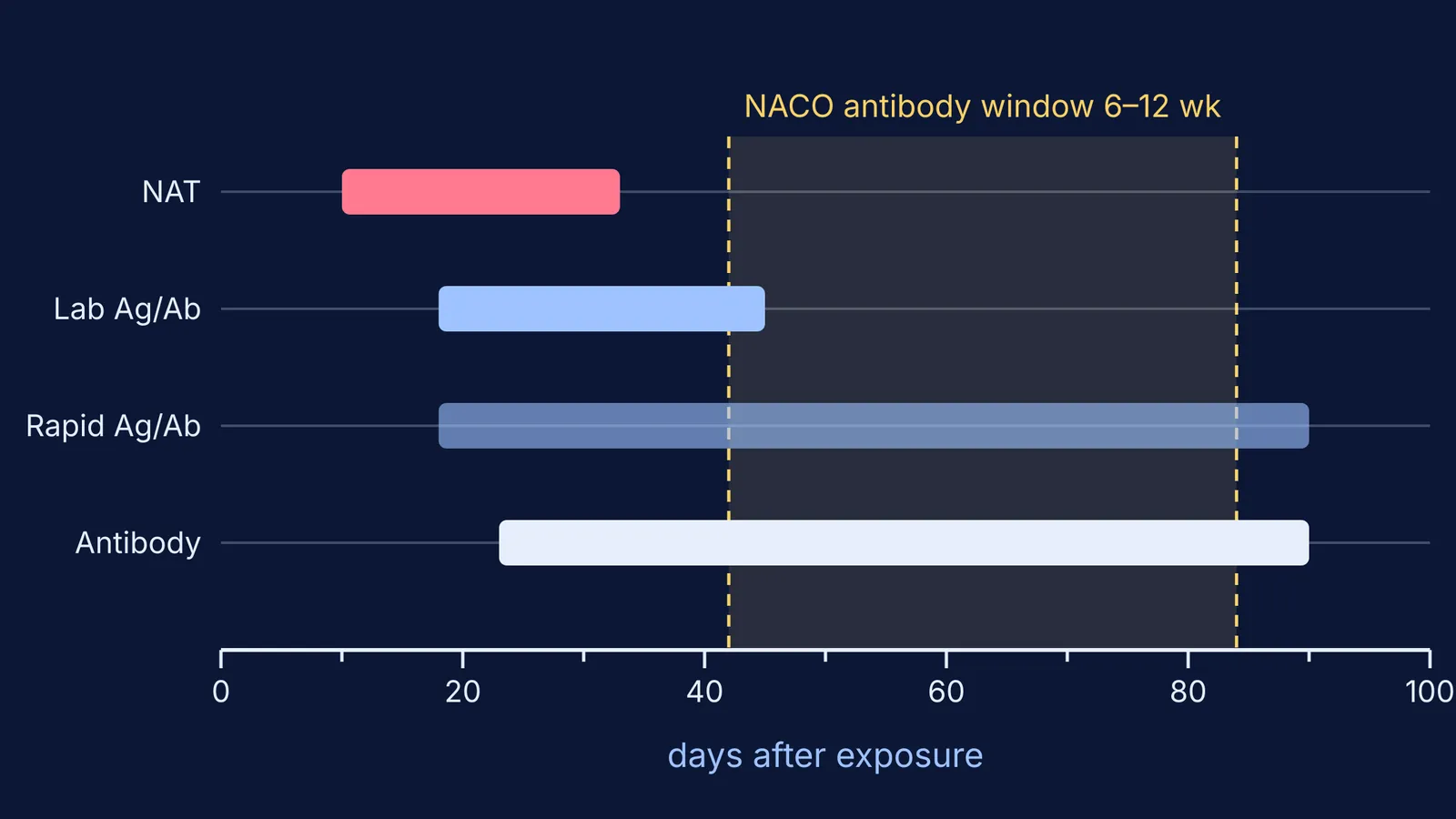
India's National HIV Counselling and Testing Guidelines 2024 from NACO define it as the time from exposure until antibodies can be detected by standard antibody tests, and put it at 6 to 12 weeks. The same guidelines say a blood test taken during the window period "may yield a negative test result for HIV antibodies" and that these cases may need retesting after 12 weeks.
The World Health Organization's Consolidated guidelines on HIV testing services, 2019 also name an earlier stretch. The eclipse period is "the period between HIV infection and detection of virological markers such as HIV RNA/DNA or HIV p24 antigen".
Why can an antibody test read negative soon after infection?
An antibody test does not look for the virus. It looks for your immune system's response, which takes weeks to reach a level a test can pick up. If the difference is hazy, our explainer on how to tell an antigen, an antibody and an antibiotic apart sorts it out.
A study of serial blood samples from newly infected plasma donors estimated that, before antibodies appear, the amount of HIV in blood doubles about every 20.5 hours (Fiebig and colleagues, AIDS, 2003). The same study estimated that an RNA test sensitive to 50 copies per millilitre would detect infection about 7 days before a p24 antigen test and 12 days before a sensitive antibody test.
In India, under the NACO guidelines, diagnosis at Integrated Counselling and Testing Centres (ICTCs) is based on detecting antibodies, and NACO recommends rapid test kits.
How do antigen and nucleic acid tests shorten the gap?
They look for markers that appear before antibodies. According to the CDC, a nucleic acid test (NAT) looks for the virus itself, and an antigen/antibody test also looks for p24, an antigen that is part of the virus and can be detected before antibodies develop. Our guide to drawing and labelling the structure of HIV shows where p24 sits.
A team led by Kevin Delaney compared 20 US-approved HIV immunoassays using 222 plasma samples collected over time from newly infected people (Clinical Infectious Diseases, 2017). They estimated that 99% of infections would be detected within 44 days by lab antigen/antibody screening tests, and within 65 days by the older Western blot.
When does each HIV test turn positive, day by day?
These are the usual detection ranges from the CDC's testing page, counting from the day of exposure.
Day 0: exposure. The eclipse period begins, and no test can detect the infection yet.
Days 10 to 33: a NAT usually turns positive.
Days 18 to 45: a lab antigen/antibody test usually turns positive.
Days 18 to 90: a rapid finger-stick antigen/antibody test usually turns positive.
Days 23 to 90: an antibody-only test usually turns positive.
Table 5.6.1 of the NACO guidelines counts from a different start: the first (baseline) test. People exposed to HIV, whether or not they took post-exposure prophylaxis (PEP), are listed for follow-up testing at 6 weeks and again after 3 months.
A worked example: say a possible exposure happened on 1 March. A rapid antibody test on 15 March is only day 14, before the CDC antibody range even begins, so a non-reactive result cannot rule infection out. Counting from that test, the 6-week follow-up falls on 26 April (day 56) and the 3-month one on 15 June (day 106), past both NACO's 12 weeks and CDC's 90 days. CDC says that if you test again after the window period, with no possible exposure in between, and the result is negative, you do not have HIV.
What should you ask at the testing centre?
A short script helps:
"My possible exposure was on [date], so today is day [number]."
"Is today's test antibody-only, antigen/antibody, or a nucleic acid test?"
"On what date should I come back so the result covers this test's window period?"
Voluntary counselling and testing are free at government hospitals, according to NACO. NACO's toll-free helpline 1097 runs 24x7 and can tell you where your nearest ICTC is. If the wait is making you anxious, Tele MANAS on 14416 is a free government mental health helpline. A doctor or ICTC counsellor, not an article, should guide decisions about your own tests.
If you are meeting this in the Class 12 Human health and disease chapter, the window period is a real case of the lag before the immune system makes enough antibodies. The Fermi Concept Library has a lesson on every concept in biology, so you can revise antigens, antibodies and immune responses together.


