

On this page
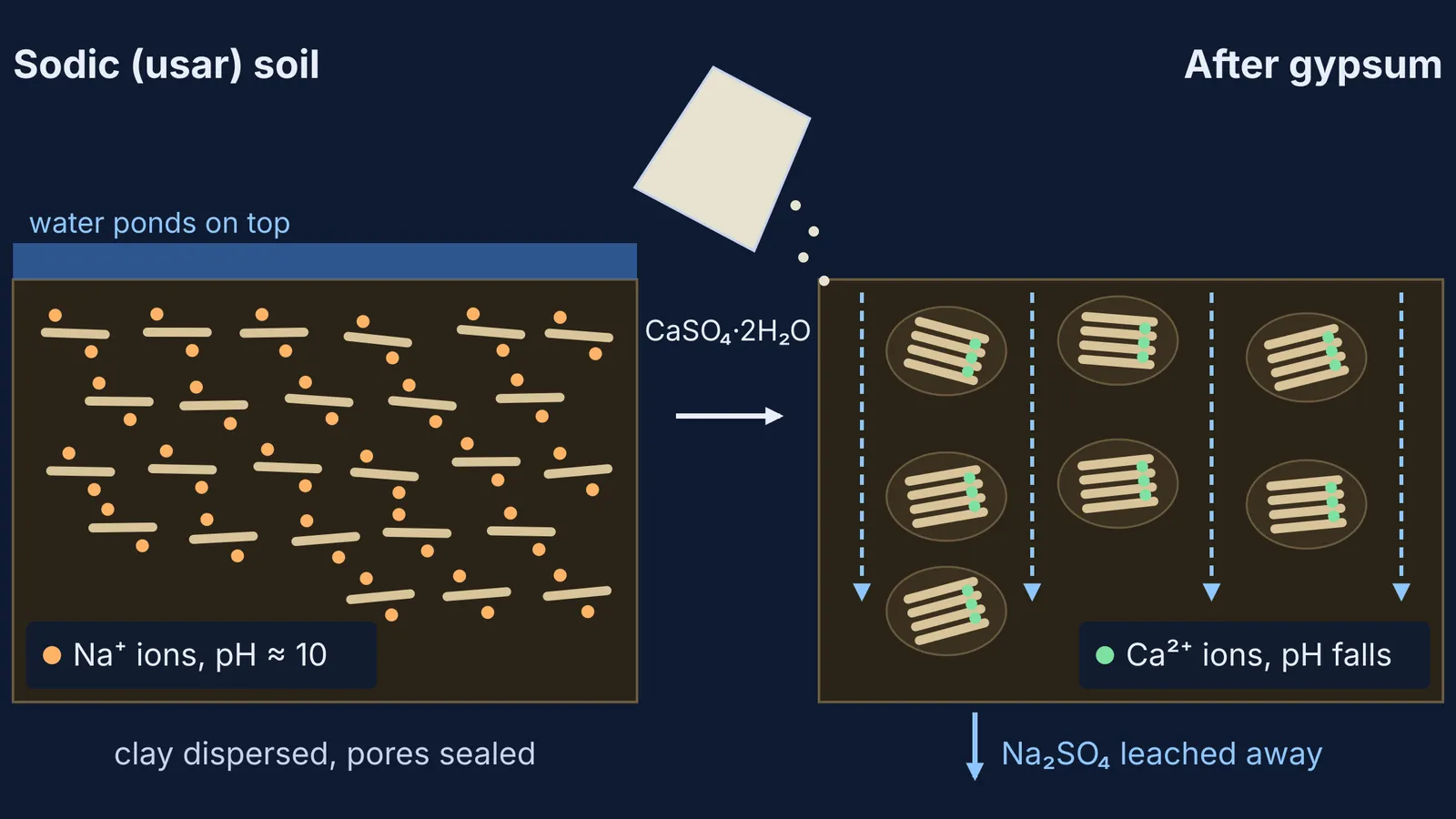
Across parts of Uttar Pradesh, Haryana and Punjab, farmers have a word for land where almost nothing grows: usar. The ground is hard and crusted, water stands on it after rain instead of sinking in, and the soil pH is often above 9. This is sodic soil, and the standard repair is to spread gypsum, CaSO₄·2H₂O, and flood the field with good water. The reason it works is Class 11 chemistry: carbonate hydrolysis, cation exchange and a solubility equilibrium.
India has a lot of this land. A field study from the Lucknow station of ICAR-Central Soil Salinity Research Institute (CSSRI) puts India's salt-affected land at about 6.73 million hectares, of which about 3.77 million hectares are sodic (Singh et al., Indian Journal of Agricultural Sciences, 2018). The Government of India's Principal Scientific Adviser credits the CSSRI gypsum technology with reclaiming about 2.22 million hectares of sodic soils (PSA technology page).
What is the difference between saline and sodic soil?
The US soil classification used in a Pacific Northwest extension guide sets the lines like this:
Saline soil: too much dissolved salt (electrical conductivity of the soil extract above 4 dS/m), but exchangeable sodium percentage (ESP) at or below 15. The structure usually stays crumbly, and the pH is usually below 8.5. Leaching with good water fixes it.
Sodic soil: less dissolved salt (conductivity below 4 dS/m), but ESP above 15. The structure collapses, and the pH is usually above 8.5. Water alone does not fix it.
Saline-sodic soil: both problems. It must be treated for sodium first.
ESP is the share of the soil's cation exchange capacity that is held by Na⁺. Usar is sodic. The Lucknow site in the study above had pH 9.8 and ESP 78, so sodium held more than three-quarters of the exchange sites.
Why is the pH of sodic soil so high?
Sodic soils carry sodium carbonate and sodium bicarbonate in their soil water. Carbonate is a base, so it hydrolyses:
CO₃²⁻ + H₂O ⇌ HCO₃⁻ + OH⁻
The constant is Kb = Kw/Ka₂, not Kw/Ka₁. See the pH of sodium carbonate and why it needs Ka₂ for the beaker version. Soil water also has bicarbonate, which makes a CO₃²⁻/HCO₃⁻ buffer. With Ka₂ = 5.6 × 10⁻¹¹, pKa₂ ≈ 10.25, so a mix with equal amounts of the two holds the pH near 10.25. More bicarbonate than carbonate pulls it lower, into the 9 to 10 range seen in usar.
The CSSRI paper notes that high pH lowers the solubility of some plant nutrients, which causes deficiencies on top of the poor drainage.
Why does sodium clay turn soil into a sealed crust?
Clay particles are tiny plates with negative charge on their surfaces. Cations from the soil water cling to those surfaces, and they can swap with other cations in the water. That is cation exchange, the same idea as a zeolite water softener, explained in our post on removing permanent hardness by ion exchange. Gypsum on usar runs that exchange the other way, pushing Na⁺ off with Ca²⁺.
Each Na⁺ carries only one charge and holds a large shell of water. When Na⁺ is the main counter-ion, the cloud of cations around each clay plate is thick and loosely held, so neighbouring plates push each other apart. The clay disperses. The loose particles block the pores, and the surface dries into a hard crust. The extension guide puts it simply: high exchangeable sodium, high pH and low calcium and magnesium together make the soil disperse.
Ca²⁺ carries two charges. It holds the clay plates closer together and lets them stick into crumbs, called flocculation. Crumbly soil has large pores, so water and air can move through it.
How does gypsum reclaim sodic soil?
Gypsum does two jobs at once.
It replaces sodium on the clay. 2Na–clay + Ca²⁺ → Ca–clay + 2Na⁺, or 2Na–clay + CaSO₄ → Ca–clay + Na₂SO₄.
It removes carbonate. Na₂CO₃ + CaSO₄·2H₂O → CaCO₃ + Na₂SO₄ + 2H₂O. Check: Na 2 = 2, Ca 1 = 1, S 1 = 1, C 1 = 1, O 9 = 9, H 4 = 4.
The second reaction is a precipitate conversion. Its equilibrium constant is K = Ksp(CaSO₄)/Ksp(CaCO₃) = 9.1 × 10⁻⁶ / 2.8 × 10⁻⁹ ≈ 3 × 10³ (NCERT values), so it runs well forward. With carbonate locked up as CaCO₃, the pH falls.
Both reactions make sodium sulphate, which is soluble. It must be washed below the root zone, which is why drainage is essential. CSSRI's Lucknow paper describes the standard practice as gypsum at 50% of the soil's gypsum requirement, followed by leaching with ponded good-quality irrigation water for about 10 days (Singh et al., 2018).
Gypsum dissolves only slightly, roughly 2 g per litre, so it acts slowly and needs water moving through the soil.
Worked example: how much gypsum per hectare?
This is an illustrative calculation to practise the chemistry, not a field recommendation. Real doses come from a laboratory gypsum requirement test and local agricultural advice.
A soil has a cation exchange capacity (CEC) of 10 cmol(+) kg⁻¹ and an ESP of 60. You want ESP down to 15 in the top 15 cm. Bulk density is 1.5 g cm⁻³.
Exchangeable Na⁺ now and after. 60% of 10 = 6.0 cmol(+) kg⁻¹. 15% of 10 = 1.5 cmol(+) kg⁻¹. You must remove 4.5 cmol(+) kg⁻¹.
Convert charge to moles of gypsum. One Ca²⁺ replaces two Na⁺, so 1 cmol(+) needs 0.5 cmol of CaSO₄·2H₂O. Per 1 cmol(+) kg⁻¹: 0.005 mol × 172.2 g mol⁻¹ = 0.86 g of gypsum per kg of soil.
Mass of soil. One hectare is 10⁴ m². At 0.15 m depth that is 1500 m³. At 1500 kg m⁻³ that is 2.25 × 10⁶ kg of soil.
Gypsum per hectare per cmol(+) kg⁻¹. 2.25 × 10⁶ kg × 0.86 g kg⁻¹ ≈ 1.94 × 10⁶ g ≈ 1.9 t.
Total. 4.5 × 1.94 ≈ 8.7 t of pure gypsum per hectare. Agricultural gypsum is not pure; at 75% purity you would need about 8.7/0.75 ≈ 11.6 t.
A cross-check: for the top 30 cm this rule gives about 3.9 t ha⁻¹ per cmol(+) kg⁻¹, or about 1.7 US tons per acre. The extension guide's table lists about 1.8 tons per acre for each 1 meq/100 g of sodium to replace in the top 12 inches. (1 meq/100 g is the same as 1 cmol(+) kg⁻¹.) The two agree.
This estimate counts only exchangeable sodium. A laboratory test measures all the calcium the soil takes up, including what is spent on soluble carbonate. The CSSRI site with pH 9.8 had a measured requirement of 15.2 t ha⁻¹.
If equivalents still trip you up, the Fermi Problem Library has worked problems with a step-by-step solver that explains the reasoning rather than printing an answer.
Checklist for sodic soil chemistry
Sodic: ESP above 15, pH usually above 8.5, low dissolved salt. Saline: high dissolved salt, ESP at or below 15.
High pH comes from CO₃²⁻ hydrolysis; use Kb = Kw/Ka₂.
Na-clay disperses and seals; Ca-clay forms crumbs that drain.
Gypsum swaps Ca²⁺ for Na⁺ on clay and precipitates carbonate as CaCO₃.
Na₂SO₄ must be leached away, so drainage and good water are part of the cure.
In dose problems, halve cmol(+) to get moles of CaSO₄·2H₂O.
For real fields, follow a soil test and ICAR-CSSRI or local advice.


