

On this page
"Study of the presence of oxalate ions in guava fruit at different stages of ripening" is one of the investigatory projects on the CBSE Class 12 chemistry list. The measurement is a redox titration you already know: oxalate reduces potassium permanganate, and the volume of KMnO₄ used tells you how much oxalate the fruit held. This guide walks through the method, a fully worked calculation, how to compare raw, half-ripe and ripe fruit, and the one big flaw in the method that most project files leave out.
What does the guava oxalate project actually measure?
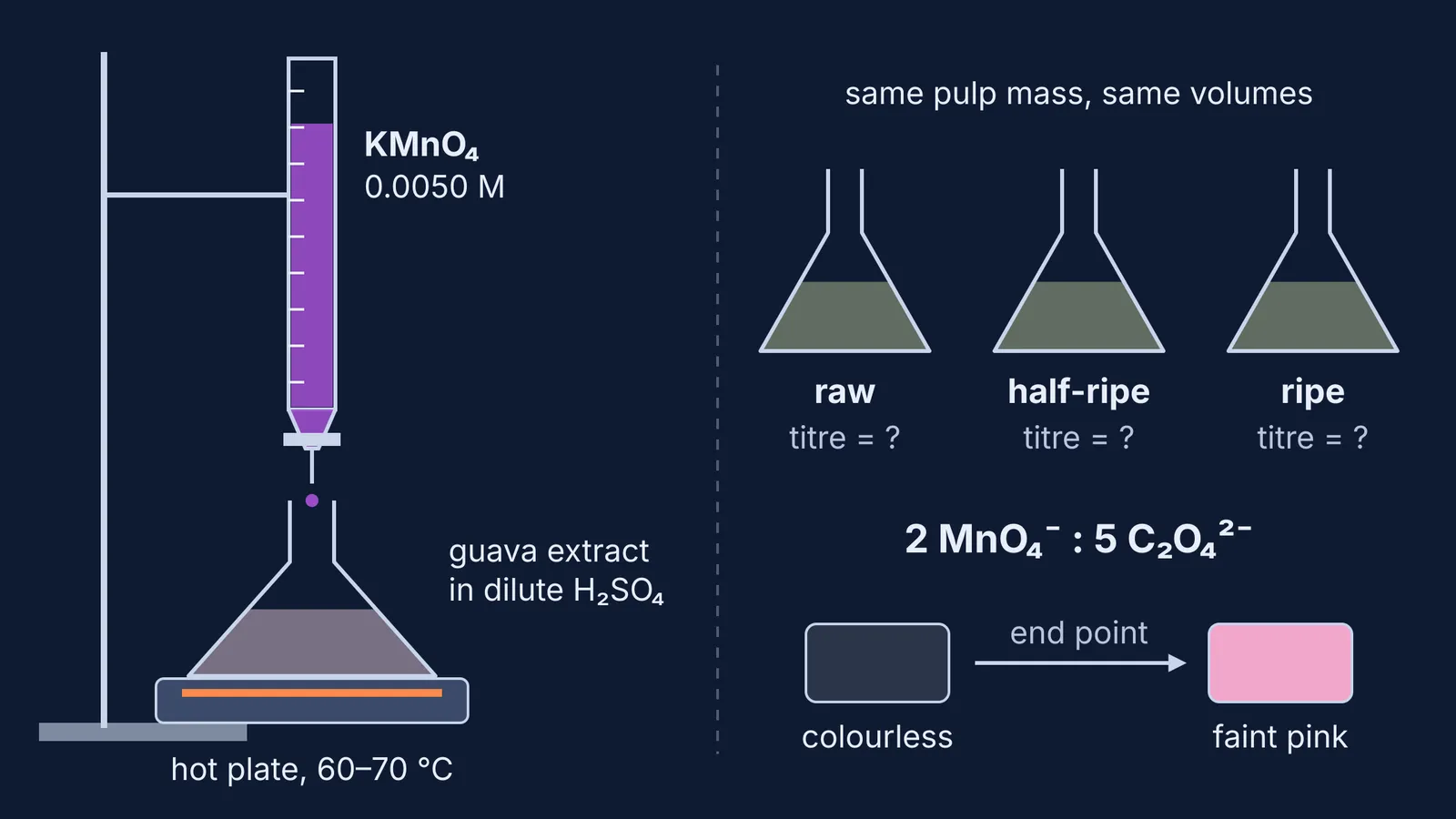
Oxalate is the C₂O₄²⁻ ion, the anion of oxalic acid, which many plants store. The project asks whether the amount in a guava changes as the fruit ripens. You answer it by extracting the oxalate into dilute sulphuric acid and titrating it with a standard KMnO₄ solution. In acid, oxalate is oxidised to carbon dioxide and permanganate is reduced to the almost colourless Mn²⁺ ion:
2MnO₄⁻ + 5C₂O₄²⁻ + 16H⁺ → 2Mn²⁺ + 10CO₂ + 8H₂O
Check it: 2 Mn, 10 C and 28 O on each side, and a charge of +4 on each side. The ratio that matters for every calculation is 2 mol MnO₄⁻ to 5 mol C₂O₄²⁻, not 1 : 1. Each MnO₄⁻ gains 5 electrons and each oxalate loses 2.
To show only that oxalate is present, see the confirmatory test for oxalate with calcium chloride and KMnO₄. This project measures how much.
How do you extract oxalate from guava pulp?
Weigh about 20 g of pulp from a raw guava. Record the mass to 0.01 g.
Crush it with a little distilled water, add about 50 mL of dilute H₂SO₄ and boil for about 10 minutes. The acid frees the oxalate as oxalic acid and helps dissolve calcium oxalate.
Cool and filter. Wash the residue with a little distilled water and add the washings to the filtrate.
Make the filtrate up to exactly 100 mL in a volumetric flask. Call this the extract.
Pipette 10.0 mL of extract into a conical flask, add about 10 mL of dilute H₂SO₄, warm to 60–70 °C, and titrate with standard KMnO₄ until a faint pink colour lasts about 30 seconds.
Repeat until you get concordant titres, then do the whole thing again for half-ripe and ripe fruit of the same variety.
Use H₂SO₄, not HCl. Permanganate oxidises chloride ions to chlorine, which uses up KMnO₄ that has nothing to do with oxalate and inflates your titre. Warm the flask because the reaction is slow at room temperature until some Mn²⁺ has formed; our explainer on why KMnO₄ fades slowly at first in oxalic acid titration explains the autocatalysis.
If the guava is pink-fleshed, the extract may be coloured. Filter it well and, if needed, dilute it further so you can see the first permanent pink.
How do you calculate oxalate content from the titre?
The numbers below are illustrative, chosen to make the arithmetic clear. They are not measured values for any real guava.
Data: 20.0 g of pulp made up to 100 mL. A 10.0 mL aliquot needs 2.0 mL of 0.0050 M KMnO₄.
Moles of MnO₄⁻ used: 0.0050 mol L⁻¹ × 2.0 × 10⁻³ L = 1.0 × 10⁻⁵ mol.
Moles of oxalate in the aliquot: use the 2 : 5 ratio. 1.0 × 10⁻⁵ × 5/2 = 2.5 × 10⁻⁵ mol.
Scale up to the whole extract: the aliquot was 10.0 mL out of 100 mL, so multiply by 10. 2.5 × 10⁻⁴ mol of C₂O₄²⁻ came from the 20.0 g of pulp.
Convert to mass: the molar mass of C₂O₄²⁻ is 2 × 12.01 + 4 × 16.00 = 88.02 g mol⁻¹. 2.5 × 10⁻⁴ × 88.02 = 0.0220 g, or 22.0 mg.
Express per 100 g of fruit: 22.0 mg in 20.0 g is 22.0 × 100/20.0 = 110 mg per 100 g.
So with these readings, the pulp contains about 110 mg of oxalate per 100 g, measured as C₂O₄²⁻. If your teacher wants the answer as oxalic acid (H₂C₂O₄, 90.04 g mol⁻¹), use that molar mass instead; the mole count does not change.
How do you compare raw, half-ripe and ripe guava fairly?
If you keep the same mass of pulp, the same 100 mL extract, the same 10.0 mL aliquot and the same KMnO₄ solution for all three stages, every step above except the titre stays fixed. The whole calculation then collapses into one factor:
oxalate (mg per 100 g) = titre (mL) × 0.0050 × 10⁻³ × 5/2 × 10 × 88.02 × 1000 × 100/20.0 = titre (mL) × 55.0
So a 2.0 mL titre means 110 mg per 100 g, a 1.6 mL titre would mean 88 mg per 100 g, and a 2.4 mL titre would mean 132 mg per 100 g. Work out this factor for your own concentrations and masses before you start.
What you should not do is decide in advance which way the trend goes. Published oxalate values for fruits vary widely with variety, growing conditions and method. The trend across ripening is the thing your project measures. Report what your titres show, and use fruit from one tree or batch so that variety is not a hidden variable.
Why might the titre overestimate oxalate in guava?
This is the weakness most project files skip. Guava is well known for being rich in vitamin C, and ascorbic acid (C₆H₈O₆) also reduces permanganate in acid, being oxidised to dehydroascorbic acid (C₆H₆O₆):
2MnO₄⁻ + 5C₆H₈O₆ + 6H⁺ → 2Mn²⁺ + 5C₆H₆O₆ + 8H₂O
That balances too: 30 C, 46 H and 38 O on each side, and +4 charge on each side. Every drop of KMnO₄ used by vitamin C is counted as oxalate in the calculation, so the direct titration gives an upper limit, not a clean oxalate value. Because vitamin C content itself changes as a fruit ripens, it can also distort the comparison between stages.
You can reduce it. A standard fix is to separate the oxalate first: add calcium chloride to the extract after adjusting it to a weakly acidic pH (around 4–5, with ammonia or an acetate buffer), so that calcium oxalate precipitates. Filter and wash the precipitate, which leaves vitamin C behind in the filtrate, then dissolve it in warm dilute H₂SO₄ and titrate that with KMnO₄. You can also measure vitamin C separately with the DCPIP test for vitamin C in fruit juices and discuss how large the interference might be.
Discussing this in your report shows the examiner you understand what the titration really measures. If the mole-ratio and dilution steps still feel shaky, the Fermi Problem Library has redox titration problems with a step-by-step solver that explains the reasoning.
Checklist before you hand in
Balanced equation written, with the 2 : 5 ratio stated.
Same variety, same mass of pulp and same volumes for all three stages.
Extract made in H₂SO₄, never HCl, and titrated at 60–70 °C.
Concordant titres for each stage.
Calculation shows moles of MnO₄⁻, the 5/2 factor, the dilution factor and the mass of pulp.
Result given in mg of C₂O₄²⁻ (or oxalic acid) per 100 g, with units.
Vitamin C interference discussed, and readings labelled as your own.


