

On this page
The first unit of the CBSE Class 11 chemistry practical is basic laboratory technique: cutting a glass tube, bending it, drawing out a jet and boring a cork to hold it. Each step follows from how glass behaves when heated, and knowing why means fewer kinked bends and cut fingers. The steps follow the NIOS Senior Secondary chemistry lab manual, which covers the same exercises as the NCERT practical.
Why does glass soften instead of melting?
Glass is an amorphous solid. Its atoms are locked in a disordered network, with no repeating crystal lattice, so there is no single temperature at which the whole network collapses at once. Heated, it just gets less and less stiff, like honey warming up. More on this in how glass is made from sand.
So the right word is softening point, not melting point. It is defined as the temperature where viscosity falls to about 10⁷·⁶ poise, where a rod starts to sag under its own weight. Approximate values:
Soda-lime glass, used for most school tubing: about 715 °C, according to Pilkington's data sheet for soda-lime glass. Other tables give values up to about 730 °C.
Borosilicate glass (the heat-resistant kind): about 820 °C, from Corning's data sheet for its 7740 glass.
So you can soften a zone, shape it and let it set. And hot glass looks exactly like cold glass: a bend that left the flame a minute ago can still burn you.
How do you cut a glass tube cleanly?
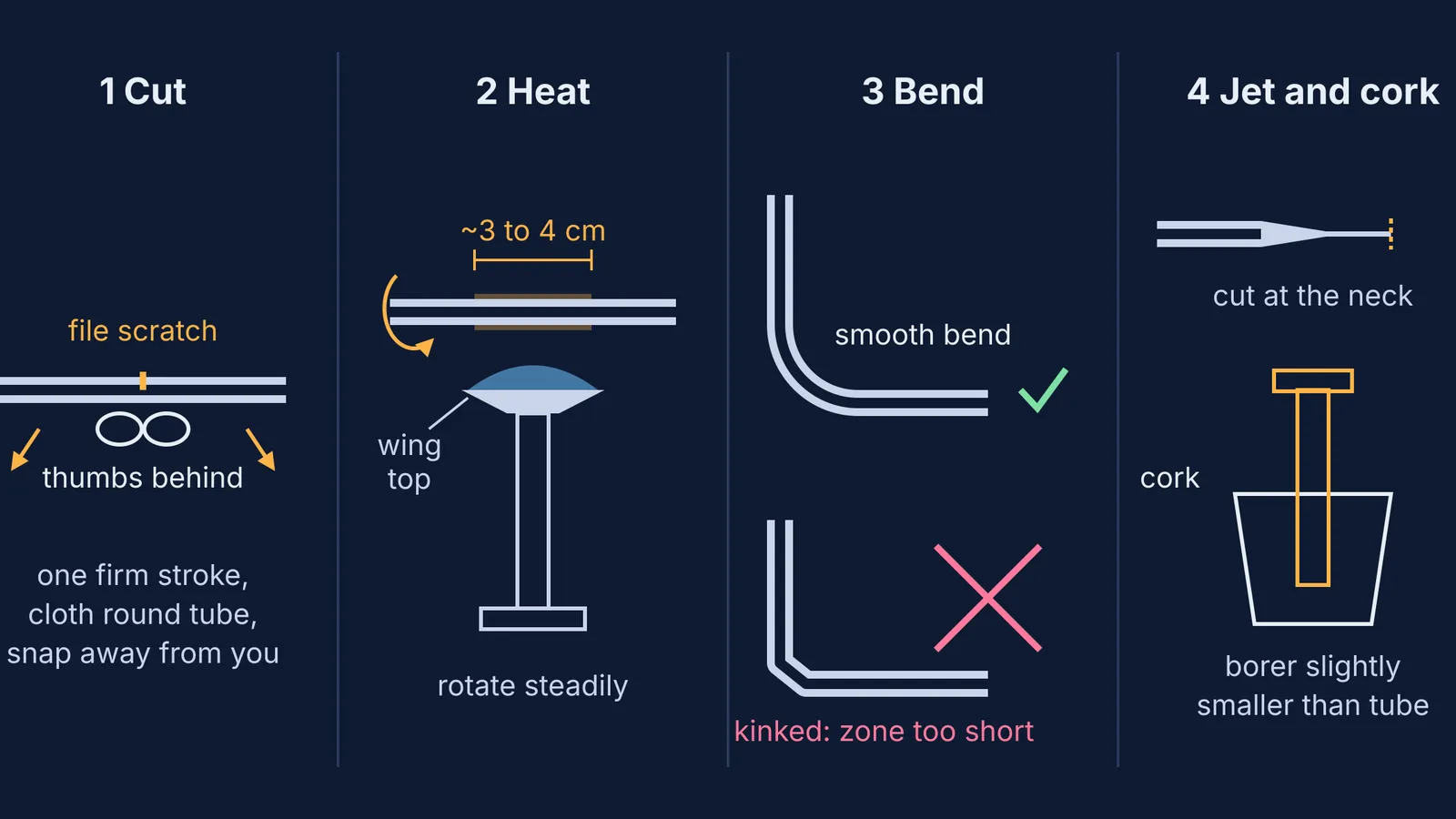
Mark the length, then make one firm scratch across it with the edge of a triangular file, in one direction only. Do not saw back and forth; several scratches give a ragged break.
Wrap the tube in a cloth. Hold it with both thumbs on the side opposite the scratch, touching each other just behind it.
Push gently outwards with your thumbs while pulling the ends slightly apart, with the scratch facing away from you. The tube snaps along the scratch.
If it does not break, scratch again in the same place. Do not force it.
Fire-polish both new ends: rotate each end in the hot part of the flame for a few seconds until the sharp edge rounds off. Stop before the bore starts to close.
The scratch works because glass breaks from small surface flaws. The scratch is a flaw placed on purpose, so the stress from your thumbs concentrates there and the crack runs straight across.
How do you bend a glass tube without kinking it?
Fit a wing top (fishtail) on the burner. It spreads the flame into a wide, flat sheet.
Hold the tube along the flame, not across it, and rotate it steadily
When the zone softens and the tube begins to sag, take it out of the flame.
Bend it in one smooth movement to the angle you need.
Lay it on a heat-resistant mat so both arms lie flat and in one plane, and leave it there to cool.
Steady rotation matters because soda-lime glass expands quite a lot when heated, about 8 × 10⁻⁶ per °C against about 3 × 10⁻⁶ per °C for borosilicate. For a 10 cm length heated through 300 °C, that is about 0.25 mm of expansion for soda-lime and 0.10 mm for borosilicate. If one side gets hotter than the other, the uneven expansion sets up stress that can crack the tube. Low expansion is why the glass in Otto Schott and the story of borosilicate glass survives heat so well.
Worked example: how long a zone should you heat?
You want a 90° bend with a radius of 2.0 cm (measured to the centre of the tube) in tubing 6 mm wide.
Find the arc length of the bend. A 90° bend is a quarter circle, so the centre line of the tube follows an arc of length πr/2.
Put in the radius. π × 2.0/2 = 3.1 cm.
Check the inner and outer walls. The outer wall sits at a radius of 2.0 + 0.3 = 2.3 cm, so it follows an arc of π × 2.3/2 = 3.6 cm. The inner wall sits at 1.7 cm and follows π × 1.7/2 = 2.7 cm. So the outer wall stretches about 15% and the inner wall squeezes about 15%.
Decide the heated length. That must all happen in soft glass, so heat about 3 to 4 cm evenly, a little more than the 3.1 cm arc.
If you heat only 1 cm, the same bend has to happen in a third of the length. The outer wall thins too much and the inner wall buckles inwards, so the bore narrows or closes. That kink will block a gas delivery tube.
How do you draw a glass jet and bore a cork?
Drawing a jet
Heat the middle of a tube in an ordinary (not wing-top) flame, rotating it steadily, until a short zone is soft.
Take it out of the flame and pull the two ends apart slowly and in a straight line. The soft zone stretches into a narrow neck.
Hold it still until it sets, then cool it on the mat.
When it is cold, scratch the narrow part with the file and snap it. Fire-polish the tip very briefly, or the fine bore will seal.
Pulling faster gives a thinner, longer neck.
Boring a cork and fitting the tube
Take an uncracked cork that fits your flask. Wet it and soften it in a cork press, or by rolling it under your shoe on the floor.
Choose a cork borer slightly smaller than the outside of the glass tube, so the tube grips tightly.
Stand the cork on the bench with its narrow end up and bore straight down with a twisting motion, keeping the borer upright.
To fit the tube, wet it with water or glycerol. Wrap it in a cloth, hold it close to the cork (not far along the tube) and push it in gently with a twisting motion.
Holding the tube far from the cork is how many hand cuts happen: the tube snaps under the push and the broken end goes into the palm.
What safety points matter most with glass and flames?
Wear goggles while cutting and working glass. Small chips fly.
Put hot glass on a heat-resistant mat to cool. Never cool it in water: the surface contracts faster than the inside and the glass cracks.
Broken glass goes in the broken-glass bin.
The chemistry lab safety rules for school practicals cover burns, spills and first aid in more detail. If you want to see why amorphous solids soften gradually while crystals melt sharply, the Concept Library has a lesson on every chemistry concept
Quick checklist
Glass has a softening point (about 715 °C for soda-lime, 820 °C for borosilicate), not a melting point.
One firm scratch, thumbs behind it, cloth round the tube, snap away from you.
Wing top, steady rotation, bend out of the flame.
Heat a zone a little longer than the bend's arc: 3 to 4 cm for a 2 cm radius right angle.
Cork borer slightly smaller than the tube; lubricate and twist, holding the tube near the cork.
Hot glass looks cold. Cool it on a mat, never in water.


