

On this page
The beaker you heat over a burner in the school lab and the lenses in a good microscope share an ancestor: one chemist in a small German town in the 1880s. His name was Otto Schott, and his method is as useful to you as his glass.
Who was Otto Schott?
Otto Schott was born on 17 December 1851 in Witten, Germany, studied chemistry and mineralogy in Aachen, Würzburg and Leipzig, and earned his doctorate from Jena in 1875 with a thesis on the theory and practice of glass making, according to the Neue Deutsche Biographie. His father, Simon Schott, made window glass (Wikipedia).
In 1879 Schott made a lithium-based glass and shared samples with the physicist Ernst Abbe (Encyclopedia.com). Abbe worked with Carl Zeiss's optical workshop in Jena, which made microscopes.
How did Schott and Abbe make new optical glass?
The problem was colour. A lens bends each colour of light by a slightly different amount, so white light splits and images get coloured fringes; this is called chromatic aberration (Bitesize Bio). How strongly a glass spreads colours is measured by its Abbe number, V = (n_d − 1)/(n_F − n_C), where a high value means low dispersion (Abbe number). Lens designers cancel colour errors by pairing glasses with different dispersions, so they needed glasses with new combinations of refractive index and dispersion.
Schott moved to Jena in 1882, backed by Zeiss, Abbe and the Prussian state government (Encyclopedia.com). In 1884 Schott, Abbe and Carl Zeiss founded a small glass laboratory there, which grew into today's SCHOTT company (SCHOTT corporate history).
His method was patient and systematic: he ran melting trials to research how the composition of a glass affected its properties (British Glass). In 1886 Zeiss produced the apochromat, a microscope objective that removed chromatic aberration for three wavelengths (Bitesize Bio).
Why does borosilicate glass not crack when heated?
Schott developed borosilicate glass between 1887 and 1893 (Wikipedia). It was used for thermometers from 1891 and laboratory glassware from 1893 (Neue Deutsche Biographie), and also suited pharmaceutical tubing and the heat-resistant cylinders of incandescent gas lamps (Encyclopedia.com). From 1918 it reached kitchens as Jenaer Glas (Schott AG).
Glass cracks in sudden heat because the hot part expands while the cold part does not, and the mismatch pulls the glass apart. Borosilicate glass 3.3 (sold as DURAN) has a coefficient of linear thermal expansion of 3.3 × 10⁻⁶ per kelvin (SCHOTT DURAN data sheet). Ordinary soda-lime glass, used for windows and bottles, is about 9 × 10⁻⁶ per kelvin (ChemEd X). Taking 3 × 10⁻⁶ per kelvin for borosilicate and the same breaking stress for both glasses, ChemEd X estimated that borosilicate glass survives a sudden temperature difference of about 183 K, against about 54 K for soda-lime glass (ChemEd X).
Worked example: how much does a glass tube grow?
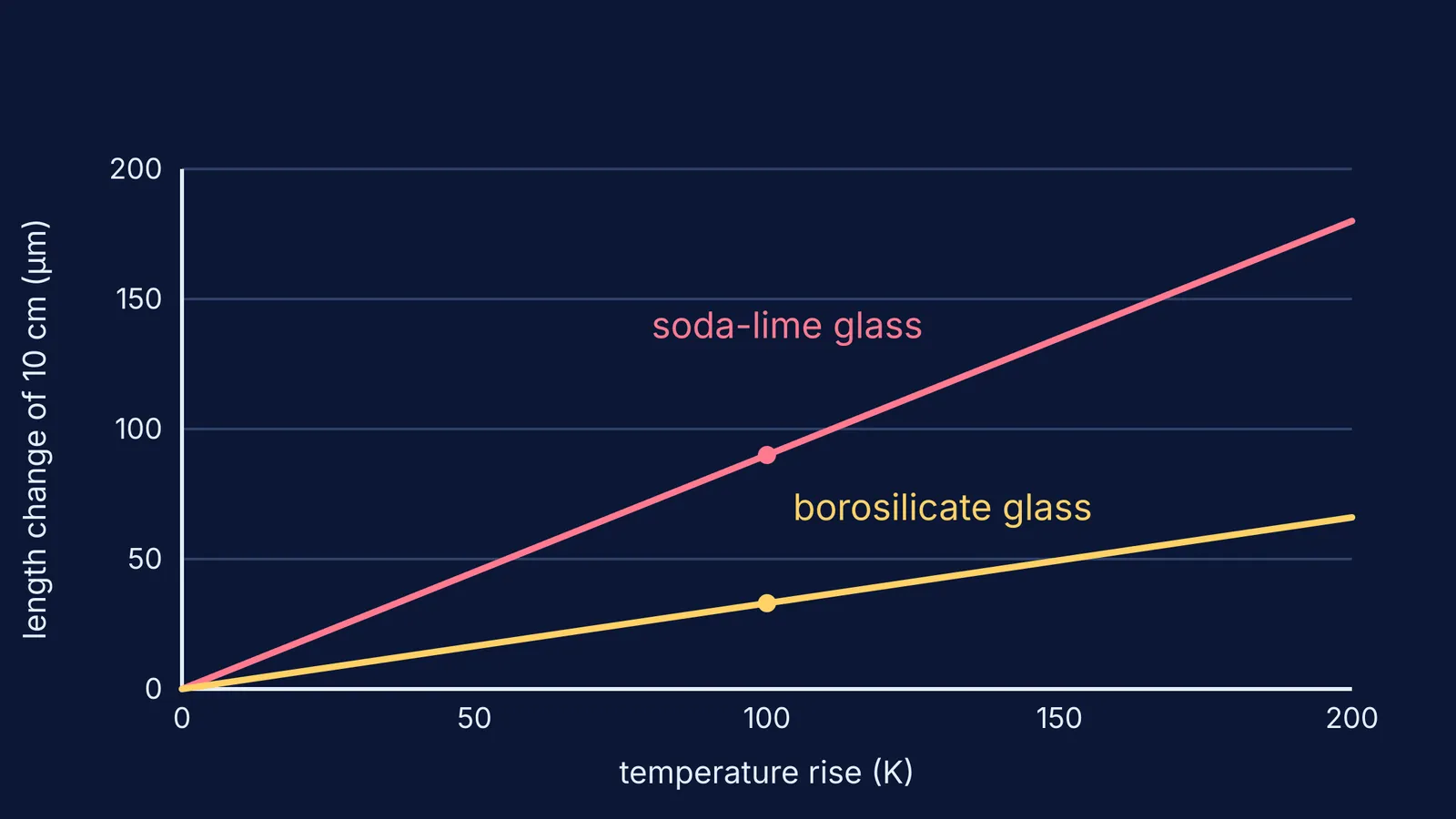
The rule from your Class 11 thermal properties chapter is ΔL = α × L × ΔT. Take a 10 cm glass tube heated by 100 K, using the expansion values from the SCHOTT data sheet and ChemEd X.
Borosilicate: ΔL = 3.3 × 10⁻⁶ × 0.10 m × 100 = 3.3 × 10⁻⁵ m, or 33 micrometres.
Soda-lime: ΔL = 9 × 10⁻⁶ × 0.10 m × 100 = 9 × 10⁻⁵ m, or 90 micrometres.
Compare: 90 ÷ 33 ≈ 2.7, so the soda-lime tube grows nearly three times as much.
Now picture boiling water poured into a cold beaker. The inner surface tries to grow; the outer surface holds it back. The smaller α is, the smaller that tug-of-war, which is why lab beakers and test tubes are usually borosilicate.
Try these yourself before checking with a friend:
A 50 cm borosilicate tube warms from 25 °C to 225 °C. How much longer does it get?
Which glass would you choose for a jar that goes from a fridge into hot water, and why?
A glass with α = 18 × 10⁻⁶ per kelvin: how much would a 10 cm tube grow for a 100 K rise?
If α, L and ΔT still feel like loose symbols, the Fermi Concept Library has a lesson for each concept in physics and chemistry, including where it sits in the map, so you can fill the gap before the next numerical.
What can students learn from Schott's method?
Schott's work is a lesson in systematic experiments: change what you put in, measure carefully, record everything, then decide. You can use the same habit in practicals and in revision. When a problem goes wrong, change one step, check the result, and note what moved.
Some ideas, like dispersion or expansion, are easier to see than to read. The Fermi Simulation Lab has interactive simulations for ideas that are easier to see than to read, so you can watch what changes when one quantity does.
Next time you light a burner under a beaker, look for the words borosilicate or 3.3, often printed on lab glass. That small number traces back to Otto Schott's work.


