On this page
Half-life problems treat a Geiger counter as perfect: every particle that enters the tube becomes one count. At low count rates that is close to true. At high rates it is badly wrong, because after each pulse the tube goes blind for a short time called the dead time. A counter with a 100 µs dead time that reads 5,000 counts a second is really being hit by 10,000 particles a second.
What is the dead time of a Geiger counter?
How the tube turns one ionising particle into a pulse, through an avalanche of electrons near the thin central wire, is covered in Hans Geiger and the counter that made radiation audible. What matters here is what the avalanche leaves behind.
The electrons reach the wire within a fraction of a microsecond. The positive ions are tens of thousands of times heavier and drift away slowly, forming a sheath around the wire. That sheath weakens the electric field near the wire so much that a new particle cannot start an avalanche. The tube is blind until the ions have moved far enough out. That interval is the dead time τ.
Two related terms are easy to mix up:
Recovery time: after the dead time, pulses are possible again but smaller; the recovery time is how long until they reach full size.
Resolving time: the shortest gap between two particles that the tube and its counting circuit together can record as two counts. It is what the counter actually shows, and it is usually close to the dead time.
How long is τ? It depends on the tube and the circuit. The manufacturer LND lists a minimum dead time of 90 µs for its 712 end-window tube (LND 712 specifications). This post uses a round illustrative value of τ = 100 µs, the same order of size.
How do you correct a count rate for dead time?
Suppose the counter records m counts per second. Each count is followed by τ seconds of blindness, so in one second the tube is dead for a total of mτ seconds and live for only (1 − mτ) seconds. All m counts came from that live time, so the true rate is:
n = m/(1 − mτ)
Rearranged, the recorded rate in terms of the true rate is m = n/(1 + nτ). The fraction of particles lost is (n − m)/n = mτ.
The correction changes the counter's reading, not the source. The source's activity is whatever it is; the counter simply misses some of its particles.
Worked example: how many counts does a 100 µs counter miss?
Take τ = 100 µs = 1.00 × 10⁻⁴ s.
m = 100 /s. mτ = 0.01, so 1% is lost. n = 100/0.99 = 101 /s.
m = 1,000 /s. mτ = 0.10. n = 1,000/0.90 = 1,111 /s. One particle in ten is missed.
m = 2,000 /s. mτ = 0.20. n = 2,000/0.80 = 2,500 /s.
m = 5,000 /s. mτ = 0.50. n = 5,000/0.50 = 10,000 /s. Half the particles are missed.
Check units. m is in s⁻¹ and τ in s, so mτ has no units, as a fraction must.
At background rates of a few counts a second, mτ is below 0.001 and the correction does not matter. It matters most exactly where you might trust the counter most, with a strong source close to the tube.
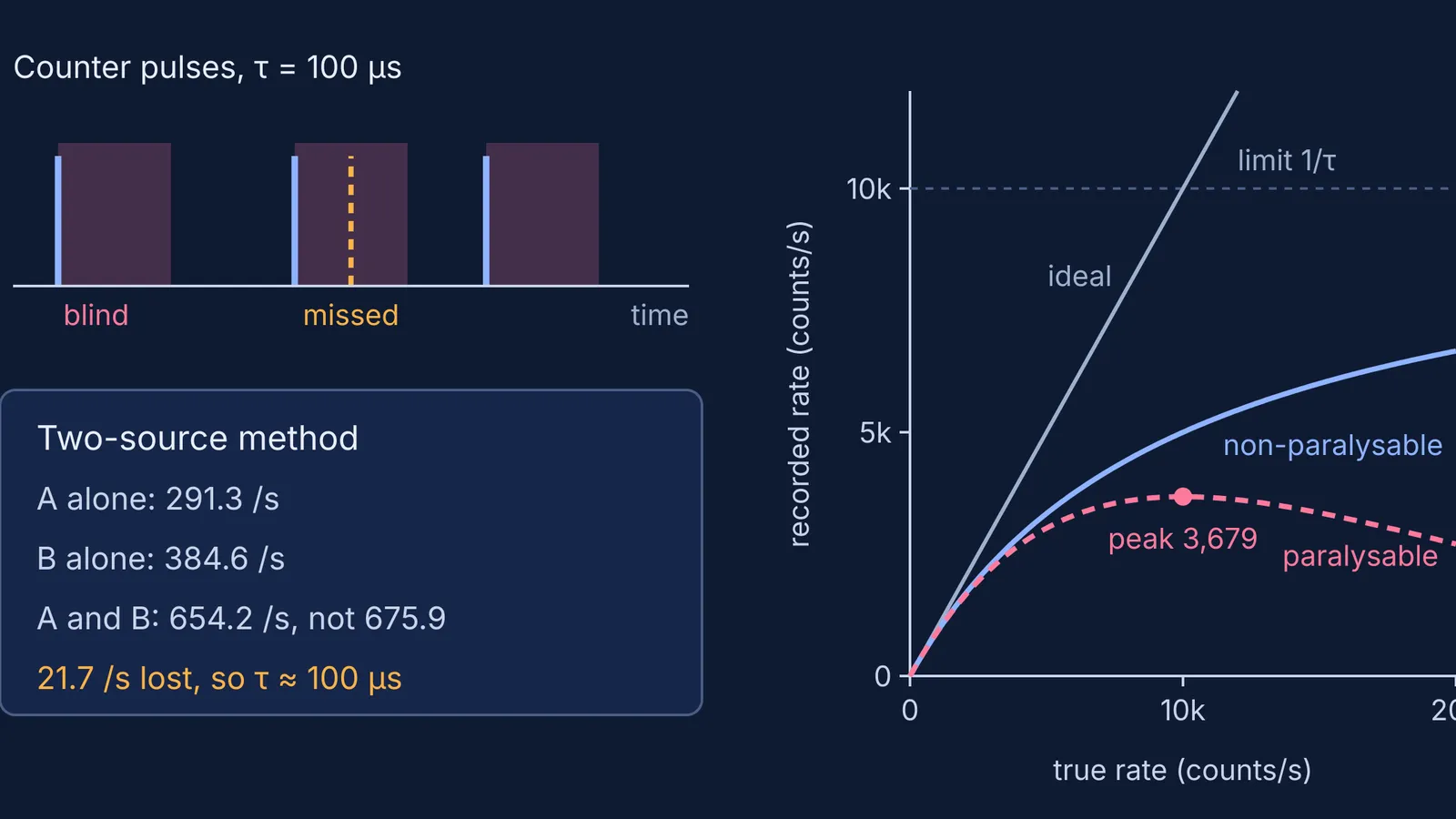
No reading can ever exceed 1/τ = 10,000 per second in this model. As the true rate grows without limit, the tube spends almost all its time dead, and the recorded rate creeps up towards 10,000.
Why can a very strong source make a Geiger counter read low?
The formula above assumes that a particle arriving during the dead time is simply ignored. That is the non-paralysable model. In the other extreme, the paralysable model, a particle arriving during the dead time is not counted but restarts the dead time. A rapid stream of particles can then keep the tube blind for a long time.
For random decays, a particle is counted only if no other particle arrived in the τ before it. The chance of that is e^(−nτ), so:
m = n e^(−nτ)
This rises, peaks and falls. The peak is at n = 1/τ = 10,000 /s, where m = 10,000/e = 3,679 /s. Push the true rate to 30,000 /s and the reading drops to about 1,494 /s. A reading of 3,000 /s could mean a true rate of about 4,900 /s or about 17,800 /s, and the reading alone cannot tell you which.
Real Geiger tubes sit somewhere between the two models. At low rates both give almost the same answer: at a true rate of 2,500 /s the non-paralysable model gives 2,000 /s and the paralysable model 1,947 /s. They differ sharply only at high rates.
How does the two-source method measure the dead time?
The two-source method uses the fact that true rates add but recorded rates do not. Ignoring background (or after subtracting it from every reading), take three readings:
Source A alone: m₁ = 291.3 /s.
Source B alone: m₂ = 384.6 /s.
Both together, in the same positions: m₁₂ = 654.2 /s.
The sum m₁ + m₂ = 675.9 /s, so 21.7 counts a second have gone missing.
Write the condition. True rates add: n₁ + n₂ = n₁₂.
Use the small-loss approximation. n ≈ m(1 + mτ), so m₁ + m₁²τ + m₂ + m₂²τ = m₁₂ + m₁₂²τ.
Simplify. Since m₁₂ ≈ m₁ + m₂, this becomes τ ≈ (m₁ + m₂ − m₁₂)/(2m₁m₂).
Substitute. τ ≈ 21.7/(2 × 291.3 × 384.6) = 21.7/224,068 = 9.68 × 10⁻⁵ s, about 97 µs.
Solve exactly. Solving n₁ + n₂ = n₁₂ with the full formula n = m/(1 − mτ) gives τ = 100 µs.
Check. With τ = 100 µs, the true rates are 300.0, 400.0 and 700.0 /s, and 300 + 400 = 700.
The small difference between the readings is the whole measurement, so each reading needs many counts to keep its random scatter well below 21.7 /s.
Do faster detectors have the same problem?
All counters have some dead time, but a Geiger tube's is long because every pulse is a full avalanche along the wire. Detectors that make small, fast pulses resolve particles far closer together. A photomultiplier, explained in how a photomultiplier turns one photon into a million electrons, gives pulses a few nanoseconds wide, so dead-time losses matter much less. Timing also matters when two pulses must be matched, as in Walther Bothe's coincidence method.
To practise dead-time and decay numericals step by step, the Fermi Problem Library has a solver that explains the reasoning at each stage.
Quick checklist
Dead time τ: the time after each pulse when the tube cannot register another particle.
True rate n = m/(1 − mτ); fraction lost = mτ.
τ = 100 µs: 1% lost at 100 /s, 10% at 1,000 /s, half at 5,000 /s.
Non-paralysable model: reading never exceeds 1/τ. Paralysable: reading peaks at 1/(eτ) and then falls.
Two-source method: τ ≈ (m₁ + m₂ − m₁₂)/(2m₁m₂), after subtracting background.
Dead time changes the reading, never the activity.