

On this page
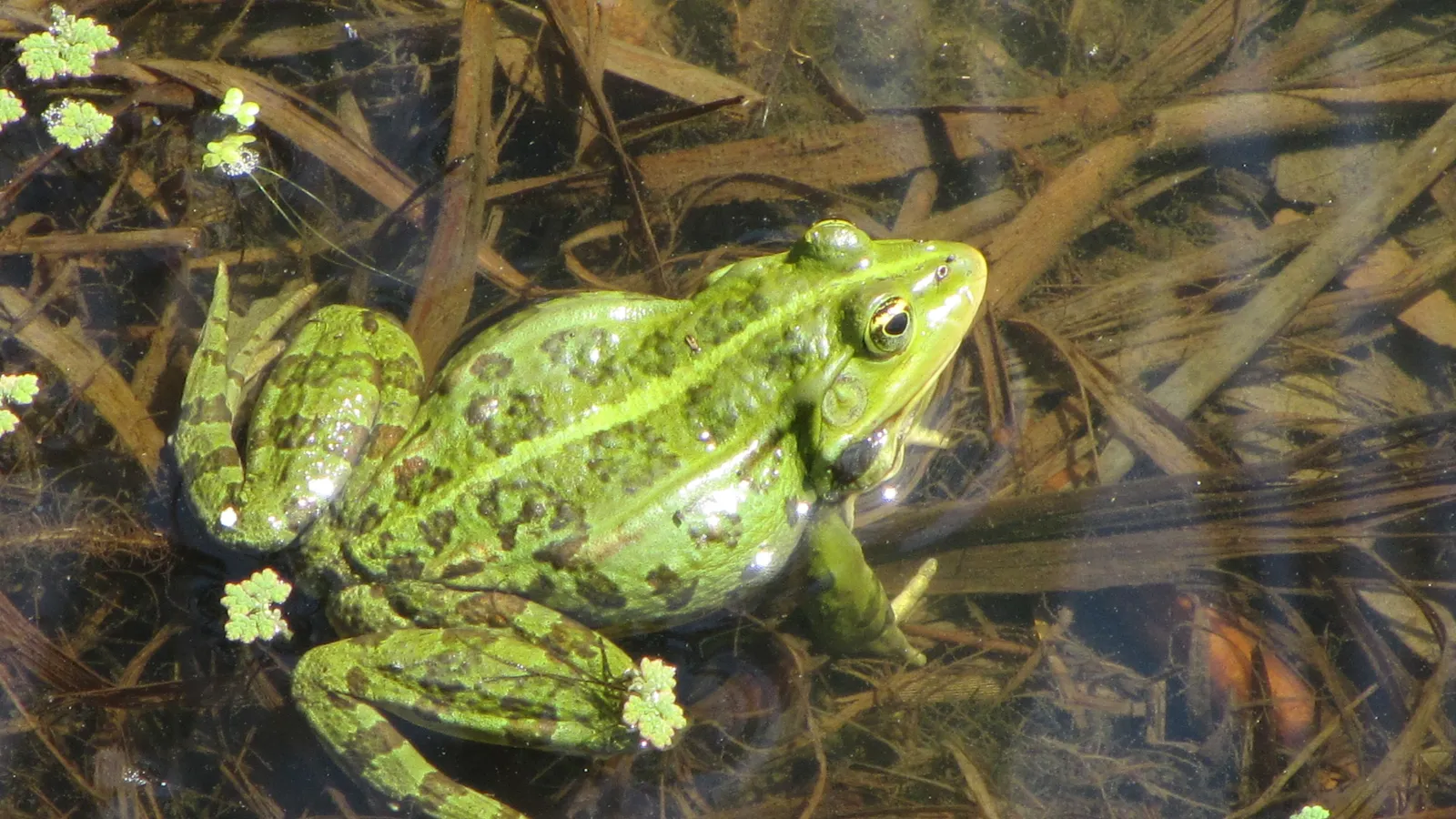
You can see both organs on a living frog: the bulging eye, and the flat, round patch of skin just behind it. NCERT's Class 11 Biology textbook covers them in two sentences: "Eyes are bulged and covered by a nictitating membrane that protects them while in water," and "On either side of eyes a membranous tympanum (ear) receives sound signals" (NCERT Biology Class 11, Chapter 7). Those two lines are your exam answer; here is why they are true.
What does the nictitating membrane do in a frog?
The nictitating membrane is a frog's translucent lower eyelid, which slides over the cornea while the upper lid stays still (Chai, Association of Reptilian and Amphibian Veterinarians, 2011).
A muscle called the retractor bulbi pulls the whole eyeball down into its socket, and as the eye sinks, the membrane slides passively over the cornea. So a frog blinks by pulling its eyes in. In the same paper, veterinarian Norin Chai reports that a resting frog closes its eyelids every 0 to 5 minutes.
Because the membrane is translucent, it can cover the eye and still let some light through. That fits the protective job NCERT gives it in water.
Pulling the eyes in has a second job that is not in the textbook. In a 2004 experiment, Robert Levine, Jenna Monroy and Elizabeth Brainerd cut the nerves to the eye-retracting muscles of northern leopard frogs. Afterwards the frogs needed 74% more swallows per cricket, rising from 2.3 to 4.0 (Journal of Experimental Biology, 2004). The researchers concluded that eye retraction is an extra swallowing aid: the sunken eyes appear to help push prey back towards the oesophagus.
How does the tympanum help a frog hear?
Frogs have no ear flap. NCERT puts it this way: "External ear is absent in frogs and only tympanum can be seen externally" (Chapter 7, linked above). The tympanum is the eardrum itself, sitting at the skin surface.
Andrea Megela Simmons and Darlene Ketten trace the path of a sound in their review "How a Frog Hears" (Acoustics Today, 2020):
Sound waves make the tympanum vibrate. It is a thin membrane held in a ring of cartilage just behind the eye.
A cartilage rod, the extracolumella, joined to a bony rod, the columella, carries the vibration across the air-filled middle ear.
The far end of the columella presses on the oval window of the inner ear. The two rods work as a lever that raises the acoustic power reaching the inner ear, much as the three middle-ear bones do in mammals.
The inner ear has no cochlea. Three organs respond to sound instead: the saccule, the amphibian papilla and the basilar papilla.
The same review notes that in bullfrogs, the male's tympanum is about 50% larger than the female's, even after adjusting for body size. In most frogs, the upper limit of hearing is below 8,000 Hz, though there are exceptions.
NCERT adds one more function: "The ear is an organ of hearing as well as balancing (equilibrium)." If a question asks what a frog's ear does, give both.
What are the sense organs of a frog?
NCERT lists five sense organs in a single sentence (Chapter 7, linked above). Here they are as a quick-revision list:
Touch: sensory papillae, a cluster of cells around nerve endings
Taste: taste buds, a cluster of cells around nerve endings
Smell: nasal epithelium, a cluster of cells around nerve endings
Vision: eyes, a well-organised organ; simple eyes "possessing only one unit", set in the orbit of the skull
Hearing and balance: tympanum with internal ears, a well-organised organ; no external ear
The pattern to remember is that only the eyes and internal ears are "well-organised structures". The other three are cellular aggregations around nerve endings.
How do you write this in an exam answer?
A two-mark answer to "Give the function of the nictitating membrane and tympanum in frog" can be this short:
Nictitating membrane: a membrane covering the bulged eyes; it protects the eyes while the frog is in water.
Tympanum: a membranous ear on either side of the eyes; it receives sound signals, which pass to the internal ear.
Three common slips to avoid:
Writing that frogs have an external ear. They do not; only the tympanum shows.
Calling the frog's eyes compound. NCERT calls them simple eyes.
Leaving out balance. The frog's ear does hearing and equilibrium.
For the rest of the frog's outer body, see our frog morphology key points, and for the whole chapter, our guide to structural organisation in animals. To compare the frog's ear with your own, read how hair cells in the cochlea turn sound into signals.
If a term in this chapter still feels shaky, the Fermi Concept Library has a lesson for every concept in biology, physics, chemistry, mathematics and computing, each with its place in the map. If you are not sure where to start revising, Fermi's AI tutor works out what you already know and builds a plan for the session.


