

On this page
Print a set of black and clear rings on film, with the radii worked out from the wavelength, and you have a lens with no glass in it. Shine a red laser through it and a bright spot appears 50 cm behind it. This is a Fresnel zone plate. It focuses light by diffraction rather than refraction, and it is how scientists focus X-rays, which no glass lens can bend. All you need to design one is Huygens' principle and path difference.
What are Fresnel zones?
Pick a point F on the axis, a distance f behind a flat wavefront. Every point of the wavefront sends a wavelet to F, but wavelets from farther out travel farther. Draw circles on the wavefront where the extra path to F is λ/2, λ, 3λ/2 and so on. The rings between neighbouring circles are the Fresnel zones.
The edge of zone n is where the distance to F is f + nλ/2. By Pythagoras, r² + f² = (f + nλ/2)², which gives
r_n = √(nλf + n²λ²/4) ≈ √(nλf)
The second term is tiny when λ is much smaller than f. Wavelets from one zone arrive at F roughly half a wavelength out of step with those from the next zone, so neighbouring zones nearly cancel.
You may have met the first Fresnel zone already in why a microwave link needs Fresnel zone clearance. That post uses only the first zone, to keep a radio beam's path clear. Here we use dozens of zones and block half of them.
How does a zone plate focus light with no glass?
If every zone is open, the contributions alternate in sign and largely cancel. Block all the even zones (2, 4, 6, ...) and leave the odd ones clear. Now every zone that gets through sends light that arrives at F in step. The amplitudes add, and F becomes a bright focus.
The same cancelling of wavelets ring by ring is behind Arago's bright spot, the bright point at the centre of a disc's shadow. A zone plate turns the idea into a working lens.
What ring radii focus red light at 50 cm?
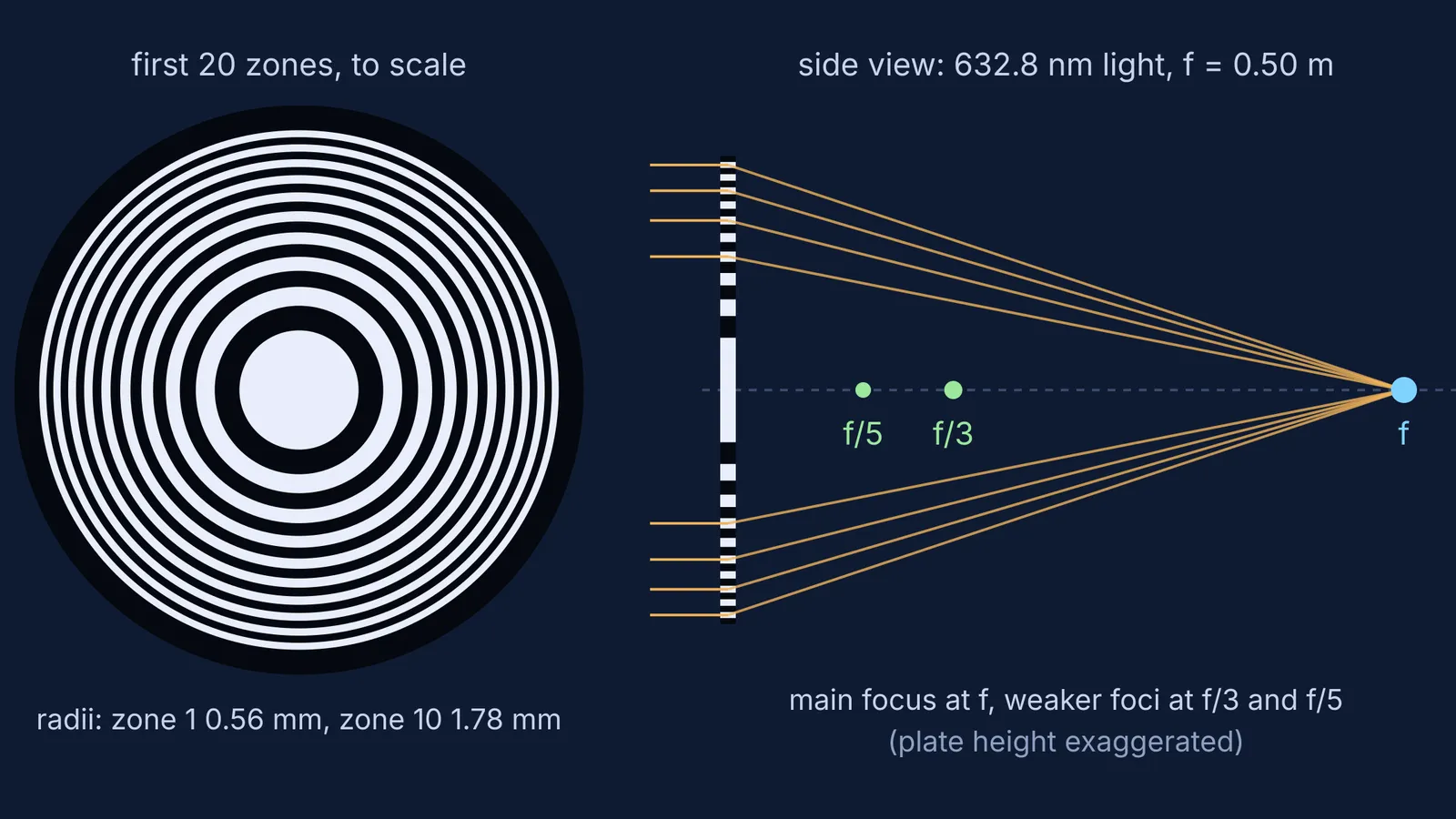
Problem. Design a zone plate that focuses helium–neon laser light (λ = 632.8 nm) at f = 0.50 m. Find r₁, r₂, r₁₀ and r₁₀₀, and the width of the hundredth zone.
First zone. λf = 632.8 × 10⁻⁹ × 0.50 = 3.164 × 10⁻⁷ m². r₁ = √(3.164 × 10⁻⁷ + (632.8 × 10⁻⁹)²/4) = 5.625 × 10⁻⁴ m = 0.562 mm. The correction term changes it by less than one part in a million.
Second zone. r₂ = √(2 × 3.164 × 10⁻⁷) = 0.795 mm. Not 2 × 0.562 mm: radii grow as √n.
Tenth zone. r₁₀ = √10 × 0.5625 mm = 1.779 mm.
Hundredth zone. r₁₀₀ = √100 × 0.5625 mm = 5.625 mm.
Zone width. r₁₀₀ − r₉₉ = 5.625 − 5.597 = 0.028 mm = 28 µm. A handy shortcut: the width of zone n is about r_n/2n = 5.625 mm/200 = 28 µm.
Check the path. At r₁₀, the distance to F is √(0.5² + (1.779 × 10⁻³)²) = 0.5 m + 3.16 µm, and 3.16 µm is 5.0 wavelengths, which is 10 × λ/2 as it should be.
So the rings crowd together as you go out. A plate with 100 zones is only 11.25 mm across, and its outer rings are thinner than a hair.
Why does a zone plate have more than one focus?
Rearranging r₁² = λf gives f = r₁²/λ. But look at the point f/3. There, each ring of the plate covers three Fresnel zones instead of one. Two of the three cancel and one is left over, so the light still adds up, just more weakly. The same happens at f/5, f/7 and so on. A zone plate has a main focus at f and weaker foci at f/3 and f/5 (and virtual ones on the other side, because it also makes a diverging wave).
Most of the light does not reach the main focus. The X-ray Data Booklet's section on zone plates, by Janos Kirz and David Attwood, published by Lawrence Berkeley National Laboratory, gives the ideal first-order efficiency of a simple black-and-clear plate as about 10% (that is 1/π² = 0.101). The opaque zones absorb half the light; a quarter goes straight through undiffracted; the rest goes to the other orders. The same source notes that replacing the opaque zones with transparent zones that shift the phase can improve the efficiency substantially.
Why does blue light focus farther than red?
Since f = r₁²/λ, the focal length is inversely proportional to the wavelength. Keep the plate designed above and switch to blue light of 450 nm:
f = 0.50 m × 632.8/450 = 0.703 m
Blue focuses 20 cm farther away than red. In a glass lens it is the other way round: glass has a higher refractive index for blue, so blue bends more and focuses closer. A zone plate's chromatic aberration is reversed and much larger, which is why it is used with laser light or X-rays of a single wavelength.
A zone plate is also not a Fresnel lens. A Fresnel lens, like the stepped lens in a lighthouse described in Augustin Fresnel's work on optics, still bends light by refraction. A zone plate works only by diffraction.
How do zone plates focus X-rays?
For X-rays, the refractive index of every material is extremely close to 1, so a glass lens bends them almost not at all. A zone plate does not need refraction, only rings of the right size.
Illustrative example. Take soft X-rays of 500 eV and a plate with 500 zones whose outermost zone is 25 nm wide.
Wavelength: λ = 1239.8 eV nm / 500 eV = 2.48 nm.
Diameter: with zone width Δr = r_N/2N, D = 2r_N = 4NΔr = 4 × 500 × 25 nm = 50 µm.
Focal length: f = r_N²/(Nλ) = (25 µm)²/(500 × 2.48 nm) = 0.50 mm.
Resolution: the X-ray Data Booklet links the finest detail to the outermost zone width; the Rayleigh limit is about 1.22Δr = 1.22 × 25 nm ≈ 30 nm.
So a plate about as wide as a fine hair focuses X-rays half a millimetre away and resolves detail about 30 nm across. Real X-ray microscope plates differ from facility to facility; these numbers are round values to show the scale.
For more practice with path difference and diffraction problems, the Fermi Problem Library has a step-by-step solver that explains the reasoning.
Quick checklist
Zone n edge: r_n = √(nλf + n²λ²/4) ≈ √(nλf).
Every zone has the same area, πλf.
Block alternate zones and the rest add in step at F.
f = r₁²/λ; extra foci at f/3, f/5.
About 10% of the light reaches the main focus of a simple plate.
Blue focuses farther than red, the reverse of glass.
Resolution is set by the outermost zone width, about 1.22Δr.


