

On this page
The lateral line is a set of sensors that lets a fish feel water moving around it, even in the dark. Here is how its sensors work, and how to see what they feel with a tray of water and some pepper.
What is the lateral line in fish?
The lateral line is a sensory system that allows fishes to detect weak water motions and pressure gradients, according to a review by Horst Bleckmann and Randy Zelick in Integrative Zoology (2009).
Its smallest working unit is the neuromast: a patch of hair cells capped by a jelly-like cupula, which connects the cells' hair bundles to the surrounding water. The same review says most fishes have hundreds of superficial neuromasts spread over the head, trunk and tail fin. Many also have neuromasts sunk inside canals that open to the water through a series of pores. That row of pores is the line you see on the fish's side.
A 2019 review by Joachim Mogdans in the Journal of Fish Biology says the system can hold up to several thousand neuromasts across the body. Its layout varies greatly between and within species, though how those differences match habitats is still debated.
How does a neuromast sense water movement?
Picture the cupula as a tiny flag of jelly standing in the water. When water slides past, it drags the cupula sideways. The cupula bends the hair bundles of the cells beneath it, and that bending changes the signal the hair cells pass to the nerve fibres below.
Two details come from a comparison of lateral-line and inner-ear hair cells by Boris Chagnaud and colleagues in Brain, Behavior and Evolution (2017):
Hair cells come in two opposite orientations, and each orientation is contacted by different nerve fibres. So water pushing one way and water pushing the opposite way send different messages.
The two kinds of neuromast are not equally sensitive. Canal neuromasts respond to the pressure gradient across their surface, which the review equates with the water's acceleration. Superficial neuromasts, sitting on the skin, are generally much less sensitive because they have fewer hair cells and smaller cupulae.
The review compares these cells with the hair cells that sense balance in your inner ear. Our guide to neurons and nerve impulses in neural control and coordination covers what happens once the signal reaches the nerve.
What does a fish use its lateral line for?
The 2017 review links the lateral line to prey detection, following trails left in the water, and orienting within a current, known as rheotaxis.
The clearest natural experiment is the blind Mexican cavefish. In the Journal of Experimental Biology (2014), Masato Yoshizawa and colleagues note that cavefish have more superficial neuromasts than their sighted stream-dwelling relatives. A mechanical model built from measurements showed that neuromasts in and below the eye socket were larger, and so about twice as sensitive in small adult cavefish as in surface fish. In behaviour tests, small cavefish were drawn towards a rod vibrating at 35 Hz in the water, while surface fish were not.
How can you see what a fish senses? A ripple-in-a-tray demo
You need a wide steel tray, water about 2 cm deep, ground black pepper and a pencil.
Let the water go still, then sprinkle pepper in a line across the tray. Each flake stands in for a cupula.
Tap the pencil tip into the water about a hand's width from the line, steadily, about twice a second.
Move the tapping point to one end of the line and repeat.
Hold a finger still in the water near the line while a friend taps.
What to notice, and what it means for the fish:
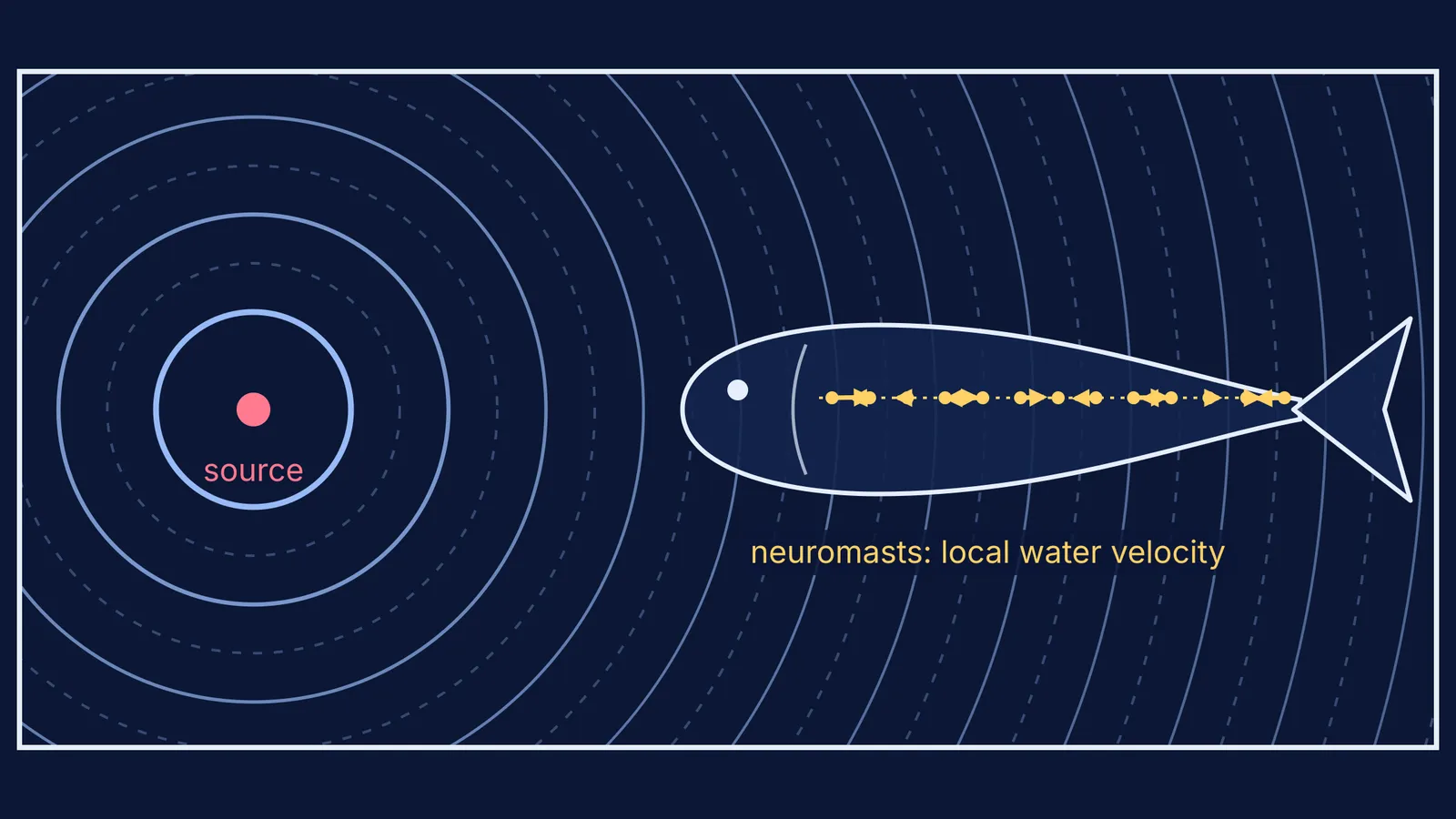
The flakes rock back and forth but do not travel with the ripple. The surface water moves to and fro as each wave passes, and that local motion is what drags a cupula.
Flakes near the pencil move more than far ones. A ripple's energy spreads around an ever-larger circle, so the motion fades with distance. That is why the lateral line is a short-range sense.
With the source at one end, near flakes start moving before far ones. A row of sensors along a body gets a timing pattern that points back towards the source.
Flakes beside your still finger move differently. Even an object that is not moving reshapes the ripples around it.
The ripples you made are short capillary-gravity waves. For the physics of how fast they move, read why no ripple on water travels slower than 23 cm/s.
How should you revise the lateral line?
Treat it as a meeting point of three ideas: receptors (hair cells), nerve signals (separate fibres for opposite directions) and waves (motion that fades with distance). If you can explain the pepper tray using all three, you understand the system.
If one idea is shaky, the Fermi Concept Library has a lesson for every concept in physics, chemistry, biology, mathematics and computing, each with its place in the map. Then fill a tray tonight and watch the pepper.


