

On this page
Why is the first trimester the most sensitive to drugs?
A developing baby is most vulnerable when its organs are first being built. That construction phase — called organogenesis — runs from about the third to the eighth week after fertilisation, and it is when a single exposure can change how a whole organ forms, from a neural tube defect to a heart or limb malformation (teratology review, WikiLectures). A 2025 review in Birth Defects Research found that the critical periods for most structural birth defects fall in the 3rd to 6th week of human embryonic development (Nangle et al., 2025).
Timing matters more than you might expect. In the first two weeks after conception (weeks 3 and 4 counting from the last menstrual period), the embryo is in an "all-or-none" period: a severe hit usually ends the pregnancy, while a minor one is often repaired, because the cells can still replace one another (MotherToBaby, 2025). After that, each organ has a short window when it cannot recover, and most of those windows close before the first trimester ends at 13 weeks and 6 days (MotherToBaby, 2025).
What does the thalidomide case prove about timing?
Thalidomide is the clearest evidence we have. Sold from the late 1950s and advertised as completely safe — even used for morning sickness — it reached 46 countries before two clinicians, Lenz in Germany and McBride in Australia, confirmed in 1961 that it caused birth defects (Vargesson, 2015). Over 10,000 children were born with severe malformations, and infant mortality among the worst affected reached as high as 40% (Vargesson, 2015). A single 50 mg tablet taken in the wrong week was enough to cause defects in up to half of exposed pregnancies (Vargesson, 2015).
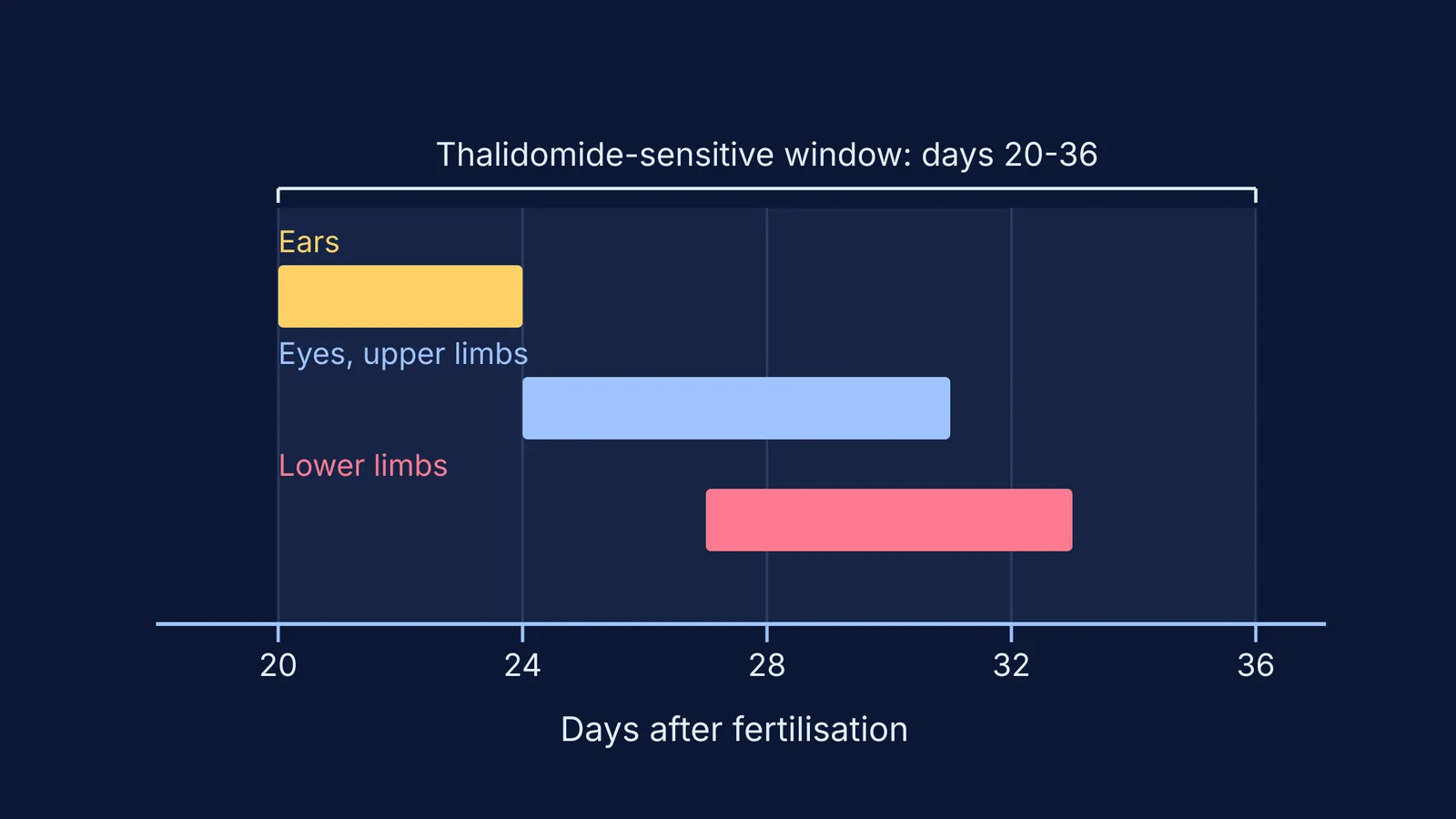
What makes it a teaching case is the precision. The damage happened only when the drug was taken between day 20 and day 36 after fertilisation — 34 to 50 days after the last period (Vargesson, 2015). Within that window, the day of exposure decided which organ was hit: days 20–24 affected the ears, exposure after day 24 struck the eyes and upper limbs, and the lower limbs were affected by later intake, after day 27 (Asatsuma-Okumura et al., 2020). Same drug, same dose — a different day, a different defect.
A week-by-week map of organ sensitivity
Counting from fertilisation (add about two weeks to get weeks of pregnancy), the embryonic period lines up roughly like this:
Weeks 1–2: all-or-none. Survival or miscarriage, rarely a structural defect (MotherToBaby, 2025).
Weeks 3–4: the neural tube forms and closes, and the heart begins to loop — which is why folic acid matters before you know you are pregnant.
Weeks 3–6: the peak window for neural tube, heart, limb and facial defects (Nangle et al., 2025).
Weeks 4–8: limbs, eyes, ears and palate take shape; the thalidomide window of days 20–36 sits right here (Vargesson, 2015).
Weeks 8–12: the hemochorial placenta — where the mother's blood meets the baby's tissue — only finishes maturing now, after the most sensitive weeks are over (Nangle et al., 2025).
One surprise from that last point: the placenta is often blamed for letting drugs through, yet its full barrier forms late, which means the embryo is most sensitive before the definitive placenta even exists (Nangle et al., 2025). The brain is the exception to the whole timeline — it keeps developing, and stays sensitive, for the rest of the pregnancy.
If you are revising this for NEET, the exam-ready version is short: organogenesis in weeks 3–8 carries the highest teratogen risk, and the brain is sensitive throughout. The Fermi Concept Library maps human development concept by concept, and the Fermi Problem Library works assertion-reason questions step by step, so you can see why "the first trimester is most sensitive" is the reason behind an answer, not just the answer.
What can students and parents take from this?
Two practical things. First, the timing explains the official advice: the WHO recommends 400 micrograms of folic acid daily from the moment someone starts trying to conceive until 12 weeks of pregnancy, because the neural tube usually closes before a missed period is even noticed (WHO ELENA). Second, it explains why doctors ask about every tablet, supplement and home remedy in early pregnancy.
A simple script for a family member who is, or might be, pregnant:
"Before you take anything — including over-the-counter and Ayurvedic remedies — check with a doctor or pharmacist first."
"Tell them the first day of your last period, so they can work out which week you are in."
"If you are planning a pregnancy, start folic acid now, not after the test."
This is general information, not medical advice; a doctor decides what is safe for an individual.
The thalidomide story also has a quieter side: in the United States, the FDA reviewer who kept the drug off the market spared thousands of families. For the biology behind the timeline, see what forms when across pregnancy, and for the chapter as a whole, how to prepare human reproduction for NEET.


