

On this page
In the Class 12 Biology syllabus, Human Reproduction is a high-weightage chapter that connects cellular processes to the macroscopic development of a human being. The nine months of human pregnancy, known as the gestation period, follow a strict developmental timeline as outlined in the NCERT Class 12 Biology textbook. For students preparing for board exams or NEET-UG, these specific milestones are highly testable. Questions often ask you to match the month to the developmental marker, or to identify which structure forms first.
Here is the exact month-by-month foetal development timeline.
What happens in the first trimester?
The first trimester covers the first 12 weeks of pregnancy and is a period of rapid organogenesis (the formation of organs). Because the fundamental structures are laid down during this time, the foetus is particularly sensitive to external factors according to the NCERT Class 12 Biology textbook.
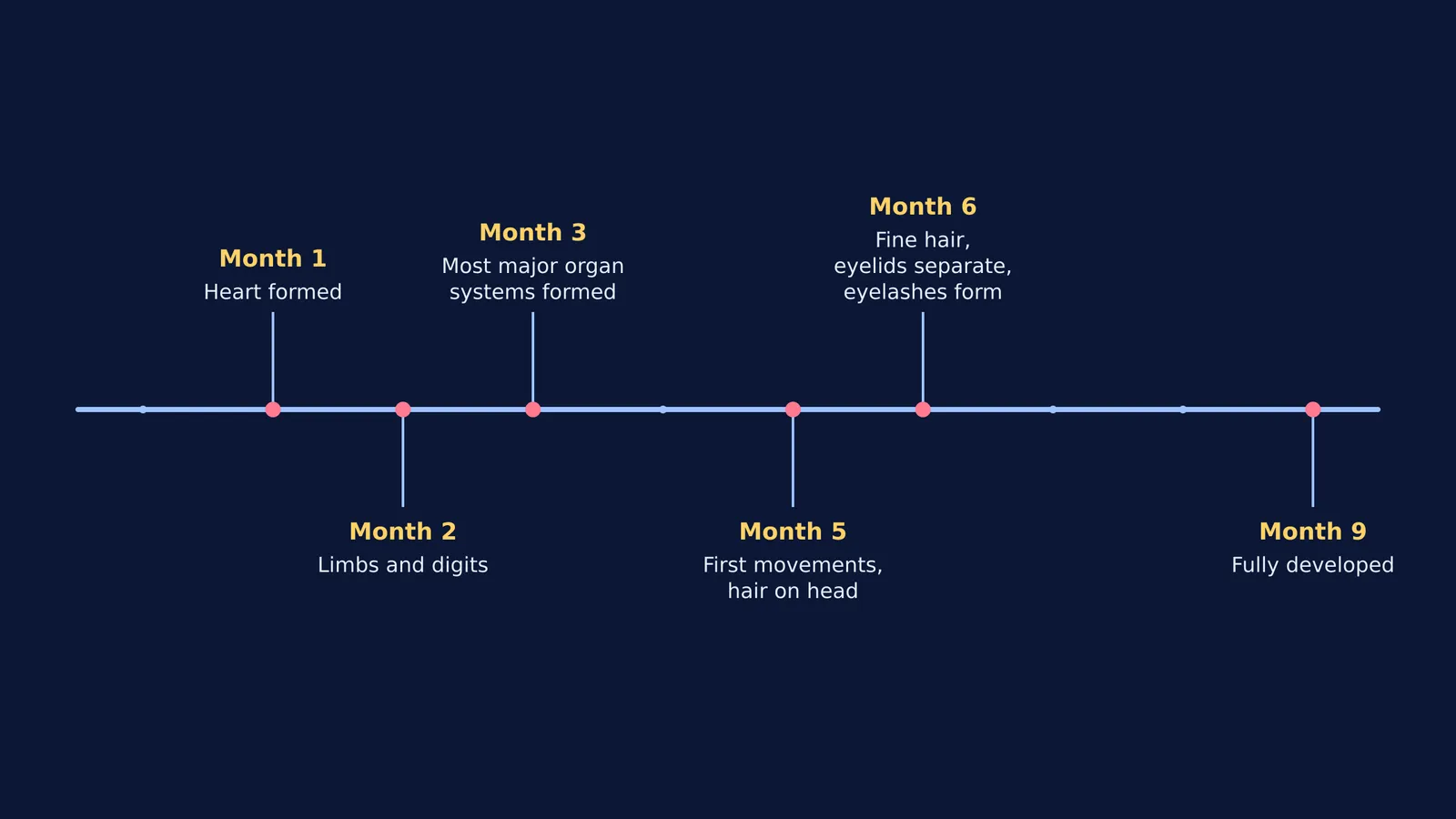
After one month: The first organ to form is the heart. The earliest sign of a growing foetus is the sound of the heartbeat, which a doctor can hear carefully through a stethoscope.
By the end of the second month: The foetus develops limbs and digits.
By the end of the third month (12 weeks): Most of the major organ systems are formed. For example, the limbs and the external genital organs are well-developed by this stage.
When biology timelines blur together across chapters, the Fermi Concept Library helps map them out. It has every concept in physics, chemistry, biology, mathematics and computing, each with its own lesson. As you learn, Fermi's AI tutor notices where you are stuck and decides whether to explain, ask, or show.
When can you feel foetal movements?
The second trimester (months four to six) is when the foetus begins to grow larger and its finer details emerge. The focus shifts from forming new organs to maturing the ones that already exist. The NCERT Class 12 Biology textbook highlights two major milestones in this phase:
During the fifth month: The first movements of the foetus are observed. This is also when hair first appears on the head.
By the end of the sixth month (24 weeks): The body becomes covered with fine hair. The eyelids separate, and eyelashes are formed.
Once you have mastered this timeline, it is helpful to look at what comes before and after. You can review the events of the first week of pregnancy in our guide to from fertilisation to implantation: the first week of pregnancy.
What happens in the third trimester?
The final three months (the third trimester) are dedicated to growth, gaining weight, and final maturation. During this final stretch, the lungs mature and the brain undergoes significant development, preparing the baby to survive outside the womb. The NCERT Class 12 Biology textbook notes that by the end of nine months of pregnancy, the foetus is fully developed.
At this point, the foetus is ready for delivery. This process, known as parturition, is a neuroendocrine mechanism. It is triggered by signals that originate from the fully developed foetus and the placenta, which induce mild uterine contractions known as the foetal ejection reflex. This leads to the release of oxytocin, causing stronger contractions. For more on how this happens, see our breakdown of parturition and lactation: the hormones behind birth and milk.
How can you memorise the milestones?
Because multiple-choice questions in exams like NEET-UG rely on specific wording, it is best to study these milestones as a sequence of key "firsts". Here is a practical study framework based on the NCERT Class 12 Biology textbook to lock them into your memory:
Focus on the "Firsts":
First organ: Heart (Month 1).
First appendages: Limbs and digits (Month 2).
First movements: Month 5.
Bundle the Trimesters logically:
Trimester 1 (Months 1 to 3) is about basic structure (heart, limbs, major organs).
Trimester 2 (Months 4 to 6) is about fine external details (hair on head, fine body hair, eyelashes, eyelids separating).
Trimester 3 (Months 7 to 9) is about overall growth and readiness for birth.
Test yourself actively without notes: Write the numbers 1, 2, 3, 5, 6, and 9 on a blank sheet of paper. Fill in the milestone for each without looking at the book. If you miss one, re-read that specific month and try the test again the next day.
Watch out for absolute terms: In biology objective questions, words like *all*, *most*, or *only* are traps. Notice how the textbook says *most* of the major organ systems are formed by 12 weeks, not *all* of them. Paying attention to these subtle qualifiers will prevent you from losing marks on assertion-reasoning questions.


