

On this page
A hen lays eggs from one ovary, not two, which surprises many students. Here is what happens to the right ovary, why biologists think birds ended up this way, and how exams test it.
Why do female birds have only one ovary?
The short answer is that both gonads start to form in the embryo, but only the left one becomes an ovary. A 2014 review by Silvana Guioli, Michael Clinton and colleagues in Sexual Development puts it plainly: the adult hen has only one ovary and a single oviduct, both on the left side.
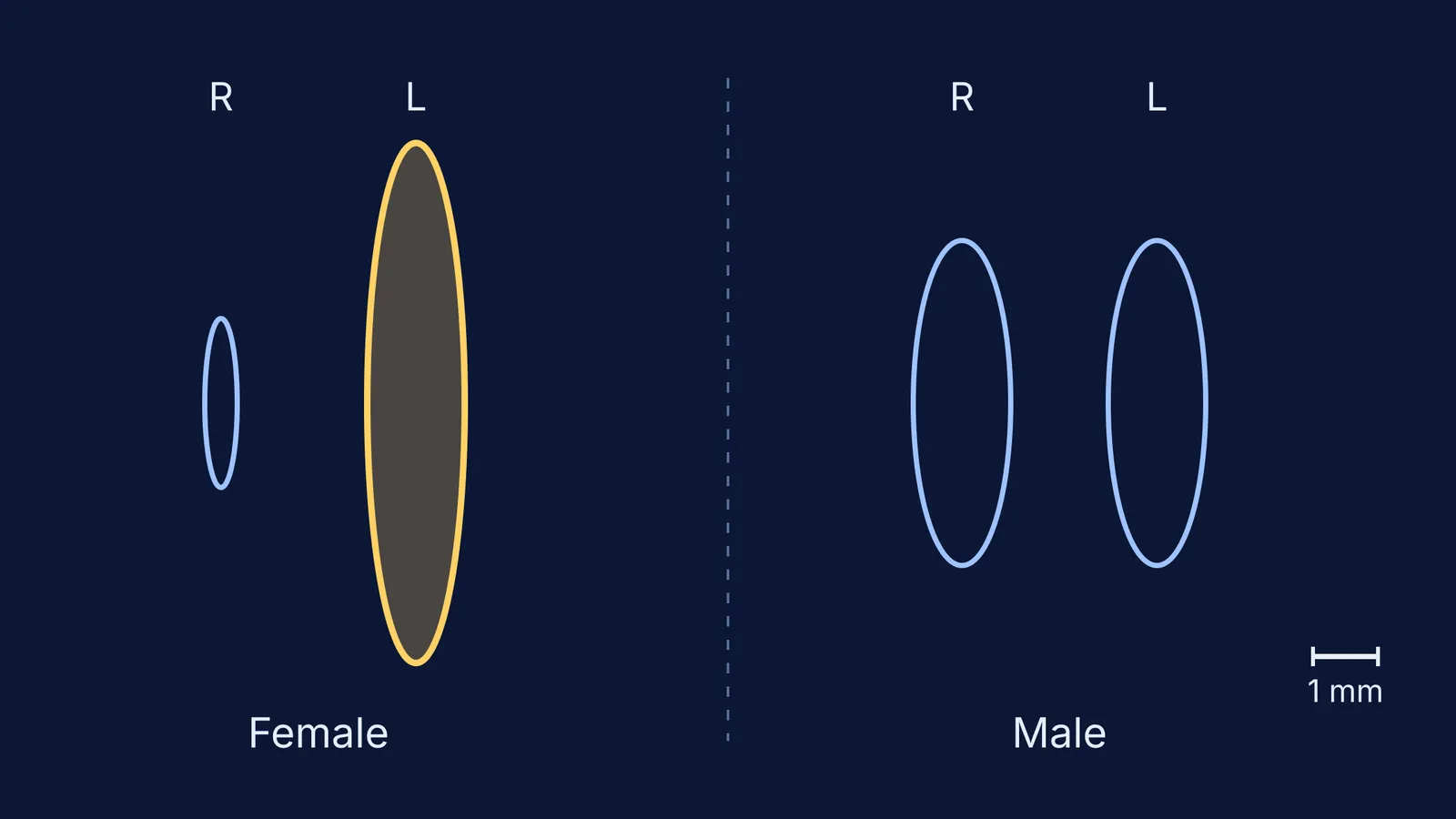
The right gonad does not simply vanish. According to the same review, just before hatching the female chick's left ovary measures about 8 mm by 1.5 mm, while the right gonad is around 2.6 mm by 0.5 mm (Guioli et al., 2014). Males at the same stage keep two testes of similar size, each about 5 mm by 1.5 mm, so the lopsided pattern belongs to females.
What switches the left side on? A gene called PITX2, which helps set up left-right differences across the vertebrate body, is involved in this asymmetry in chickens, according to a 2023 study in PNAS Nexus that describes birds as the only vertebrates whose females do not develop a pair of ovaries.
Is the single ovary really about saving weight for flight?
The Guioli review calls weight the most popular theory, comparing it to an airline baggage allowance (Guioli et al., 2014). The weight in question is the ovary with its series of large maturing follicles, as opposed to the weight of the egg.
The same review then lists problems with the weight idea:
Most birds breed for only a short season. Outside it, the ovaries are small and quiet and contain no mature follicles.
Male testes also grow a lot in the breeding season, yet males keep two.
The flightless kiwi has two ovaries, while the other flightless ratites have one.
In some birds of prey (Falconiformes), paired ovaries are common, even though these birds fly well.
Overall, species from at least 16 of the more than 35 bird orders have two ovaries, the review notes (Guioli et al., 2014).
The second idea is about the egg itself. Between release from the ovary and laying, the egg spends around a day in the oviduct getting its shell, and it has been suggested that two or more shelled eggs close together in the abdomen would lower their chances of survival (Guioli et al., 2014). Even birds with two ovaries usually have one oviduct, typically the left. The authors suggest that space limits and egg fragility, rather than weight, may be the reason, and they note that how the single ovary evolved is not clear.
How does this show up in reproduction questions?
The single ovary usually sits in a list of flight adaptations, next to how air sacs and hollow bones keep a bird light and the question of whether birds have a urinary bladder. Here is a worked example in assertion-reason form.
Assertion (A): In most female birds, only the left ovary and left oviduct are functional.
Reason (R): Having fewer reproductive organs reduces body weight, which is thought to help in flight.
Check A on its own. It is true; note the word most.
Check R on its own. It is the most popular explanation, though still a hypothesis, so school answers usually accept it.
Ask whether R explains A. Weight saving is the standard textbook explanation, so mark R as explaining A.
Flip it. If A said all birds have one ovary, A would be false: the kiwi has two.
Common traps:
"The right ovary never forms." False: it starts forming and then stays small.
"Male birds have one testis." False: males keep two.
"Two ovaries means two oviducts." Not in birds: even paired-ovary birds usually have one oviduct.
Left and right in diagrams. A drawing seen from the belly side shows the bird's left on your right, so read the labels, not the position on the page.
For more traps like these, see odd-one-out and exception questions from Animal Kingdom.
A 10-minute revision plan for bird reproduction
Write one line: females, left ovary and left oviduct; males, two testes.
Add the two reasons: weight for flight and egg safety.
Add two exceptions: kiwi, and some birds of prey.
Sketch a belly-side diagram and label L and R.
Solve three assertion-reason questions, saying why each R does or does not explain A.
If gonads, oviducts and follicles still feel hazy, the Fermi Concept Library covers every concept in biology, each with its own lesson and its place in the map. For step 5, the Fermi Problem Library has worked problems with a step-by-step solver that explains the reasoning rather than printing an answer.


