

On this page
If someone at home has told you to cook gajar ki sabzi in a little ghee "so the vitamins work", they had a point. Vitamins A, D, E and K dissolve in oil, not water, so they need fat to carry them through a watery gut. Here is the route, with real numbers from carrots.
Why do fat-soluble vitamins need fat to be absorbed?
The fat-soluble vitamins A, D, E and K are absorbed in the intestine in the presence of fat, as a 2016 review in Clinical Biochemist Reviews puts it.
Beta-carotene, the orange pigment in carrots, is the main provitamin A carotenoid in the human diet, according to a review by Reboul and Borel. It is a long chain of carbon and hydrogen that does not mix with water. With no fat around, it has nowhere to dissolve and no way to reach the gut wall.
How do micelles and chylomicrons carry vitamins A, D, E and K?
Follow one molecule of beta-carotene from your plate to your blood:
Release. Chewing, cooking and mashing open plant cells so the pigment can dissolve into fat in the meal.
Micelle. In the duodenum, bile and pancreatic secretions break fat down. A mixed micelle is a tiny cluster of bile salts and fat-digestion products, and the vitamin is carried inside it (Reboul, 2017).
Uptake. The vitamin leaves the micelle and enters the cells lining the small intestine, the enterocytes. For vitamins D, E and K and carotenoids, membrane transporters such as SR-BI, CD36 and NPC1L1 help them across (Reboul, 2023).
Chylomicron. Inside the cell, absorbed fat is repackaged into chylomicrons, large fat-carrying particles. Most vitamin E is loaded into chylomicrons in its free form and leaves in the lymph (Reboul, 2017); vitamin A leaves the same way as retinyl esters (Albahrani and Greaves, 2016).
Lymph, then blood. Chylomicrons enter the lacteals, the lymph vessels in each villus, and reach the blood later. Our explainer on how fats are absorbed through micelles, chylomicrons and lacteals shows this step in more detail.
About 70% of dietary retinoids are taken up by the liver and stored as retinyl palmitate, according to Albahrani and Greaves. So fat dissolves the vitamin first, then its digestion products help carry it.
Carrots cooked in ghee vs raw carrots: what changes?
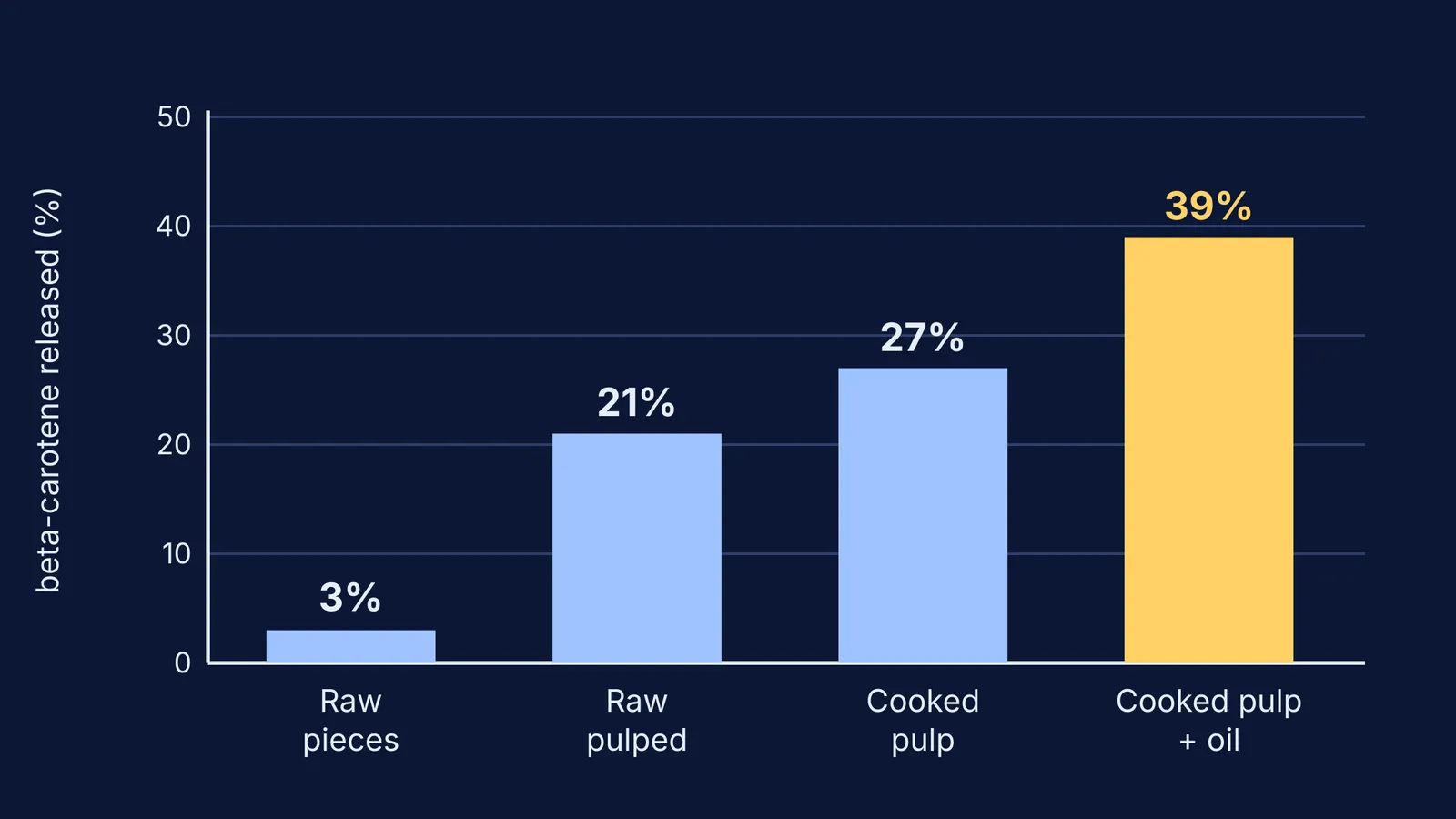
Here is the worked example. In a lab study that copied stomach and intestinal digestion, Hedren, Diaz and Svanberg (2002) measured how much beta-carotene carrots released in a form available for absorption:
Raw carrot in chewed-sized pieces: 3%
Raw carrot, pulped: 21%
Cooked pulp: 27%
Cooked pulp with cooking oil added: 39%
Read the list as two barriers. Pulping and cooking break the cell walls that trap the pigment; fat gives the freed pigment somewhere to dissolve. Carrots cooked soft in ghee clear both barriers; raw carrot sticks on their own clear neither. This was a lab digestion, not a person, so treat the numbers as a guide to direction.
Human studies agree. In 8 volunteers with ileostomies, 65.1% of beta-carotene was absorbed from cooked, pureed carrots against 41.4% from raw, chopped carrots, with 40 g of sunflower oil in both meals (Livny and colleagues, 2003). And when 7 people ate salads of spinach, lettuce, cherry tomatoes and carrots, carotene in their chylomicrons was negligible with fat-free dressing and rose with 6 g, then 28 g, of canola oil (Brown and colleagues, 2004).
How much fat do you actually need?
Less than you might think. In a trial by Roodenburg and colleagues (2000), eating 3 g or 36 g of fat with a meal made no clear difference to how much vitamin E, alpha-carotene and beta-carotene from supplements reached the blood. Lutein esters, another pigment, did need more fat. A review of vitamin E absorption notes that other studies disagree, so the exact amount is not settled. The practical takeaway: some fat in the same meal, not a pool of ghee.
A quick kitchen and exam checklist
Eat carrots, spinach and other orange or green vegetables with a meal that has some fat in it, such as dal with a tadka or a sabzi cooked in oil or ghee.
Raw carrots are still good food; grate them and eat them alongside something with fat.
In a biology answer, write the full chain: dietary fat, bile salts, micelle, enterocyte, chylomicron, lacteal.
Link it to the rest of digestion. Our dal-rice timeline of carbs, protein and fat shows when fat is digested, and our Class 12 guide to fat- and water-soluble vitamins covers the deficiency diseases.
If the micelle-to-chylomicron step still feels abstract, the Fermi Concept Library gives each biology and chemistry concept its own lesson and its place in the map, and Fermi's AI tutor can draw the figure and check your understanding as it goes.


