

On this page
This set follows our first Experimental Skills NEET practice set with eight new NEET-style MCQs, easy to hard, each with a worked solution and its trap.
The NMC syllabus for NEET (UG)-2026 lists 14 experiments in Physics Unit 20. This set covers the screw gauge, convex lens, capillary rise, viscosity, a liquid's specific heat, resistivity, figure of merit and Young's modulus.
How should you use this practice set?
Cover the answers and allow about a minute per question.
Before any number, write what is varied, read and calculated.
Count a guess as wrong and read its trap.
The NEET-UG 2026 NTA information bulletin gave +4 for a correct answer and -1 for a wrong one. For a revision plan, read our guide on how to prepare Experimental Skills for NEET.
Easy: can you link a reading to its formula?
Q1 (easy). A screw gauge has pitch 0.5 mm, 50 circular divisions and a zero error of +0.03 mm. For a metal sheet, the main scale reads 1.5 mm and the 27th circular division lines up with the reference line. What is the thickness of the sheet?
(A) 1.74 mm (B) 1.80 mm (C) 2.01 mm (D) 1.77 mm
Answer: (A). Least count = 0.5/50 = 0.01 mm. Reading = 1.5 + 27 × 0.01 = 1.77 mm. Corrected = 1.77 - 0.03 = 1.74 mm.
Trap: (B) adds a positive zero error instead of subtracting it.
Q2 (easy). In the parallax method, a convex lens has the object pin 36.0 cm in front and the parallax-free image pin 45.0 cm behind it. What is the focal length?
(A) 180 cm (B) 20.0 cm (C) 40.5 cm (D) 81.0 cm
Answer: (B). With u = -36.0 cm and v = +45.0 cm, 1/f = 1/v - 1/u = 1/45 + 1/36 = 1/20, so f = 20.0 cm.
Trap: (A) uses the mirror formula, 1/v + 1/u.
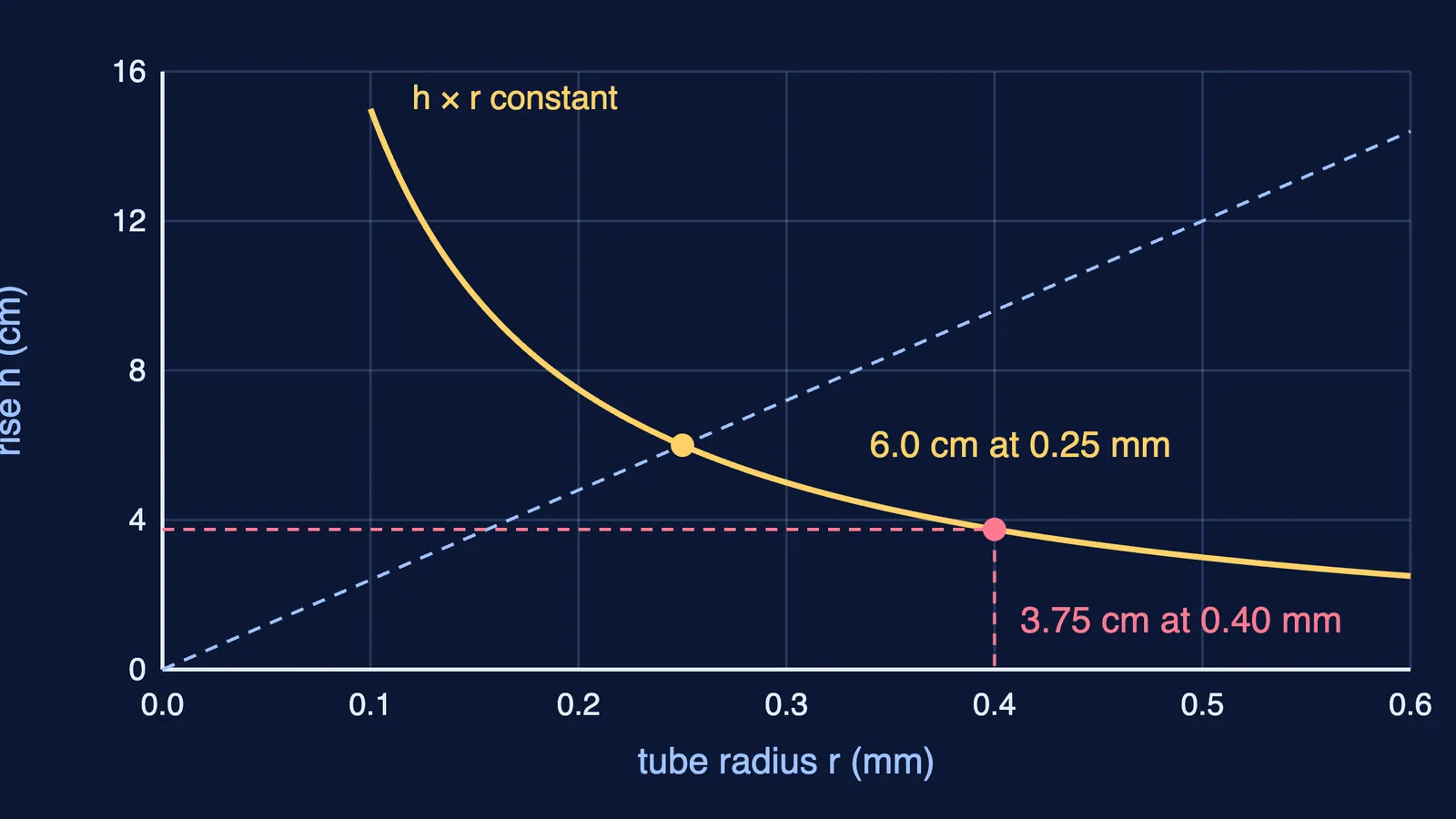
Q3 (easy). Water rises 6.0 cm in a clean glass capillary of internal radius 0.25 mm. How high will the same water rise in a clean capillary of the same glass with internal radius 0.40 mm?
(A) 3.75 cm (B) 9.60 cm (C) 2.34 cm (D) 15.4 cm
Answer: (A). From NCERT Class 11 Physics, Chapter 9, hρg = 2S cos θ/a, so h × r stays fixed for the same liquid and glass. h = 6.0 × 0.25/0.40 = 3.75 cm.
Trap: (B) assumes a wider tube lifts the water higher.
Medium: can you turn readings into a result?
Q4 (medium). A steel ball of radius 1.0 mm and density 7800 kg/m³ falls through glycerine of density 1260 kg/m³ at a terminal velocity of 1.7 cm/s. Take g = 9.8 m/s². What is the coefficient of viscosity of the glycerine?
(A) 1.00 Pa s (B) 0.84 Pa s (C) 3.35 Pa s (D) 0.42 Pa s
Answer: (B). From NCERT Class 11 Physics, Chapter 9, v = 2r²(ρ - σ)g/(9η), so η = 2 × (1.0 × 10⁻³)² × 6540 × 9.8/(9 × 0.017) ≈ 0.84 Pa s.
Trap: (A) forgets buoyancy and uses 7800 instead of 7800 - 1260.
Q5 (medium). A 200 g copper block at 95.0 °C is dropped into 150 g of a liquid at 25.0 °C in a 100 g copper calorimeter. The final temperature is 35.0 °C. Take the specific heat of copper as 390 J kg⁻¹ K⁻¹. What is the specific heat of the liquid?
(A) 3120 J kg⁻¹ K⁻¹ (B) 2600 J kg⁻¹ K⁻¹ (C) 2860 J kg⁻¹ K⁻¹ (D) 3380 J kg⁻¹ K⁻¹
Answer: (C). The block loses 0.200 × 390 × 60.0 = 4680 J. The calorimeter takes 0.100 × 390 × 10.0 = 390 J, the liquid the rest: 0.150 × s × 10.0 = 4290 J, so s = 2860 J kg⁻¹ K⁻¹.
Trap: (A) leaves out the calorimeter.
Q6 (medium). In a metre bridge, 50.0 cm of wire of diameter 0.30 mm is in the left gap and 2.0 Ω in the right gap. Balance is at 60.0 cm from the left end. What is the resistivity of the wire's material?
(A) 1.70 × 10⁻⁶ Ω m (B) 1.88 × 10⁻⁷ Ω m (C) 2.12 × 10⁻⁷ Ω m (D) 4.24 × 10⁻⁷ Ω m
Answer: (D). X = 2.0 × 60/40 = 3.0 Ω. A = π(0.15 × 10⁻³)² = 7.07 × 10⁻⁸ m². ρ = XA/L = 3.0 × 7.07 × 10⁻⁸/0.500 ≈ 4.24 × 10⁻⁷ Ω m.
Trap: (C) divides by the 1 m bridge wire instead of the 50.0 cm sample.
Hard: can you handle two steps at once?
Q7 (hard). A galvanometer is in series with a resistance box and a 2.0 V cell of negligible internal resistance. With 1900 Ω in the box it shows 40 divisions; with 1500 Ω it shows 50 divisions. What is the galvanometer's figure of merit?
(A) 2.63 × 10⁻⁵ A/div (B) 5.00 × 10⁻⁴ A/div (C) 2.78 × 10⁻⁵ A/div (D) 2.50 × 10⁻⁵ A/div
Answer: (D). Figure of merit is current per division: k = E/((R + G)θ). The same k for both readings gives 40(1900 + G) = 50(1500 + G), so G = 100 Ω. Then k = 2.0/(2000 × 40) = 2.50 × 10⁻⁵ A/div.
Trap: (A) drops G from the circuit.
Q8 (hard). Wires A and B give straight extension-against-load graphs. The slope for A is twice the slope for B. Wire A is 1.5 m long with diameter 0.40 mm; wire B is 1.0 m long with diameter 0.60 mm. What is the ratio of their Young's moduli, Y_A/Y_B?
(A) 1.13 (B) 6.75 (C) 1.69 (D) 0.33
Answer: (C). Slope = L/(AY), so Y = L/(A × slope). Y_A/Y_B = (1.5/1.0) × (0.60/0.40)² × (1/2) = 1.5 × 2.25 × 0.5 ≈ 1.69.
Trap: (A) uses the ratio of diameters, not their squares, for the areas.
What should you do after checking your answers?
Sort each miss into setup, formula or arithmetic. If you also sit JEE Main, read experimental skills in the JEE Main physics syllabus.
If your method is the problem, the Fermi Problem Library has worked problems with a step-by-step solver that explains the reasoning rather than printing an answer.
Retry both sets in a week, without notes.


