

On this page
Eight original Experimental Skills questions for the JEE Main numerical section, easy to hard, with worked solutions and the wrong number most students type.
What does the JEE Main numerical section look like?
NTA's Information Bulletin for JEE (Main) 2027 says each Paper 1 subject has Section A (MCQs) and Section B (numerical value). Physics has 5 Section B questions, marked +4 for a correct answer and −1 for an incorrect one. You type an integer on an on-screen keypad, rounded off to the nearest integer.
All eight use experiments from Unit 20, Experimental Skills, of the Syllabus for JEE (Main) 2027. For what each experiment involves, see our explainer on experimental skills in the JEE Main physics syllabus.
Easy: can you turn a reading into a number?
Q1 (easy). A vernier calipers has 50 vernier divisions equal to 49 main-scale divisions of 1 mm, and no zero error. For a cylindrical vessel, the internal diameter reads 52 mm with the 15th vernier division coinciding; the depth reads 68 mm with the 40th. What is the vessel's volume, in cm³, to the nearest integer?
Answer: 148. Least count = 1 − 49/50 = 0.02 mm. Diameter = 52 + 15 × 0.02 = 52.30 mm; depth = 68 + 40 × 0.02 = 68.80 mm. V = π × (2.615 cm)² × 6.880 cm ≈ 147.8 cm³.
Trap: 591, using the diameter as the radius.
Q2 (easy). In the method of mixtures, 300 g of copper (390 J kg⁻¹ K⁻¹) at 95 °C is dropped into 150 g of water (4200 J kg⁻¹ K⁻¹) at 22 °C in a calorimeter of water equivalent 25 g. What is the final temperature, in °C, to the nearest integer?
Answer: 32. Heat lost = heat gained: 0.300 × 390 × (95 − T) = 0.175 × 4200 × (T − 22). So 117(95 − T) = 735(T − 22), giving T = 27285/852 ≈ 32.0 °C.
Trap: 33, leaving out the calorimeter.
Q3 (easy). For a simple pendulum, a plot of ln(A²) against time, where A is the amplitude, is a straight line of slope −0.020 s⁻¹. What percentage of the initial energy is left after 80 s, to the nearest integer?
Answer: 20. Energy ∝ A², and ln(A²) falls by 0.020 × 80 = 1.6. So E/E₀ = e^(−1.6) ≈ 0.202, which is 20%.
Trap: 45, from e^(−0.8), reading the graph as ln A, which gives the amplitude fraction, not the energy.
Medium: can you see what the experiment cancels?
Q4 (medium). A uniform metre scale balances on a knife edge at its 50.0 cm mark. A stone hangs from the 20.0 cm mark and is balanced by a 50 g mass at the 98.0 cm mark. With the stone fully immersed in water, the 50 g mass must move to the 78.8 cm mark. What is the density of the stone, in kg/m³?
Answer: 2500. The scale's weight has no moment about the pivot. Arms are 48.0 cm in air and 28.8 cm in water. Weight ∝ 48.0 and apparent weight ∝ 28.8, so relative density (water 1000 kg/m³) = 48.0/(48.0 − 28.8) = 2.5.
Trap: 5104, using the marks 98.0 and 78.8 as arms instead of distances from the knife edge.
Q5 (medium). Two spheres of the same radius of steel (7900 kg/m³) and aluminium (2700 kg/m³), are dropped in turn into the same viscous liquid. Their terminal velocities are 13.4 cm/s and 3.0 cm/s. Using Stokes' law, what is the density of the liquid, in kg/m³?
Answer: 1200. With v = 2r²(ρ − σ)g/(9η), the radius, g and η cancel: (7900 − σ)/(2700 − σ) = 13.4/3.0. Solving, σ = 1200 kg/m³.
Trap: 9400, from inverting the velocity ratio; a liquid denser than steel should warn you.
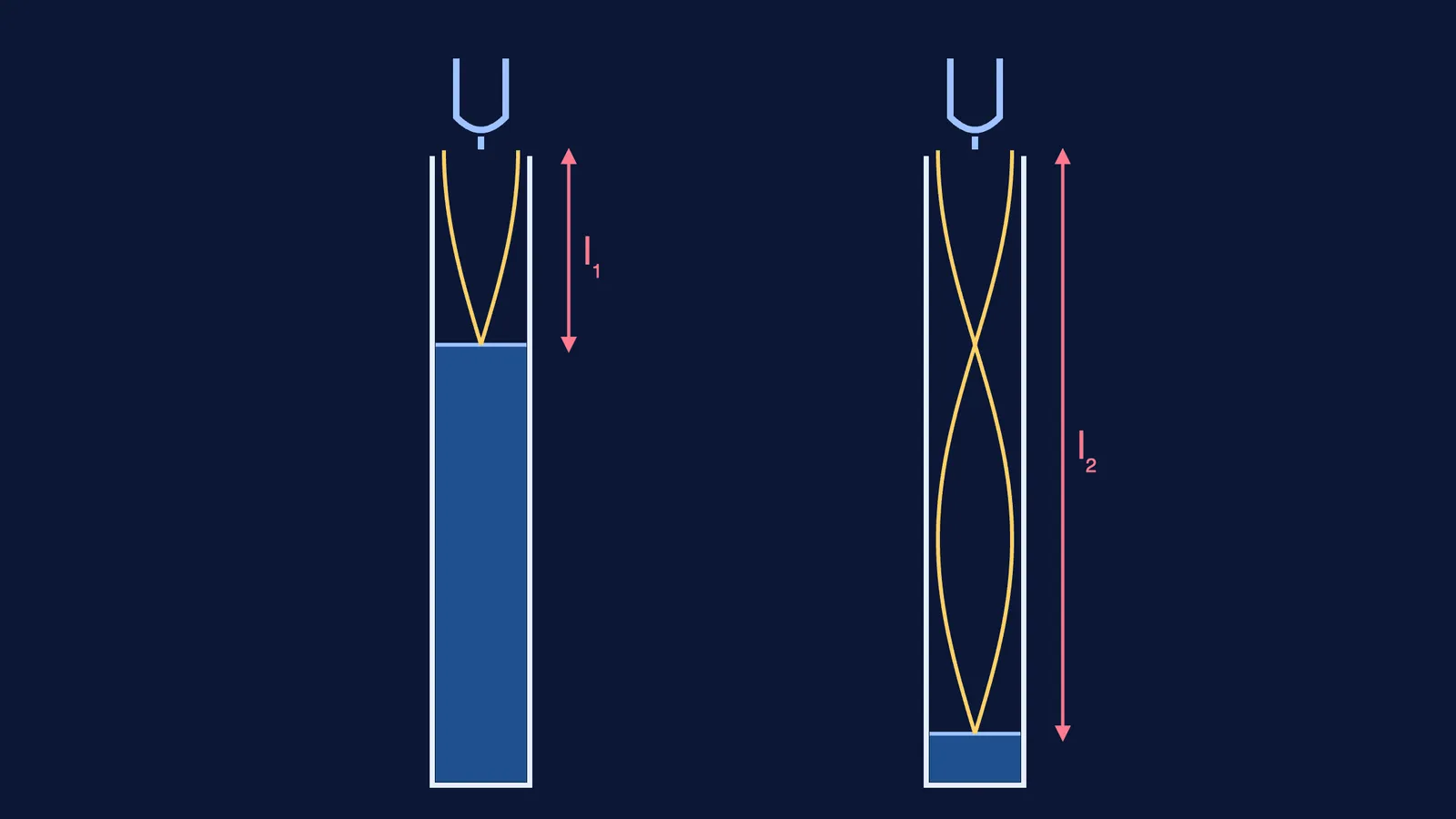
Q6 (medium). A resonance tube is excited by a 320 Hz tuning fork. The first resonance is at an air column of 26.4 cm and the second at 80.8 cm. Sound travels at 331 m/s at 0 °C, and its speed varies as √T. What is the room temperature, in °C, to the nearest integer?
Answer: 29. λ/2 = 80.8 − 26.4 = 54.4 cm, so v = 320 × 1.088 = 348.16 m/s. T = 273 × (348.16/331)² ≈ 302.0 K, which is 29 °C.
Trap: 12, from v = 4fl₁, ignoring the 0.8 cm end correction.
Hard: can you handle what the apparatus adds?
Q7 (hard). A metre bridge has 5.0 Ω in the left gap and 15.0 Ω in the right; the null point is 24.6 cm from the left end. With the resistors interchanged, it is 75.0 cm from the left end. Treat each end correction as extra wire length at that end. What is the left-end correction, in mm?
Answer: 6. With corrections α (left) and β (right), first: 5.0/15.0 = (24.6 + α)/(75.4 + β). Interchanged: 15.0/5.0 = (75.0 + α)/(25.0 + β). These give 3α − β = 1.6 and α − 3β = 0, so β = 0.2 cm and α = 0.6 cm.
Trap: 2, the right-end correction, from mixing up the ends.
Q8 (hard). A student plots deviation against incidence for a 50° glass prism of refractive index 1.60. Below some angle of incidence no ray emerges from the second face, so the plot starts there. What is that smallest angle of incidence, in degrees, to the nearest integer?
Answer: 18. C = sin⁻¹(1/1.60) ≈ 38.7°. The ray just grazes out when r₂ = C, so r₁ = 50° − 38.7° = 11.3°. Then sin i = 1.60 × sin 11.3° ≈ 0.314, and i ≈ 18.3°.
Trap: 39, the critical angle, which applies at the second face, not the first.
How do you get the number right in experimental skills?
Find the least count before reading any scale (Q1).
Write the balance condition first, and measure every arm from the right point (Q4, Q7).
Count every body that gains heat, calorimeter included (Q2).
Check what a slope or length stands for: A or A², l₁ or l₂ − l₁ (Q3, Q6).
Round only the final answer.
For least count and error rules, see our guide on how to prepare Units and Measurements for JEE Main.
Right number, shaky method? The Fermi Problem Library has worked problems with a step-by-step solver that explains the reasoning rather than printing an answer.


