

On this page
NCERT Exercise 8.6 asks how you would turn ethanal into three different products: butane-1,3-diol, but-2-enal and but-2-enoic acid. All three start with the same aldol reaction. What changes is the reagent you apply afterwards, and each reagent has to touch one group while leaving another alone. That idea is called chemoselectivity, and it is what examiners are really testing. The aldol step itself is covered in the four-step aldol condensation mechanism, so here we start from its product.
What is the common first step from ethanal?
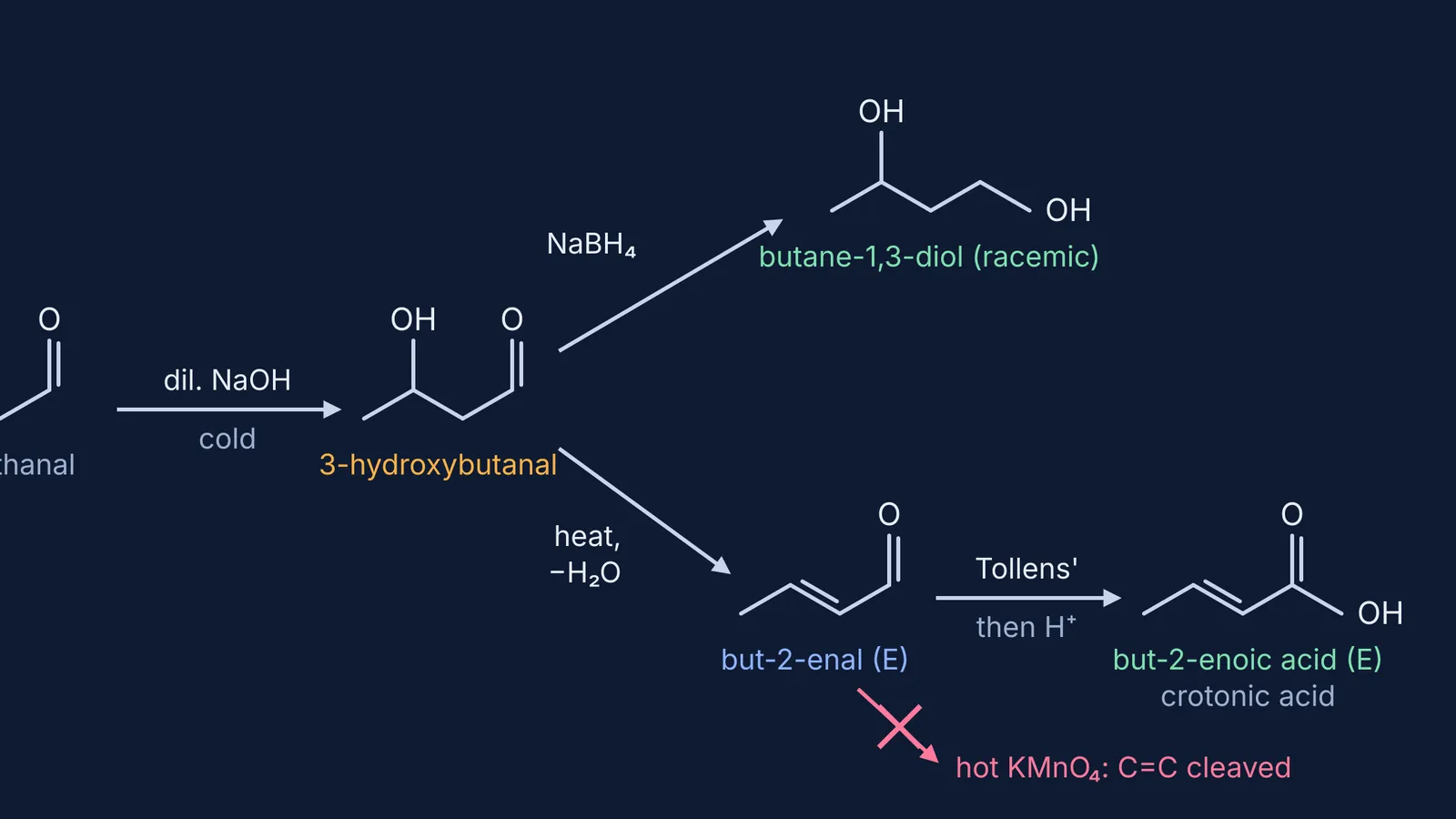
Two molecules of ethanal react in dilute NaOH, kept cold, to give the aldol:
2CH₃CHO → CH₃CH(OH)CH₂CHO (3-hydroxybutanal)
Count the atoms: 2 × C₂H₄O = C₄H₈O₂. Nothing is lost, which is why this step is an addition, not yet a condensation.
The conditions matter. Dilute alkali in the cold stops at the aldol. Warming the same mixture removes water and gives but-2-enal. If you write "NaOH, heat" for the diol route, you have already lost the OH group you need. The earlier post on converting ethanol to 3-hydroxybutanal stops at this point. The rest of this post is what you do next.
How do you get butane-1,3-diol from ethanal?
Reduce the aldehyde group of the aldol, and leave the secondary alcohol as it is.
CH₃CH(OH)CH₂CHO + NaBH₄ (then water) → CH₃CH(OH)CH₂CH₂OH
NaBH₄ reduces aldehydes and ketones but not alcohols, so it is a clean choice. H₂ over Ni also works here, because the aldol has no C=C for hydrogen to attack.
The product, butane-1,3-diol (C₄H₁₀O₂), has a stereocentre at C-3, the carbon carrying the secondary OH. The aldol is formed as a racemic mixture, and an achiral reagent such as NaBH₄ cannot change that, so the diol is also racemic. Saying so earns credit in a stereochemistry follow-up question.
How do you get but-2-enal from ethanal?
Heat the aldol, usually in the same basic solution. It loses water to form a C=C conjugated with the C=O:
CH₃CH(OH)CH₂CHO → CH₃CH=CHCHO + H₂O
But-2-enal (crotonaldehyde, C₄H₆O) can exist as E and Z isomers. The conjugated E isomer, with the CH₃ and CHO on opposite sides of the double bond, is the main product. Draw it that way, with a zigzag chain.
How do you get but-2-enoic acid without breaking the C=C?
Now you need to oxidise the CHO to COOH while keeping the C=C. That rules out strong oxidants. Hot alkaline or acidic KMnO₄ attacks the double bond and cleaves the chain, so you would end up with two-carbon fragments such as ethanoic acid, not a four-carbon acid.
The right reagent is a mild one that only oxidises aldehydes. NCERT uses Tollens' reagent:
RCHO + 2[Ag(NH₃)₂]⁺ + 3OH⁻ → RCOO⁻ + 2Ag + 4NH₃ + 2H₂O
Check it: Ag 2 = 2, N 4 = 4, O 4 = 4, H 16 = 16 (counting only the hydrogens outside R), and the charge is −1 on both sides. Tollens' is used in basic solution, so you get the carboxylate. Acidify to get the free acid, CH₃CH=CHCOOH.
Name the isomer you draw. The E isomer of but-2-enoic acid is crotonic acid, a solid melting at about 72 °C. The Z isomer is isocrotonic acid. Since the enal is mostly E, so is the acid. For why Tollens' only reacts with aldehydes, see Tollens' and Fehling's tests.
Worked example: all three routes, with masses
Start with 8.8 g of ethanal (M = 44.05 g mol⁻¹) and assume every step goes to completion. Find the maximum mass of each product.
Moles of ethanal = 8.8 / 44.05 = 0.200 mol.
Aldol step: 2 mol ethanal give 1 mol aldol, so 0.100 mol of 3-hydroxybutanal (M = 88.11), or 8.81 g. The mass is unchanged because nothing is lost.
Route (i): NaBH₄ reduces the CHO. 0.100 mol of butane-1,3-diol (M = 90.12) = 9.01 g. The extra 0.20 g is the two hydrogens added.
Route (ii): heating removes one H₂O per molecule. 0.100 mol of but-2-enal (M = 70.09) = 7.01 g. The 1.80 g lost is exactly 0.100 mol of water.
Route (iii): Tollens' then acid turns CHO into COOH, adding one O. 0.100 mol of but-2-enoic acid (M = 86.09) = 8.61 g.
Trap route: H₂/Ni on but-2-enal adds two H₂. 0.100 mol of butan-1-ol (M = 74.12) = 7.41 g.
Notice how the mass change at each step tells you what happened: +2 H for a reduction of C=O, −H₂O for dehydration, +O for aldehyde oxidation, +4 H when both π bonds are hydrogenated. Checking this is a quick way to catch a wrong structure. If you want more practice with multi-step conversions, the Fermi Problem Library has a step-by-step solver that explains why each reagent was chosen.
Which reagent touches which group?
Here is the summary in one list. For each reagent, ask which groups in the molecule it reacts with, then pick the one that reacts only with the group you want changed.
Dilute NaOH, cold: joins two aldehydes at the α-carbon. Product keeps OH and CHO.
Dilute NaOH, heat: also removes H₂O to give the conjugated C=C.
NaBH₄: reduces C=O of aldehydes and ketones; leaves C=C mostly untouched.
H₂/Ni: reduces C=C and C=O alike.
Tollens' reagent: oxidises CHO only; leaves C=C and alcohols alone.
Hot KMnO₄: oxidises aldehydes and also cleaves C=C, so it is wrong for route (iii).
If the difference between NaBH₄ and LiAlH₄ is still unclear, read the comparison of LiAlH₄ and NaBH₄ before trying more of these. The Concept Library has a lesson on each of these reagents too.
Quick checklist
Every route starts with 2CH₃CHO in cold dilute NaOH giving 3-hydroxybutanal.
(i) NaBH₄ or H₂/Ni on the aldol gives butane-1,3-diol, racemic at C-3.
(ii) Heating the aldol removes water to give but-2-enal, mainly E.
(iii) Tollens' reagent, then acid, turns but-2-enal into E-but-2-enoic acid (crotonic acid).
Hot KMnO₄ cleaves the C=C; H₂/Ni on but-2-enal gives butan-1-ol.
Check each step with the formula: +2H, −H₂O, +O.


