

On this page
Organic conversions often require you to build a longer carbon chain from a smaller starting molecule. When you need to convert ethanol to 3-hydroxybutanal, the aldol reaction is your best tool.
If you are memorising the long list of Ethanol and ethanoic acid reactions for your board exams or competitive tests, you might notice that ethanol itself does not undergo an aldol reaction. Because ethanol is a primary alcohol, you must first convert it into an aldehyde to use the chemistry of carbonyl groups.
How do you convert ethanol to ethanal?
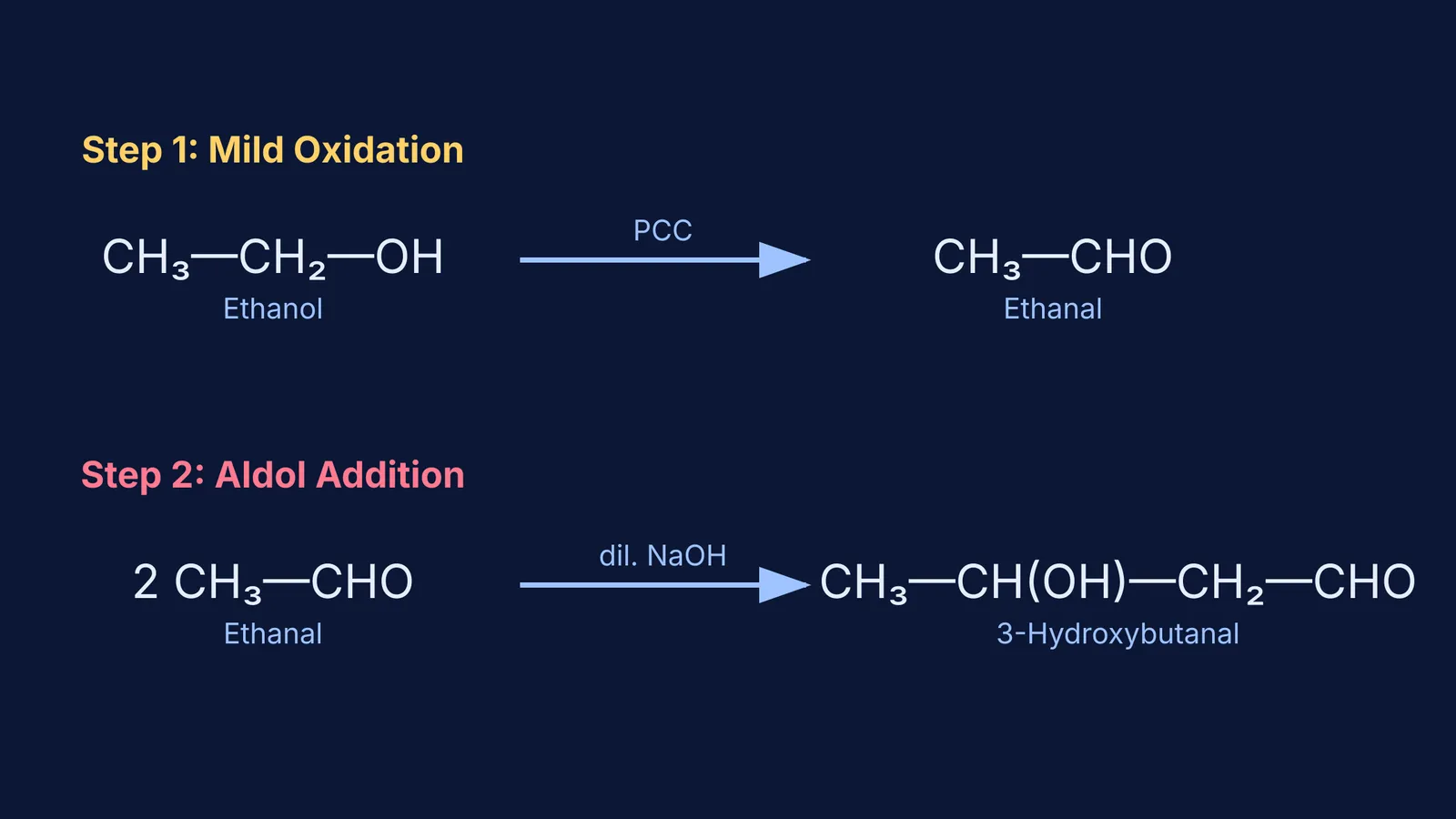
The first step is to mildly oxidise your starting alcohol. Ethanol (CH₃CH₂OH) contains a hydroxyl group attached to an end carbon. Strong oxidising agents, such as acidified potassium dichromate or potassium permanganate, will aggressively oxidise primary alcohols straight through to carboxylic acids, leaving you with ethanoic acid. Because you need to stop at the aldehyde stage to perform the next step, you need a milder reagent that halts the oxidation early.
According to standard organic chemistry references on Pyridinium chlorochromate (PCC), this yellow-orange salt dissolved in a solvent like dichloromethane selectively stops the oxidation process at the aldehyde. When you react ethanol with PCC, it yields ethanal (acetaldehyde, CH₃CHO) safely without progressing to ethanoic acid. This controlled step provides the exact starting material required for the aldol sequence.
What is an aldol condensation?
Once you have ethanal, you have a molecule with an alpha-carbon (the carbon directly attached to the carbonyl group) that carries alpha-hydrogens. Molecules with alpha-hydrogens can undergo self-condensation in the presence of a dilute base. This is one of the most reliable methods for forming new carbon-carbon bonds. Aldol reactions are central to many biological pathways and industrial chemical syntheses because they neatly stitch together small carbon fragments into more complex, functionalised molecules.
An aldol condensation is a reaction where two carbonyl molecules bond together to form a larger β-hydroxyaldehyde. When you treat your newly formed ethanal with dilute sodium hydroxide (NaOH) or barium hydroxide (Ba(OH)₂), the base removes a slightly acidic alpha-hydrogen from one ethanal molecule. This removal creates an enolate ion, which is highly nucleophilic.
This enolate ion then attacks the partially positive carbonyl carbon of a second ethanal molecule. The result is a new carbon-carbon bond, linking two two-carbon molecules into a single four-carbon chain. After picking up a proton from the surrounding water, the final product is 3-hydroxybutanal (CH₃CH(OH)CH₂CHO).
What happens if you heat 3-hydroxybutanal?
A common mistake in organic synthesis problems is pushing a reaction too far by applying unnecessary heat. If you heat the mixture containing 3-hydroxybutanal in the presence of the base, the molecule will undergo a dehydration reaction (it will lose a water molecule).
During this elimination, the hydroxyl (-OH) group on the beta-carbon and a neighbouring hydrogen atom on the alpha-carbon are stripped away to form a carbon-carbon double bond. This yields an α,β-unsaturated aldehyde known as but-2-enal (or crotonaldehyde).
If your target is strictly the aldol product (3-hydroxybutanal), you must keep the reaction cold and strictly avoid applying heat. If you are struggling to keep track of these branching pathways in your revision, the Fermi Concept Library maps out each named reaction so you can see where they connect in the wider syllabus.
How do you write the full conversion?
When writing this specific conversion in an exam or homework assignment, break it down cleanly into its two distinct steps and write the specific reagents over the reaction arrows. A clear presentation prevents marks from being deducted for missing intermediate steps.
Oxidation: CH₃CH₂OH → (using PCC in CH₂Cl₂) → CH₃CHO
Aldol addition: 2 CH₃CHO → (using dilute NaOH) → CH₃CH(OH)CH₂CHO
For more complex reactions, such as forming anti-Markovnikov alcohols, plotting out the step-by-step mechanism helps you avoid losing track of your carbon atoms. If you get stuck on a tricky conversion while studying, you can scan your working into the Fermi Problem Library. The AI tutor will check your reasoning step by step, rather than just printing the final structure, so you learn exactly where your mechanism went off track.


