

On this page
Your Class 11 biology notes list "no blood vessels" as a feature of epithelial tissue. So how do these cells get food and oxygen? The answer is a short trip by diffusion from the tissue underneath, and that trip also limits how thick epithelium can be.
Why doesn't epithelium have blood vessels?
Epithelium is a covering. The open textbook OpenStax Anatomy and Physiology describes most epithelia as "large sheets of cells covering all the surfaces of the body exposed to the outside world and lining the outside of organs". The tissue is "highly cellular, with little or no extracellular material present between cells".
Epithelial tissue is nearly completely avascular: no blood vessels cross the basement membrane to enter it (OpenStax). Surface epithelium also sheds damaged or dead cells and replaces them. A tightly packed, constantly renewed sheet leaves little room for vessels, so the blood supply stays below.
How does epithelial tissue get nutrients without blood vessels?
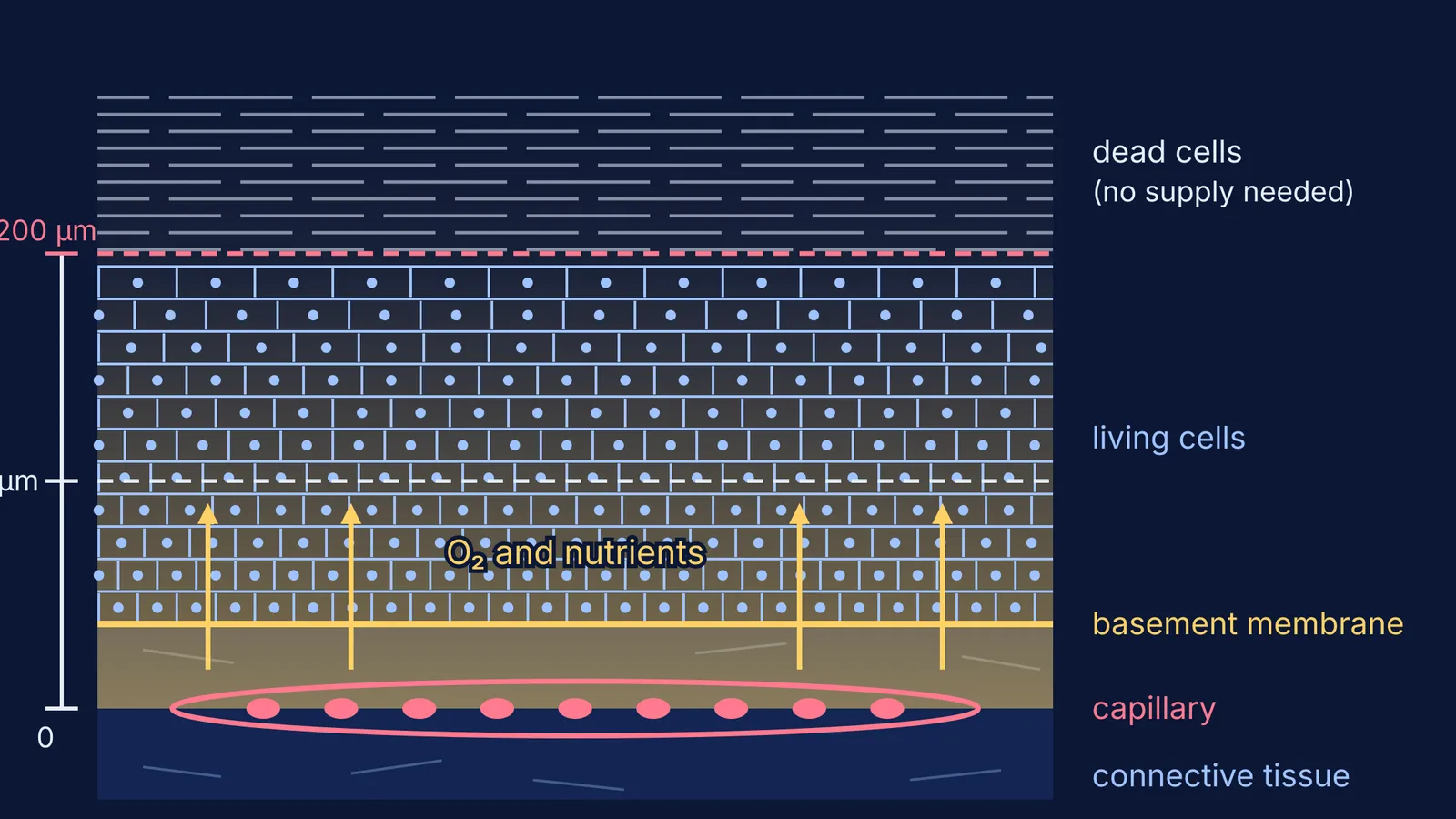
It gets them from below, through the basement membrane. The basement membrane is two thin layers: a basal lamina of glycoproteins and collagen that the epithelium attaches to, joined to a reticular lamina secreted by the connective tissue underneath (OpenStax).
The connective tissue under it has the blood vessels. In skin, OpenStax says the dermis "is well vascularized" and that its upper papillary layer is loose areolar connective tissue (OpenStax, layers of the skin). Our guide to the cells and fibres of areolar tissue explains that layer.
The route:
Capillaries in the connective tissue bring oxygen and nutrients.
These leave the capillary and spread through the loose connective tissue.
They cross the basement membrane into the basal epithelial cells.
They pass from cell to cell towards the surface; wastes move the other way.
OpenStax states the rule directly: nutrients "must come by diffusion or absorption from underlying tissues or the surface". For skin, the US National Cancer Institute's SEER training module says one main function of the dermis is "to supply the epidermis with nutrient-saturated blood".
Why does diffusion limit how thick an epithelium can be?
Diffusion has no pump behind it. Molecules spread by random motion, and each layer of cells uses some oxygen and glucose, so supply falls off with distance.
Cells need to be within about 100–200 µm of a capillary for long-term survival and function, according to a 2021 review by Masson-Meyers and Tayebi in the Journal of Tissue Engineering and Regenerative Medicine. The review is about engineered tissue, but it gives the figure for cells in the surrounding natural tissue too.
For epithelium, this means the living part has to stay thin. In skin, OpenStax describes how keratinocytes pushed upward change as they go: "The nuclei and other cell organelles disintegrate as the cells die". The keratinocytes of the top layer, the stratum corneum, "are dead and regularly slough away". Dead cells need no supply, so they can pile up beyond the reach of diffusion.
Worked example: how can the sole of your foot have 1.5 mm of epidermis?
The SEER module gives the numbers: the epidermis is "only .05 mm thick on the eyelids, and is 1.5 mm thick on the palms and the soles of the feet" (NCI SEER). Test them against the diffusion limit.
Eyelid: 0.05 mm = 50 µm. That is well inside 100–200 µm, so every cell is close to the blood supply.
Sole: 1.5 mm = 1,500 µm. That is 7.5 to 15 times the 100–200 µm range, so living cells could not be fed across that whole depth.
Resolution: the outer part of the epidermis is dead, keratinised cells, which need no supply. The dermis below is also folded up into dermal papillae, and its papillary layer holds "an abundance of small blood vessels". Thick skin on palms and soles also has five epidermal layers instead of the four in thin skin (OpenStax).
For a labelled view of all the skin layers, see our post on the structure of human skin.
How do you write this in an exam answer?
For a "how is epithelium nourished?" question, make these four points in order:
Epithelium is avascular. It has no blood vessels of its own.
It rests on a basement membrane (basal lamina plus reticular lamina) over vascular connective tissue.
Oxygen and nutrients diffuse from capillaries in the connective tissue, across the basement membrane, into the cells. Wastes diffuse back.
Diffusion works only over short distances, so the living layers stay thin. In skin, the outer layers are dead keratinised cells.
Two traps to avoid: do not call the basement membrane a plasma membrane, and do not say epithelium "has capillaries in its basal layer".
If diffusion still feels abstract, the Fermi Simulation Lab has interactive simulations for ideas that are easier to see than to read. To see where epithelium sits among the other animal tissues, the Fermi Concept Library gives each concept its own lesson and its place in the map.
Next, see what the free surface of epithelium does in our explainer on microvilli and cilia.


