

On this page
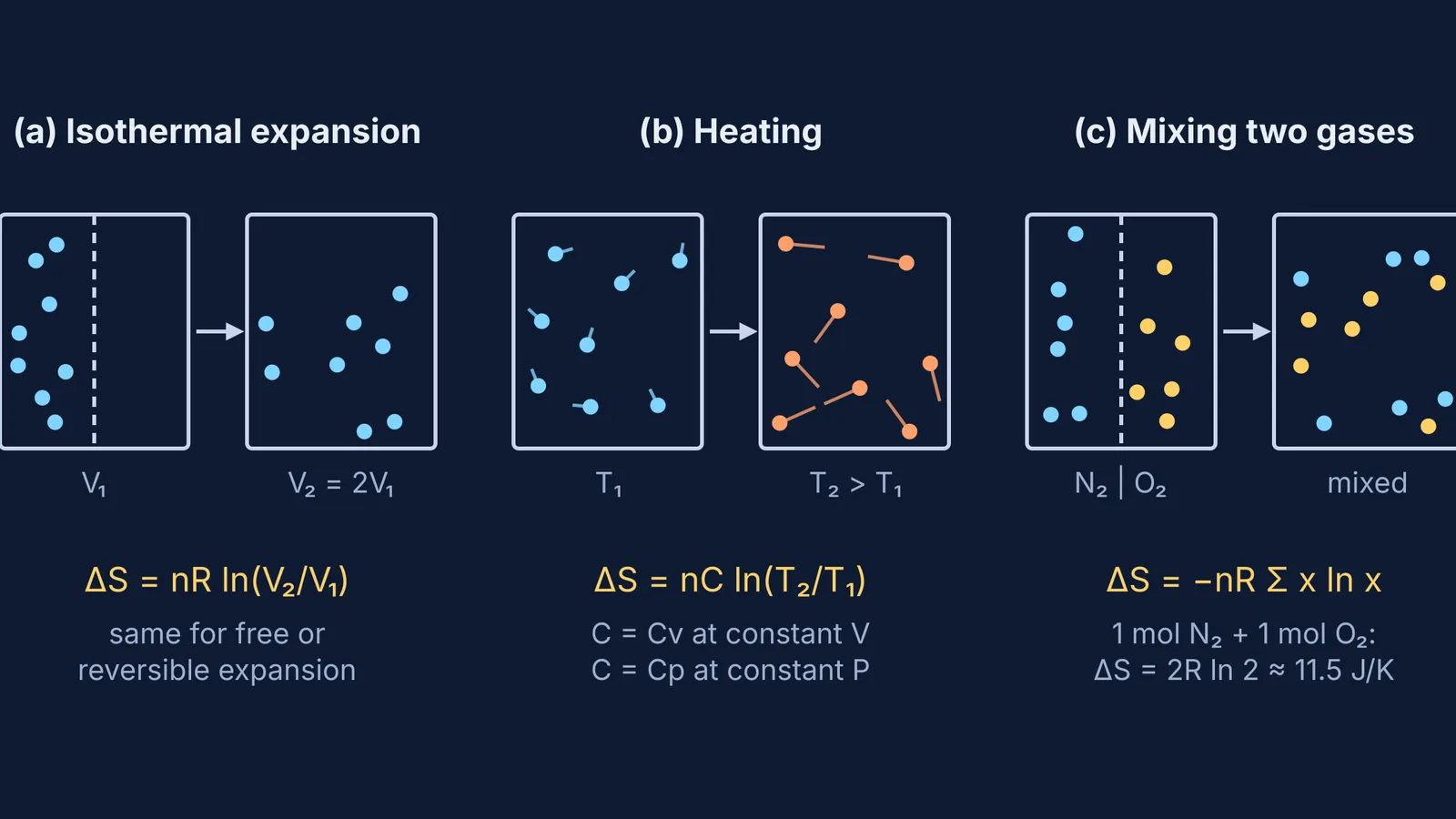
Three entropy formulas come up again and again in JEE thermodynamics: one for a gas that expands at constant temperature, one for a substance that is heated, and one for two gases that mix. Each is short, but students lose marks by using the wrong heat capacity, mixing up ln and log, or thinking that a process with q = 0 must have ΔS = 0. Here all three come from one idea, with a numerical for each.
Where do the entropy formulas come from?
Entropy is defined through heat absorbed reversibly: dS = dq_rev / T. For an ideal gas, the first law with dU = nCv dT and P = nRT/V gives
dS = nCv dT/T + nR dV/V
Integrate between state 1 and state 2 (taking Cv as constant) and you get the general result:
ΔS = nCv ln(T₂/T₁) + nR ln(V₂/V₁)
Every formula below is a special case of this line. Because S is a state function, ΔS depends only on the start and end states, not on the path. So you can always calculate it along an imaginary reversible path, even when the real process is sudden and irreversible.
If you need a refresher on predicting the sign of ΔS or using standard entropies, see entropy in chemistry: predicting the sign of ΔS and calculating it. This post covers only the ideal gas calculations.
How do you find ΔS for isothermal expansion of a gas?
At constant temperature T₂ = T₁, so the first term vanishes:
ΔS = nR ln(V₂/V₁) = 2.303 nR log(V₂/V₁)
Since P₁V₁ = P₂V₂ at constant T, the same result in pressure form is ΔS = nR ln(P₁/P₂).
Expansion (V₂ > V₁) gives positive ΔS: the molecules have more room, so there are more ways to arrange them. Compression gives negative ΔS. The work done in the same reversible expansion, w = −nRT ln(V₂/V₁), is covered in reversible isothermal work and the −2.303 nRT log formula. Notice that q_rev = −w = nRT ln(V₂/V₁), so q_rev/T gives back exactly nR ln(V₂/V₁).
Why does free expansion have ΔS > 0 when q = 0?
When an ideal gas rushes into a vacuum, no work is done, ΔU = 0 and q = 0. The reasons are explained in free expansion of an ideal gas. Many students then write ΔS = q/T = 0. That is wrong.
The formula ΔS = q/T uses q_rev, not the heat that actually flowed. Free expansion is irreversible, so its q tells you nothing about ΔS. Instead, pick a reversible path between the same two states. The start and end states of free expansion are the same as those of a reversible isothermal expansion (same T, same V₁ and V₂). So ΔS of the gas is the same: nR ln(V₂/V₁).
The difference shows up in the surroundings:
Reversible isothermal expansion. The surroundings supply q_rev, so ΔS_surr = −nR ln(V₂/V₁) and ΔS_total = 0.
Free expansion. No heat leaves the surroundings, so ΔS_surr = 0 and ΔS_total = +nR ln(V₂/V₁) > 0. This is the second law's signal that the process is spontaneous and cannot reverse on its own.
How do you find ΔS when a gas is heated?
When the temperature changes, keep the heat capacity term:
At constant volume: ΔS = nCv ln(T₂/T₁)
At constant pressure: ΔS = nCp ln(T₂/T₁)
For a monatomic ideal gas, Cv = 3/2 R and Cp = 5/2 R. For a diatomic gas near room temperature, Cv = 5/2 R and Cp = 7/2 R. The same form works for liquids: heating 1 mol of water (Cp ≈ 75.3 J K⁻¹ mol⁻¹) from 25 °C to 75 °C gives ΔS = 75.3 × ln(348.15/298.15) ≈ 11.7 J K⁻¹.
How do you calculate the entropy of mixing ideal gases?
Take n_A mol of gas A and n_B mol of gas B at the same T and P, separated by a wall. Remove the wall. Each gas now spreads through the whole volume V, so each one undergoes an isothermal expansion of its own:
ΔS_mix = n_A R ln(V/V_A) + n_B R ln(V/V_B)
At constant T and P, volume is proportional to moles, so V_A/V = x_A, the mole fraction. That turns the expression into
ΔS_mix = −R(n_A ln x_A + n_B ln x_B) = −nR Σ x ln x
where n is the total moles. Each x is less than 1, so each ln x is negative and ΔS_mix is always positive. For ideal gases ΔH_mix = 0, so ΔG_mix = −TΔS_mix is negative: mixing is always spontaneous.
If the two "gases" are the same gas, nothing changes when the wall is removed and ΔS = 0. The formula applies only to different gases.
Worked example: one problem for each formula
Take R = 8.314 J K⁻¹ mol⁻¹.
Part 1. Isothermal expansion. 2 mol of an ideal gas expands from 10 L to 50 L at 300 K. Find ΔS of the gas, and ΔS_total for (a) a reversible path and (b) free expansion into a vacuum.
ΔS_gas = nR ln(V₂/V₁) = 2 × 8.314 × ln 5 = 2 × 8.314 × 1.609 ≈ +26.8 J K⁻¹.
Check with logs: 2.303 × 2 × 8.314 × log 5 = 2.303 × 2 × 8.314 × 0.699 ≈ 26.8 J K⁻¹.
(a) Reversible: q_rev = TΔS = 300 × 26.76 ≈ 8.03 kJ taken from the surroundings, so ΔS_surr ≈ −26.8 J K⁻¹ and ΔS_total = 0.
(b) Free expansion: ΔS_gas is still +26.8 J K⁻¹, ΔS_surr = 0, so ΔS_total ≈ +26.8 J K⁻¹.
Part 2. Heating. 2 mol of a monatomic ideal gas is heated from 300 K to 600 K.
At constant volume: ΔS = 2 × (3/2 × 8.314) × ln 2 ≈ +17.3 J K⁻¹.
At constant pressure: ΔS = 2 × (5/2 × 8.314) × ln 2 ≈ +28.8 J K⁻¹.
Why the difference? At constant pressure the volume also doubles. The extra 28.8 − 17.3 ≈ 11.5 J K⁻¹ is exactly nR ln 2, the expansion term from the general equation.
Part 3. Mixing. 1 mol N₂ and 1 mol O₂ mix at constant T and P.
n = 2 mol, x(N₂) = x(O₂) = 0.5.
ΔS_mix = −2 × 8.314 × (0.5 ln 0.5 + 0.5 ln 0.5) = 2 × 8.314 × ln 2 ≈ +11.5 J K⁻¹.
Another way to see it: each gas doubles its volume, so each contributes R ln 2 ≈ 5.76 J K⁻¹.
With unequal amounts, say 1 mol N₂ and 3 mol H₂: ΔS_mix = −8.314 × (1 × ln 0.25 + 3 × ln 0.75) ≈ +18.7 J K⁻¹.
To watch molecules spread out as a partition is removed, try the Simulation Lab, which has interactive simulations for ideas that are easier to see than read.
Quick checklist
General ideal gas result: ΔS = nCv ln(T₂/T₁) + nR ln(V₂/V₁).
Isothermal: ΔS = nR ln(V₂/V₁) = nR ln(P₁/P₂).
Heating: nCv ln(T₂/T₁) at constant V, nCp ln(T₂/T₁) at constant P, with T in kelvin.
Mixing different ideal gases: ΔS = −nR Σ x ln x, always positive; 1 mol + 1 mol gives 2R ln 2 ≈ 11.5 J K⁻¹.
Free expansion has q = 0 but the same ΔS_gas as reversible expansion; only ΔS_surr differs.
ln = 2.303 log.


