

On this page
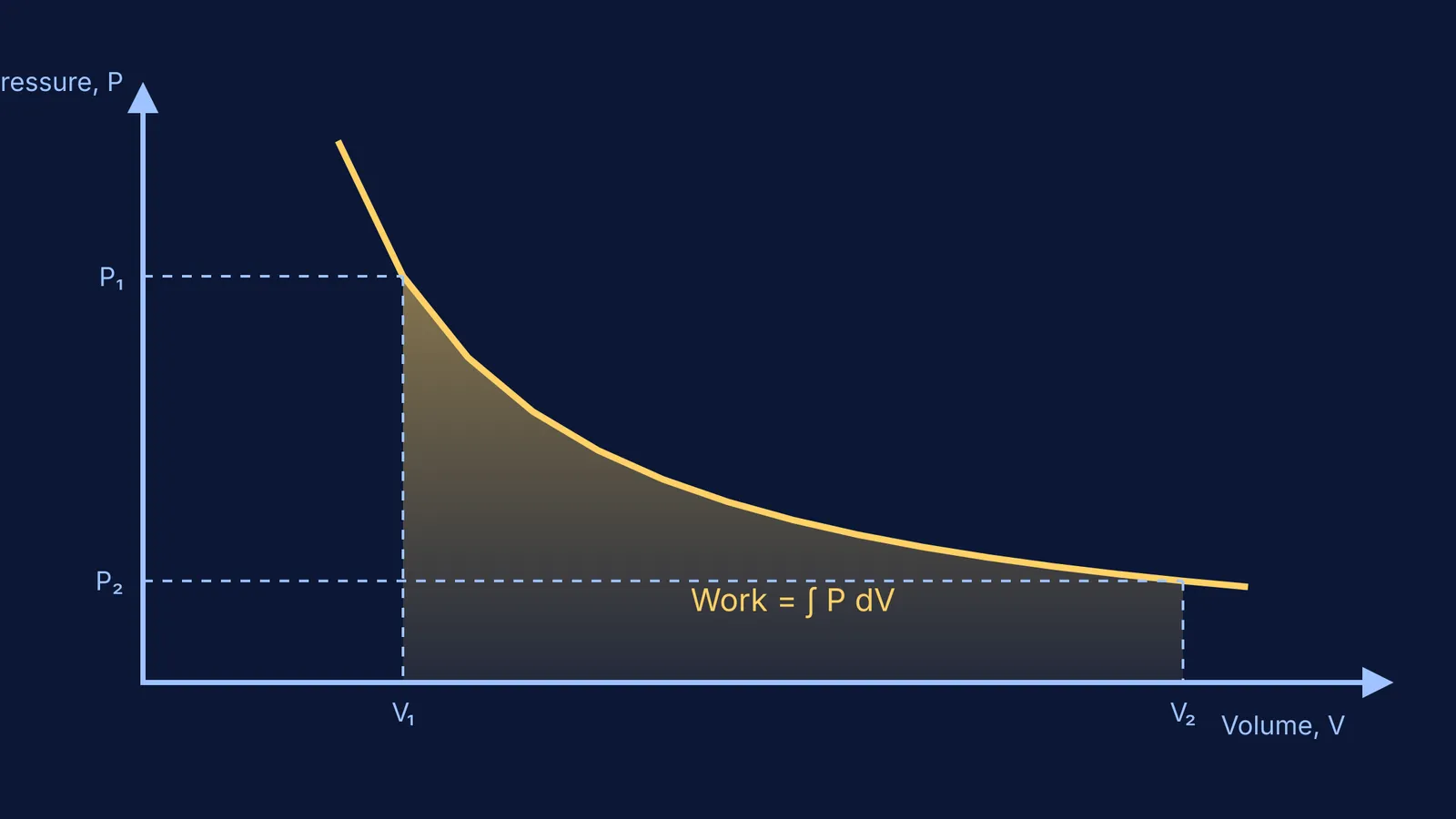
In the study of chemical thermodynamics, calculating the energy transferred as an ideal gas expands requires keeping a close eye on your state variables and signs. Imagine a frictionless piston inside a cylinder, slowly moving outward as the gas inside does work on the surroundings. When an ideal gas undergoes a reversible isothermal expansion—meaning the process happens infinitely slowly so that the system remains at a constant temperature throughout—the work done cannot be found by simply multiplying a single pressure and volume. Instead, because the pressure drops continuously as the volume increases, the total work done must be calculated using a specific logarithmic equation.
What is the work done in reversible isothermal expansion formula in chemistry?
According to the NCERT Class 11 Chemistry curriculum, the formula for the work done (w) by an ideal gas during a reversible isothermal expansion is:
w = −2.303 nRT log(V₂ / V₁)
Here is what each term means:
n: The number of moles of the ideal gas.
R: The universal gas constant (8.314 J K⁻¹ mol⁻¹).
T: The absolute temperature in Kelvin.
V₁ and V₂: The initial and final volumes of the gas.
Because this process is highly controlled and reversible, the internal and external pressures are always nearly equal. If the expansion was instead sudden and irreversible against a constant external pressure, you would use a simpler, non-logarithmic equation, as detailed in our guide on work in irreversible expansion.
Why do we use −2.303 and log?
The fundamental physics definition of work done by a gas expanding is the integral of pressure with respect to volume. Using the ideal gas law (P = nRT/V) and integrating from the initial volume to the final volume yields a natural logarithm (ln):
w = −nRT ln(V₂ / V₁)
However, many students and standard chemistry textbooks prefer working in base-10 logarithms (log₁₀) because they are much easier to compute by hand or look up in standard log tables during exams. To mathematically convert a natural logarithm to a base-10 logarithm, you multiply by approximately 2.303. Thus, the equation transforms into the familiar w = −2.303 nRT log(V₂ / V₁).
If you have concept gaps around logarithms or thermodynamic paths, you can use the Fermi Concept Library to find the lesson for each concept and see its place in the map.
How to calculate work using pressures instead of volumes
Sometimes, a chemistry problem gives you the initial and final pressures of the system but leaves out the volumes entirely. You do not actually need to calculate those volumes first to find the work done.
For an ideal gas at a constant temperature (an isothermal process), Boyle's law states that P₁V₁ = P₂V₂. Rearranging this relationship gives:
V₂ / V₁ = P₁ / P₂
By substituting the volume ratio with the pressure ratio, the formula becomes:
w = −2.303 nRT log(P₁ / P₂)
For instance, if a gas expands isothermally from a pressure of 10 atmospheres down to 1 atmosphere, the ratio P₁/P₂ becomes 10/1, or exactly 10. The base-10 logarithm of 10 is simply 1, making the calculation straightforward: the work done simplifies to w = −2.303 nRT (1). This form is incredibly useful for exam questions that test your understanding of state variables, much like how knowing molar heat capacities is crucial when exploring a polytropic process.
Why reversible isothermal expansion yields the maximum work
In chemical thermodynamics, a reversible process is a theoretical ideal. It assumes that the expansion happens in infinitesimally small steps, meaning the internal pressure of the gas is always perfectly balanced with the external pressure resisting it. Because the gas pushes with the maximum possible force against the surroundings at every tiny step of the expansion, a reversible isothermal expansion produces the maximum theoretical work a system can perform.
In real-world engines or laboratory reactions, processes happen too quickly to be truly reversible. Energy is often lost to friction or rapid pressure changes. However, calculating this maximum reversible work gives chemists an absolute upper limit or theoretical baseline to compare against their real-world, irreversible reactions.
Is expansion work positive or negative?
In chemistry, the International Union of Pure and Applied Chemistry (IUPAC) convention is strictly system-centric: work is defined from the perspective of the system's internal energy. Work done on the system increases its internal energy and is recorded as positive, while work done by the system decreases its internal energy and is recorded as negative.
When a gas expands, it pushes against the surroundings, transferring energy outward. Therefore, the work done during expansion must be negative.
Expansion (V₂ > V₁): The ratio V₂/V₁ is greater than 1, making its logarithm positive. The negative sign at the front of the formula ensures the final value for w is negative.
Compression (V₁ > V₂): The ratio is less than 1, making its logarithm negative. The negative sign at the front perfectly cancels this out, resulting in a positive value for w.
Checklist for solving isothermal work problems
Before you punch numbers into the calculator on your next exam, pause and check these three things:
Match your R value: If you need the final energy answer in Joules, use R = 8.314 J K⁻¹ mol⁻¹. If the problem uses liter-atmospheres, use R = 0.0821 L atm K⁻¹ mol⁻¹.
Convert temperature to Kelvin: Always add 273.15 to your Celsius temperatures. A common trap is leaving T in degrees Celsius, which ruins the calculation.
Verify the final sign: Before handing in your answer, do a common-sense check. Did the gas expand? The answer must be negative following the IUPAC chemistry convention. Did it compress? The answer must be positive.


