

On this page
You have probably memorised the list: pepsin, trypsin and chymotrypsin are endopeptidases, while carboxypeptidase and aminopeptidase are exopeptidases. A list of names is easy to forget. Draw one short chain and mark where each enzyme cuts, and you can see the difference.
What is the difference between an endopeptidase and an exopeptidase?
An endopeptidase hydrolyses peptide bonds inside a polypeptide chain, away from either end, according to the MEROPS peptidase database glossary at EMBL-EBI. An exopeptidase needs a free end of the chain and cuts a bond no more than three residues from that end, the same glossary says.
Two kinds of exopeptidase matter for digestion. An aminopeptidase releases a single amino acid from the N-terminus, and a carboxypeptidase releases a single amino acid from the C-terminus (MEROPS glossary). Memory hook: endo means within, exo means outside.
Where does each enzyme cut on a ten-amino-acid chain?
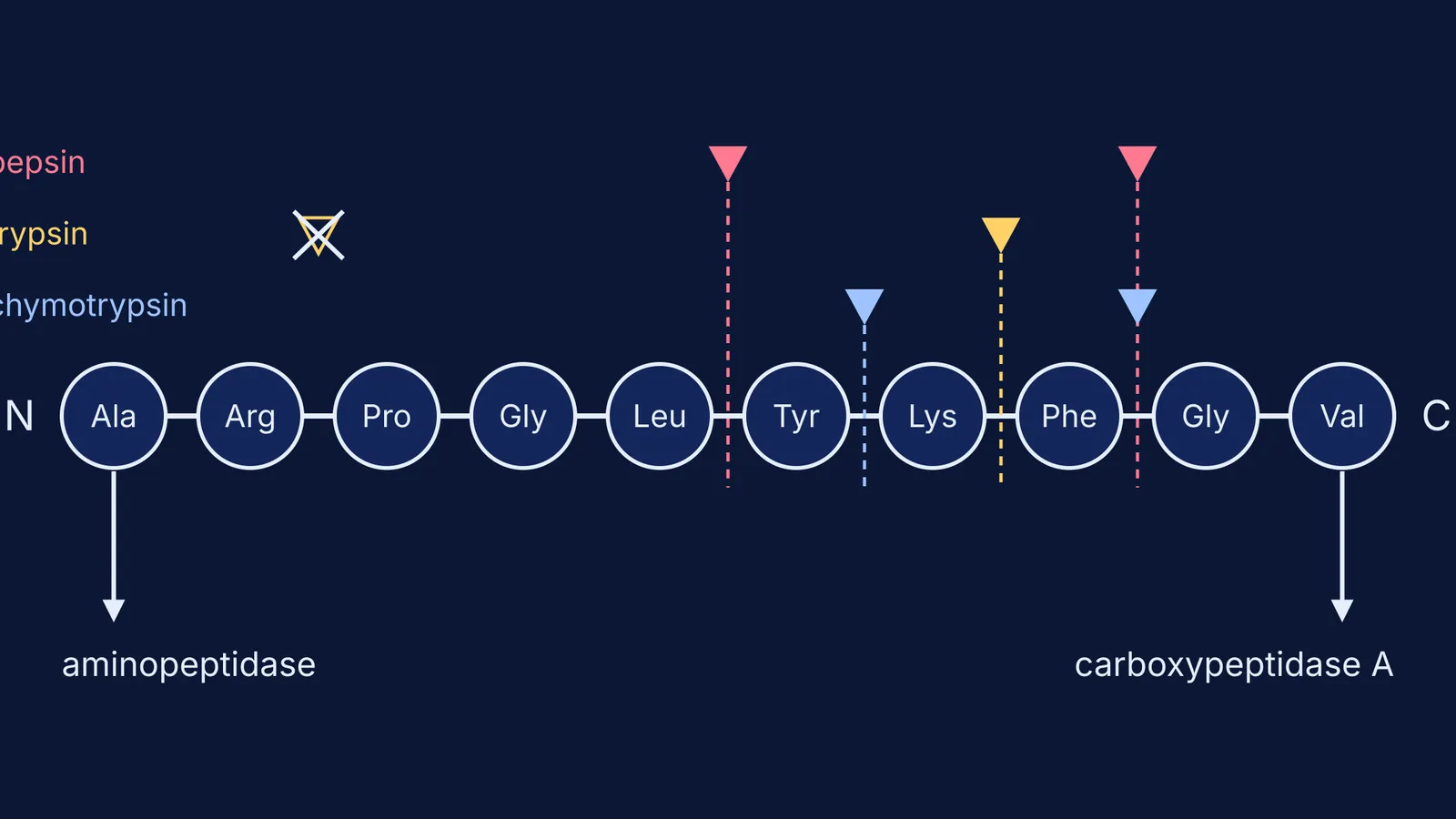
Here is the chain in the diagram above, written from the N-terminus to the C-terminus:
Ala1 - Arg2 - Pro3 - Gly4 - Leu5 - Tyr6 - Lys7 - Phe8 - Gly9 - Val10
We picked these residues so that each enzyme's rule shows up at least once. The rules come from the cleavage table of Expasy PeptideCutter, which names positions around a bond: P1 is the residue just before the bond being cut, and P1' is the residue just after it.
Which endopeptidases cut inside the chain?
Trypsin cuts after Arg or Lys at P1, and a Pro at P1' usually blocks it (PeptideCutter). In our chain it cuts Lys7-Phe8. It does not cut Arg2-Pro3, because Pro comes straight after the Arg.
Chymotrypsin cuts after the bulky aromatic residues Trp, Tyr and Phe, and a Pro at P1' blocks it (the same source's high-specificity rule; a low-specificity form also cuts after Leu, Met and His). Here it cuts Tyr6-Lys7 and Phe8-Gly9.
Pepsin prefers Phe, Tyr, Trp and Leu on either side of the bond, and at pH 1.3 it mostly cuts after Phe and Leu (same source). Using that stricter rule, it cuts Leu5-Tyr6 and Phe8-Gly9.
Which exopeptidases trim the ends?
Aminopeptidase removes Ala1 from the N-terminus. Membrane alanyl aminopeptidase prefers Ala there but can release most amino acids (IUBMB enzyme list, EC 3.4.11.2).
Carboxypeptidase A removes Val10 from the C-terminus. It releases most C-terminal amino acids but has little or no action on Asp, Glu, Arg, Lys or Pro (IUBMB, EC 3.4.17.1).
In your body these enzymes work one after another along the gut, not all on one chain at once. The drawing simply puts their rules side by side.
Why do endopeptidases and exopeptidases work as a team?
Count the ends. The intact chain has one N-terminus and one C-terminus, so the exopeptidases have just two places to work. After the four internal cuts above (Leu5-Tyr6, Tyr6-Lys7, Lys7-Phe8 and Phe8-Gly9), the chain is in five pieces with ten ends. Three of those pieces are already single amino acids, and the two longer fragments each offer fresh ends for exopeptidases to trim.
The pairing goes further. Trypsin always leaves a fragment ending in Lys or Arg, which carboxypeptidase A barely touches. Carboxypeptidase B fills that gap, because it preferentially releases a C-terminal Lys or Arg (IUBMB, EC 3.4.17.2).
The body follows the same order. Protein digestion starts in the stomach, where hydrochloric acid and pepsin break proteins into smaller polypeptides; pancreatic trypsin, chymotrypsin, elastase and carboxypeptidase continue in the small intestine; and brush-border aminopeptidase and dipeptidase break the peptide chains down further (OpenStax Anatomy and Physiology 2e, section 23.7). The same OpenStax section notes that 95 to 98 percent of protein is digested and absorbed in the small intestine.
The same cutting explains why insulin is injected, not swallowed. For protein alongside carbohydrate and fat, see which is digested first: carbs, protein or fat.
How do you answer exam questions on endopeptidases and exopeptidases?
Use this checklist:
Ask "inside or end?" first. Inside means endopeptidase; a free end means exopeptidase.
For trypsin, find Lys or Arg, then check the next residue for Pro.
For chymotrypsin, find Phe, Tyr or Trp, then check for Pro.
Amino acids removed one at a time from an end? That is an exopeptidase.
Match the site: pepsin in the stomach; trypsin, chymotrypsin and carboxypeptidase from the pancreas; aminopeptidase at the brush border.
Draw a 6 to 10 residue chain, mark the cuts, then check it in PeptideCutter.
If peptide bond or N-terminus still feels shaky, the Fermi Concept Library has a lesson for every concept in biology and chemistry, each with its place in the map. For the wider chapter, read our common biomolecules mistakes in NEET Biology.


