

On this page
Most people will tell you the oldest female leads an elephant herd and the rest follow. That is mostly right for African savannah elephants. For the Asian elephants of India, the story is more interesting: older females still help their families survive, but the herd is not led by one boss.
Why do elephant herds follow the oldest female?
Because she knows more. A matriarch is the oldest, most experienced female in a family group of related females and their young.
The classic evidence comes from Amboseli in Kenya. Karen McComb, Cynthia Moss and colleagues played recorded elephant calls to wild families and found that the oldest female's ability to tell familiar callers from strangers shaped how the whole group reacted (McComb et al., 2001, Science). The authors suggest that this may give groups led by older females higher reproductive success per female.
A second study tested danger directly. When researchers played lion roars, families with younger matriarchs typically under-reacted to the roars of male lions, which are especially dangerous, while sensitivity to this threat was greatest under the oldest matriarchs (McComb et al., 2011, Proceedings of the Royal Society B).
Water is the other half of the story. During a severe drought in Tanzania in 1993, elephant family groups that left Tarangire National Park lost fewer calves than those that stayed, which suffered heavy calf loss (Foley, Pettorelli and Foley, 2008, Biology Letters). The paper concludes that extreme droughts may let only animals with "the appropriate behaviour and/or knowledge" survive. That hints that remembered routes to water matter, though the abstract does not say who led each family out.
Do Asian elephant herds have a matriarch?
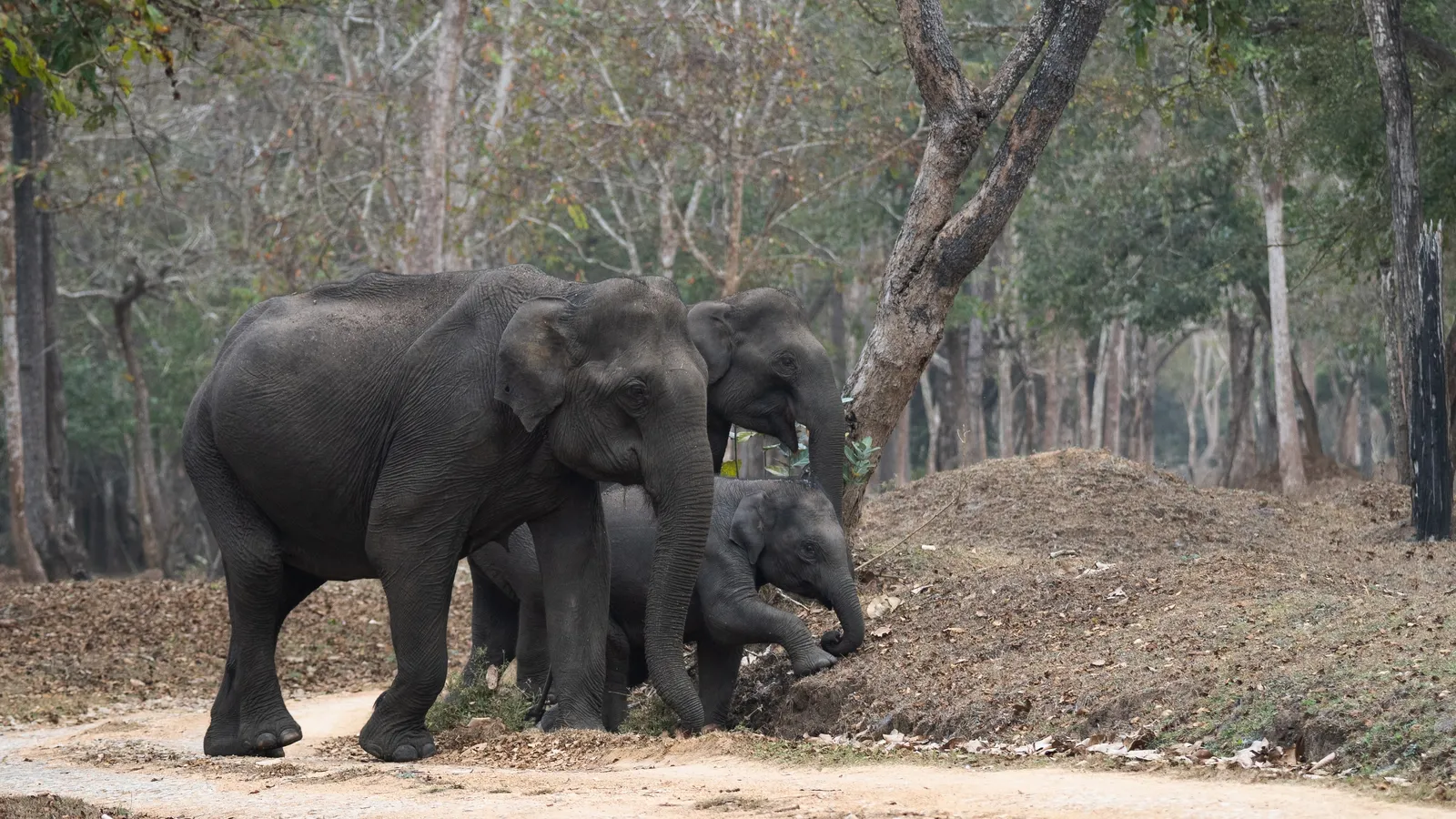
Not in the African sense. Asian elephants live in small herds of related females, their daughters and young males, and males usually leave at puberty, between 8 and 13 years old (Smithsonian's National Zoo). The same page states plainly that, unlike African elephants, Asian elephants do not have a matriarch, though individual females sometimes take a more dominant role.
Field studies show a looser but still lasting structure. Tracking 286 adult females at Uda Walawe National Park in Sri Lanka for 20 months, Shermin de Silva and colleagues found small day-to-day groups, but also larger social units that stayed stable across years (de Silva et al., 2011, BMC Ecology). A later comparison found that female Asian elephants showed less than a third as many dominance interactions as African savannah elephants, with no clear order among social units (de Silva, Schmid and Wittemyer, 2017, Behavioral Ecology). The authors expected the Asian elephants' more productive, stable habitat to lower competition. In Kabini, Karnataka, researchers found female elephants grouped into distinct social communities they call clans (Nandini, Keerthipriya and Vidya, 2018, Behavioral Ecology).
Older females still count. In semi-captive timber elephants in Myanmar, calves of mothers under 20 had 8 times lower mortality risk when their grandmother lived with them than when she lived elsewhere (Lahdenperä, Mar and Lummaa, 2016, Scientific Reports). For more on how Indian elephants use their landscape, see Raman Sukumar's research on Asian elephants and crops.
What happens to a herd when the matriarch is lost?
In South Africa, Pilanesberg National Park's elephants descend from young orphans brought in during the early 1980s and 1990s, after culls of adults in Kruger National Park. Tested between 2007 and 2010, decades later, they still failed to tell familiar callers from unfamiliar ones (Shannon et al., 2013, Frontiers in Zoology).
There is some resilience. In a wild African population hit by poaching, daughters took on the social roles their mothers had held, which helped the network keep its shape (Goldenberg, Douglas-Hamilton and Wittemyer, 2016, Current Biology). Even so, the 2001 Science paper warns that removing older animals, often hunters' targets, could seriously harm endangered populations.
How do you explain matriarch leadership in an exam answer?
A neat way is Tinbergen's four questions of animal behaviour. Here is a worked example for "Why do elephants follow the oldest female?":
Causation: the older female recognises calls and threats, such as male lion roars, and the group responds to her lead.
Development: young females grow up among their mothers and older relatives, and daughters can step into their mothers' social roles.
Survival value: better threat judgement and, in Myanmar's Asian elephants, a grandmother living with the family means more calves survive.
Evolution: in long-lived social animals where experience builds up over decades, older leaders benefit the group, which may help explain selection for long life.
Before writing any claim about elephant leadership, check:
Which species: African savannah or Asian?
Wild, semi-captive or zoo animals?
Was it an experiment, such as playbacks, or an observed pattern?
What was measured: reactions, calf survival or social ties?
If terms like fission-fusion or kin groups are new, the Fermi Concept Library has every concept in biology, each with its own lesson and its place in the map. You can also compare this with why territorial fights between animals drop over time.
Next time you see elephants crossing a forest road in Kabini, look for the oldest female near the calves.


