

On this page
Three exercises at the end of NCERT's Structure of Atom chapter give you a mass number, sometimes a charge, and a percentage: "x% more neutrons than electrons" or "x% more neutrons than protons". You have to find the element and write its symbol. All three use the same one-line equation. Students lose marks not on the algebra but on reading the sentence, because the comparison changes from protons to electrons between questions. This post gives you one template, solves all three NCERT problems with it, and shows what goes wrong if you misread "than electrons".
What do the NCERT "x% more neutrons" questions ask?
The three problems are:
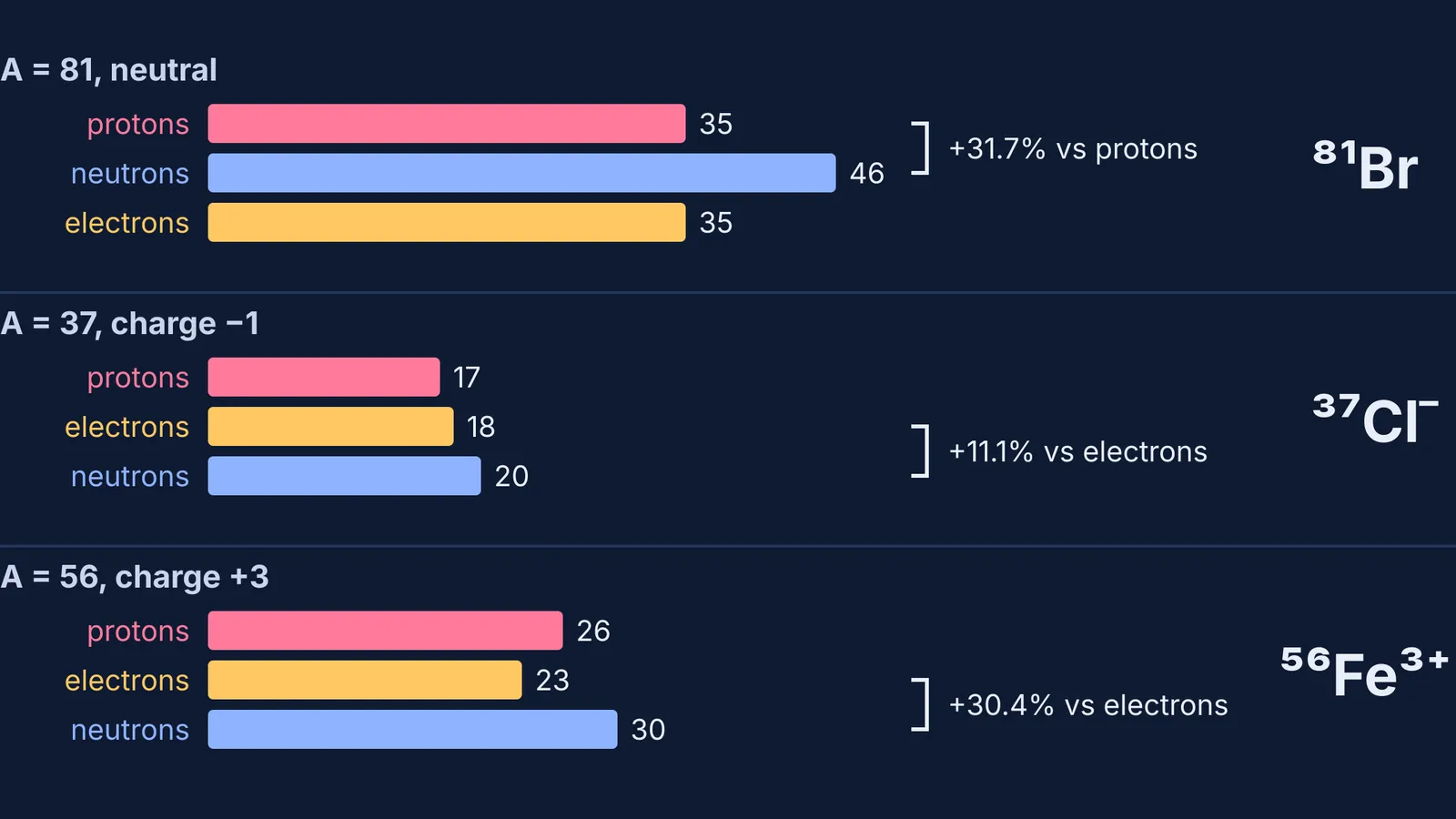
An element with mass number 81 contains 31.7% more neutrons than protons. Assign the atomic symbol.
An ion with mass number 37 carries one unit of negative charge. It contains 11.1% more neutrons than electrons. Find the symbol of the ion.
An ion with mass number 56 carries three units of positive charge. It contains 30.4% more neutrons than electrons. Find the symbol of the ion.
Each gives you the mass number A and a relation between neutrons and one other particle. You must find the number of protons p, because p is the atomic number and identifies the element. If you need a refresher on what the mass number counts, see atomic mass vs mass number.
What is the one equation that solves all three?
Every version starts from the same fact: the mass number counts protons plus neutrons.
A = p + n
Then you write n in terms of p using the sentence in the question. "x% more than" means multiply by (1 + x/100). So 31.7% more becomes × 1.317, 11.1% more becomes × 1.111 and 30.4% more becomes × 1.304.
What you multiply depends on what the neutrons are compared with:
Compared with protons: n = (1 + x/100) × p
Compared with electrons in an anion of charge −z: the ion has gained z electrons, so electrons = p + z and n = (1 + x/100)(p + z)
Compared with electrons in a cation of charge +z: the ion has lost z electrons, so electrons = p − z and n = (1 + x/100)(p − z)
Substitute into A = p + n and solve for p. Electrons never change the mass number, so they enter only through this comparison.
How do you solve the three NCERT problems step by step?
Worked example 1: mass number 81, 31.7% more neutrons than protons.
Write n in terms of p: n = 1.317p.
Substitute: 81 = p + 1.317p = 2.317p.
Solve: p = 81/2.317 = 34.96, so p = 35.
Check: n = 81 − 35 = 46. Compare with protons: 46/35 = 1.314, so 31.4% more. The question's 31.7% is a rounded value, which is why p came out as 34.96 rather than exactly 35.
Element 35 is bromine. The symbol is ⁸¹Br (written in full as ⁸¹₃₅Br).
Worked example 2: mass number 37, charge −1, 11.1% more neutrons than electrons.
Count the electrons: an anion with charge −1 has one extra electron, so electrons = p + 1.
Write n in terms of p: n = 1.111(p + 1) = 1.111p + 1.111.
Substitute: 37 = p + 1.111p + 1.111, so 2.111p = 35.889.
Solve: p = 17.00.
Check: n = 37 − 17 = 20 and electrons = 18. 20/18 = 1.111, so 11.1% more. It works.
Element 17 is chlorine. The ion is ³⁷Cl⁻.
Worked example 3: mass number 56, charge +3, 30.4% more neutrons than electrons.
Count the electrons: a cation with charge +3 has lost three electrons, so electrons = p − 3.
Write n in terms of p: n = 1.304(p − 3) = 1.304p − 3.912.
Substitute: 56 = p + 1.304p − 3.912, so 2.304p = 59.912.
Solve: p = 26.00.
Check: n = 30 and electrons = 23. 30/23 = 1.304, so 30.4% more. It works.
Element 26 is iron. The ion is ⁵⁶Fe³⁺.
What goes wrong if you read "than electrons" as "than protons"?
Try example 2 with the wrong reading, n = 1.111p. Then 37 = 2.111p and p = 17.53. In example 3, the same mistake gives 56 = 2.304p and p = 24.31. Neither is a whole number, and an atom cannot have half a proton.
That is your built-in check. The proton number must come out as a whole number, or very close to one. A value such as 34.96 is just rounding in the question's percentage. A value such as 17.53 or 24.31 means you have set up the equation wrongly. Do not round it to the nearest integer and move on: go back and reread which particle the neutrons are compared with, and whether the charge adds or removes electrons.
How do you check your answer is right?
Use three quick checks after you find p.
Integer check. p is a whole number, or within a few hundredths of one.
Ratio check. Work out n and the compared particle, divide, and see that you get back the percentage in the question.
Sense check. For light and medium elements, n is equal to or a bit larger than p. A heavy element such as bromine has noticeably more neutrons than protons (46 against 35). The physics behind that trend is in why heavy nuclei need more neutrons than protons.
Practice question. An ion of mass number 24 carries a charge of +2 and contains 20% more neutrons than electrons. Electrons = p − 2, so n = 1.2(p − 2). Then 24 = p + 1.2p − 2.4, so 2.2p = 26.4 and p = 12. The ion is ²⁴Mg²⁺, with 12 neutrons and 10 electrons, and 12/10 = 1.2 confirms the 20%.
These questions run the opposite way to the more common counting problems. In counting electrons, protons and neutrons in a given mass you start from a known ion and count its particles. Here you start from a relation between particles and work back to the ion.
If you want more problems where the setup matters more than the arithmetic, the Fermi Problem Library has a step-by-step solver that explains the reasoning behind each line.
Quick checklist
Start from A = p + n every time.
"x% more than" means multiply by (1 + x/100).
Read the word after "than": protons or electrons.
Anion of charge −z: electrons = p + z. Cation of charge +z: electrons = p − z.
p must come out as a whole number; if not, reread the question.
Check by dividing n by the compared particle to recover the percentage.
NCERT answers: ⁸¹Br, ³⁷Cl⁻ and ⁵⁶Fe³⁺.


