

On this page
If you look at a single atom of carbon, it has 6 protons and 6 neutrons, giving a nice, clean mass number of 12. But look at carbon on the periodic table, and you will see a mass of 12.011. For chlorine, the gap is even wider at 35.5.
Students often confuse mass number with atomic mass. Mixing them up leads to basic errors in stoichiometry and mole concept calculations. Here is the exact difference, and why those decimal numbers exist on the periodic table.
What is mass number?
The mass number, represented by the symbol A, is the total count of protons and neutrons (the nucleons) inside a single atom's nucleus. Because you cannot have a fraction of a proton or a neutron, the mass number is always a whole integer.
For example, an atom of the most common form of carbon has 6 protons and 6 neutrons, so its mass number is 12. If an atom has 17 protons and 18 neutrons, its mass number is 35.
Mass numbers are used to identify specific isotopes of an element. Isotopes are atoms of the same element that have the same number of protons but a different number of neutrons. If you are struggling with these building blocks, the Fermi Concept Library breaks down atomic structure into step-by-step lessons, making sure you can picture what is inside the nucleus before moving on to chemical reactions.
What is atomic mass?
While mass number is a simple count, atomic mass is the actual physical mass of a single atom. It is measured in unified atomic mass units (u) or daltons (Da). A single atom of carbon-12 has an atomic mass of exactly 12 u.
However, the decimal number you see on the periodic table is the atomic weight (also known as relative atomic mass). According to the standard definition detailed by Wikipedia, this is the ratio of the average mass of atoms of an element in a given sample to the atomic mass constant. In practice, this gives the weighted average of the atomic masses of all naturally occurring isotopes of an element.
To see how scientists first proved that elements are mixtures of isotopes with whole-number masses, read about Francis Aston and the mass spectrograph.
Why is chlorine 35.5?
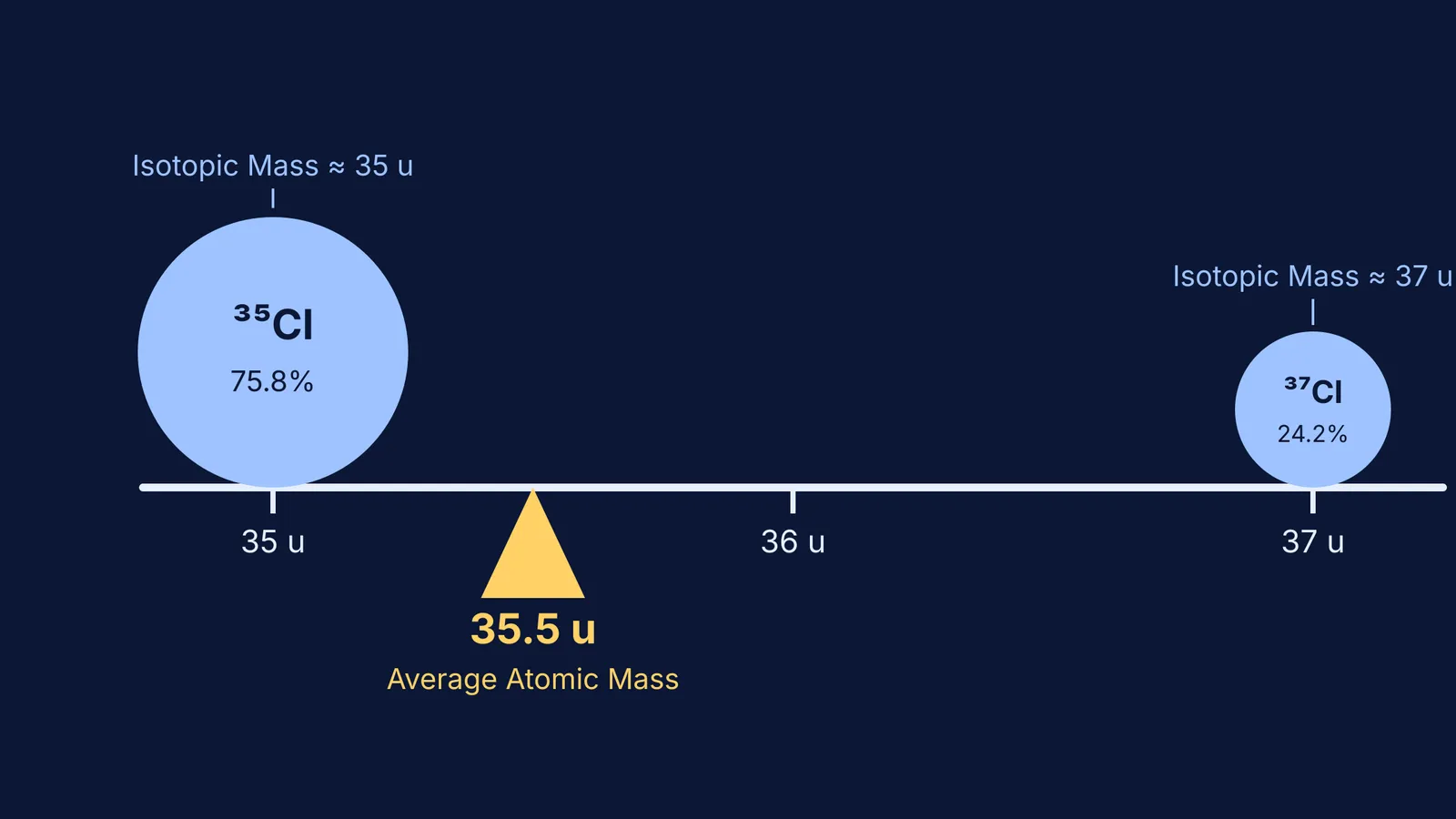
Chlorine is the classic textbook example of why we need weighted averages. In nature, chlorine exists almost entirely as two stable isotopes. According to standard data from the Commission on Isotopic Abundances and Atomic Weights, the natural breakdown is:
Chlorine-35: 17 protons, 18 neutrons, with an abundance of 75.8%.
Chlorine-37: 17 protons, 20 neutrons, with an abundance of 24.2%.
If you take a sample of salt from the ocean, about three out of every four chlorine atoms will be chlorine-35, and one will be chlorine-37.
To find the average mass for a mole of chlorine, you multiply each isotope's mass number by its fraction and add them up. Using the rounded 75% and 25% approximations found in most textbooks: (0.75 × 35) + (0.25 × 37) = 26.25 + 9.25 = 35.5
This means a typical bulk sample of chlorine behaves as if each atom has a mass of 35.5 u, even though no single chlorine atom actually weighs 35.5 u. A more precise calculation using the exact masses of 34.97 u and 36.97 u alongside the true percentages yields 35.45, which is the exact number printed on the periodic table.
When you solve stoichiometry problems in the Fermi Problem Library, the AI tutor will notice if you accidentally use 35 or 37 for a bulk sample, and it will explain why the weighted average is needed.
Why is carbon 12.011?
You can see the exact same mathematical process in carbon. According to data from Wikipedia on the isotopes of carbon, the vast majority of carbon on Earth—about 98.9%—is carbon-12. However, a small fraction (about 1.1%) is carbon-13, which has an extra neutron.
When you average 98.9% of carbon-12 and 1.1% of carbon-13, you get roughly 12.011. Because carbon-12 is so dominant, the average stays very close to the whole number 12. Chlorine has a much larger proportion of its heavier isotope, which pulls its average much further away from a whole number.
For more on how these fractional masses behave when elements mix to form bulk gases, see our guide on average molar mass of a gas mixture.
Why do isotopes behave the same chemically?
If chlorine-35 and chlorine-37 have different mass numbers and different physical masses, you might wonder why they are both considered the same element. The answer lies in their electrons.
Chemical reactions are driven entirely by the exchange and sharing of electrons between atoms. The nucleus sits safely in the centre of the atom, unaffected by standard chemical changes. Because both chlorine isotopes have exactly 17 protons, they both attract exactly 17 electrons to balance their charge. Their electron configurations are identical, meaning they form the exact same types of chemical bonds.
This is why, in a beaker of sodium chloride, you do not need to separate the two isotopes. They react identically with the sodium. The only difference is that the chlorine-37 atoms are slightly heavier, which makes the overall bulk sample slightly more massive than if it were pure chlorine-35.
How to choose which number to use in an exam?
When solving chemistry and physics problems for JEE or NEET, you need to know which number to pick up. Follow this simple framework:
Writing nuclear equations: Use the mass number. If you are tracking alpha or beta decay, you need the exact integer count of nucleons.
Finding the number of neutrons: Use the mass number. Subtract the atomic number (the number of protons) from the mass number.
Mole concept and stoichiometry: Always use the atomic weight from the periodic table (e.g., 35.5 for chlorine, 12.01 for carbon, 63.5 for copper). In a beaker, you are dealing with trillions of atoms, so you must use the natural weighted average.
Understanding this difference makes everything from balancing equations to calculating yields much easier. If you are curious about how the concept of isotopes evolved, read about Frederick Soddy, isotopes and the displacement law explained.


